

















About Us
At Juniper, we strive to deliver network experiences that transform how people connect, work and live.
By challenging the inherent complexity in the 5G and cloud era, our solutions power the connections that matter most - from education to healthcare to secure banking. Our commitment is to advance real outcomes for network teams and every individual they serve.
It’s that simple.

We make every connection count.
Nearly every vital experience today starts with a strong network connection, but mere connectivity is not the same as experiencing a great connection. Measuring for connectivity alone fails users, and ultimately operators. Backed by the industry’s first AI-Native Networking Platform, Juniper makes every connection reliable, measurable, and secure.
Being bold
We pursue simplicity. We challenge the status quo, including challenging ourselves. We embrace diverse ideas and the change that they bring. That’s what being bold is all about.
Building trust
Our success is determined by our customers’ success. We say what we mean and take the initiative, so you can count on us to get things done.
Delivering excellence
We’re obsessed with exceptional quality and a remarkable customer experience. Even when we’ve achieved that goal, we are always looking for ways to improve. And if we fall short, we act fast to fix it.

We are driven by experience
We strive to deliver a simplified experience for those who run networks and those who depend on them.
We are relentlessly focused on putting our customers – the network architects, builders and operators – at the center of all that we do, so that their customers – the team connecting on Zoom, the associate using a scanner in a store, the student during their online class - are as happy and productive as possible.
It all starts with software innovation. From Junos to Apstra and Paragon to Mist AI, we push the envelope on predictability, programmability, automation, and insights. By making experience the top priority, you can build agile networks that transcend customer expectations.

Connecting the world where it matters most
When it comes to social responsibility, we’re leading by example. As a global company, it’s vital that we step up to support our people, protect the planet and uphold the highest ethical principles.
From our green goals and integrity-driven supply chain, to our operational changes and philanthropic outreach programs, we’re setting the standard for our sector.


Engineer your next step
Great connections start with great people. From engineers and analysts, to service managers and marketeers, at Juniper, we want the best new talent to help our business develop and grow. We call this the Juniper Way.
We’re committed to ensuring a collaborative and nurturing culture, building a diverse and inclusive workforce and providing benefits that make our employees’ lives better.
All the latest from Juniper
Our lineup of events and happenings make it easier than ever to make connections that matter, discover our products and learn from those in the know.
Juniper Summits
The network of the future needs to deliver superior experiences for every operator, user and device. Join us to hear how these results from industry luminaries.
Demos
Our experts are ready to show you how to power connections with Juniper technology. Claim your spot today.
Masterclasses and Bootcamps
From AI to Automation to Data Center, our community is here to deep dive with you on the top technologies.
Don’t just take our word for it
We’re very proud of the recognition we’ve received and awards that we’ve won. They’re the world’s way of recognizing excellence and applauding our approach. Here are just a few recent additions to our virtual trophy case.
-

Gartner names Juniper a Leader in the 2025 Gartner® Magic Quadrant™ for Data Center Switching
-

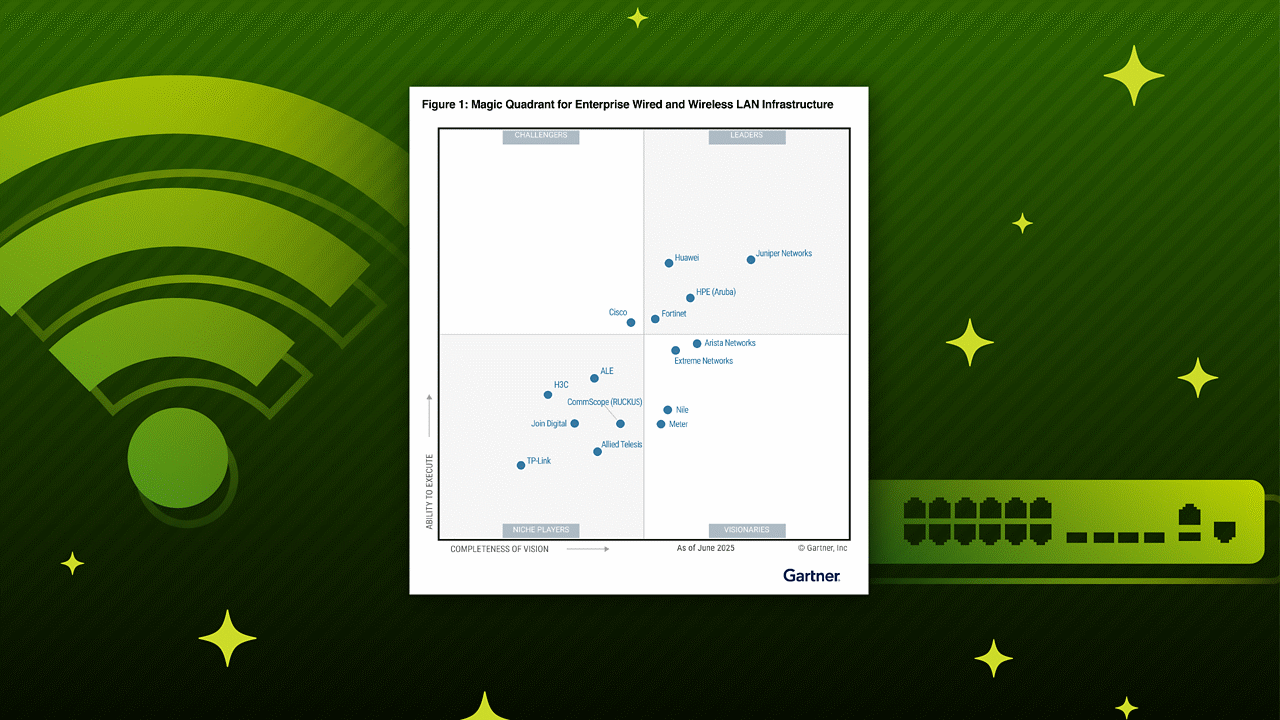
Gartner names Juniper a Leader in the 2024 Gartner® Magic Quadrant™ for Enterprise Wired and Wireless LAN Infrastructure.
-

For the third year running, Gartner names Juniper a Leader in the 2024 Gartner® Magic Quadrant™ for Indoor Location Services.

Experience Juniper for Yourself
Gartner, Magic Quadrant for Data Center Switching, Andrew Lerner, Simon Richard, et al., 31 March 2025
Gartner Magic Quadrant for Enterprise Wired and Wireless LAN Infrastructure, Tim Zimmerman, Christian Canales, et al., 6 March 2024
Gartner, Magic Quadrant for Indoor Location Services, Tim Zimmerman, Annette Zimmermann, Nick Jones, 28 February 2024