
Core Network Deployment (EX Series Switches)
Initial Switch Staging
Initial Switch Staging involves the physical preparation and basic connectivity verification of the Juniper EX Series switches before they are integrated into the network. This step starts with carefully unboxing the switches. Securely install them into designated racks, ensuring proper mounting and airflow. Following installation, the switches perform basic power-on procedures to confirm that they receive power and initiate their boot sequence. Crucial connectivity checks involve verifying console access, confirming link lights on ports, and ensuring the switch gets an IP address via DHCP (if configured). These steps establish network communication for Zero-Touch Provisioning (ZTP).
- Unboxing and physical installation.
- Basic power-on and connectivity checks.
Cloud-Ready Campus Ethernet Switches
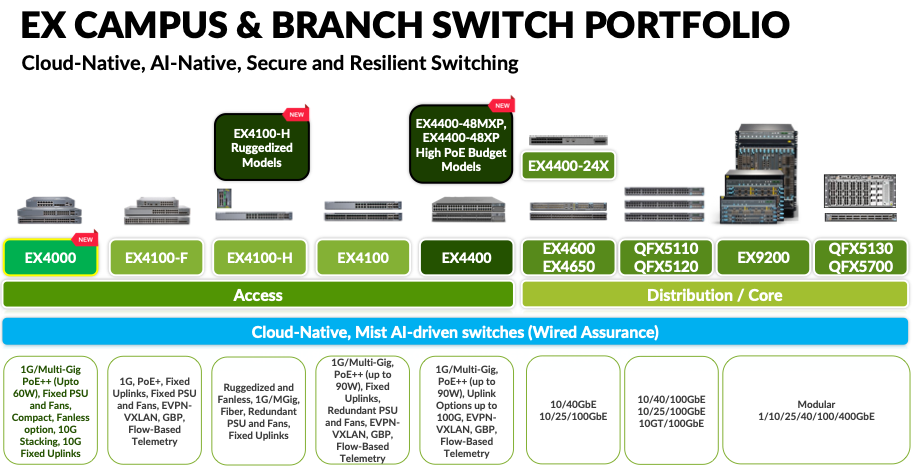
Juniper offers an AI-driven, programmable, and open portfolio of cloud-ready access, distribution, and core switches for enterprise campus networks. The access switches are cloud-ready and support Juniper Mist Wired Assurance, bringing AIOps to access layer switching. The switches meet several campus requirements, such as:
- Cloud-ready and managed by the Juniper Mist cloud architecture
- Multigigabit support
- Media Access Control Security (MACsec) AES256
- Power over Ethernet (PoE, PoE+, PoE++)
- Scalable fabric architectures via Virtual Chassis and EVPN-VXLAN
- Multivendor support
- Standards-based micro segmentation using group-based policies (GBP)
- Flow-based telemetry
Zero-Touch Provisioning (ZTP) Configuration
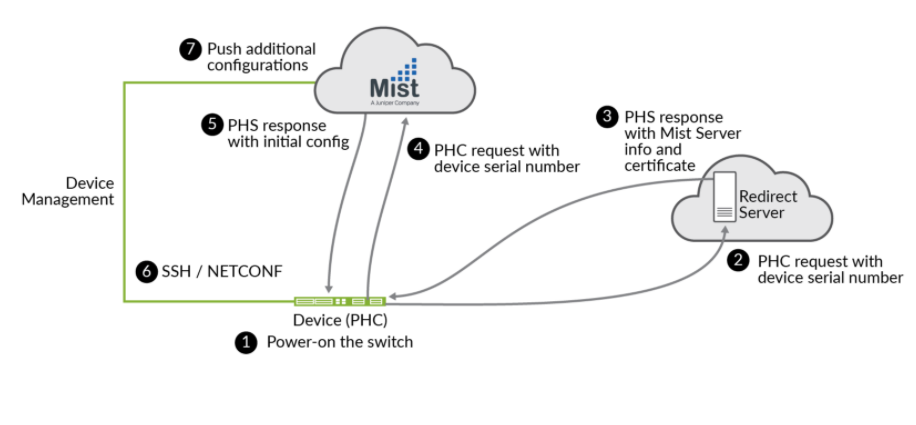
Zero-Touch Provisioning (ZTP) is a cornerstone of simplified deployment for Juniper EX-Series switches, enabling rapid and automated onboarding to the Juniper Mist Cloud. Once the switches are physically connected to the network and powered on, they automatically attempt to reach the Mist Cloud. Leveraging ZTP, the switches automatically download their initial configuration templates from the cloud, eliminating the need for manual, per-device configuration. This process significantly accelerates large-scale deployments, minimizes human error, and ensures consistency across the wired infrastructure, seamlessly integrating the switches into the AI-Driven Enterprise environment.
- Ensure the right ports are open in your firewall to allow switch communication with the Mist cloud.
- Connect your switches to the network.
- Onboard your switches to the Juniper Mist cloud.
Wired Assurance Onboarding
Wired Assurance onboarding extends the power of Mist AI to the wired network, providing unparalleled visibility and automation for Juniper EX-Series switches. This crucial step involves enabling the Wired Assurance service for the EX-Series switches within the Juniper Mist Cloud. Once enabled, IT teams can configure specific Wired Service Level Expectations (SLEs) to define and monitor the desired performance and experience for wired clients and devices. By continuously monitoring wired client experience against these SLEs, the Mist AI engine can proactively detect anomalies, identify root causes of issues, and provide actionable insights, transforming reactive troubleshooting into a proactive and predictive approach for the wired infrastructure.
- Enable Wired Assurance service for EX Series Switches in Mist Cloud.
-
Configure wired SLEs and monitor wired client experience.
To create a switch configuration template for Wired Assurance provisioning of one or more EX switches to the Mist cloud, you need to use the Juniper Mist portal.
Campus Fabric (EVPN-VXLAN) Implementation (If Applicable)
Campus Fabric implementation, particularly using EVPN-VXLAN, is a critical step for building a scalable, agile, and resilient wired network with Juniper EX Series Switches. This phase involves configuring the spine and leaf switches according to the low-level design and establishing the underlying IP fabric. Next, you’ll set up the EVPN-VXLAN overlay to provide efficient network segmentation and simplified routing across the campus. This advanced architecture enables the flexible placement of workloads and devices, supports seamless mobility, and enhances security by allowing for micro-segmentation, all while simplifying the overall network design and operations.
- Configure spine and leaf switches.
- Set up EVPN-VXLAN overlay for network segmentation and simplified routing.
Refer to the following JVDs for details on Campus and Branch Fabric
https://www.juniper.net/documentation/validated-designs/us/en/campus/