
ON THIS PAGE
BGP
When configuring WAN links, create BGP groups to integrate your WAN with your data center or data providers.
Before You Begin
-
Create the networks that you want to reference in your routing configurations. For help, see Network Settings.
-
Configure any Secure Edge Connectors that you want to reference in your routing configurations. For help, see Juniper Mist Secure Edge Connector Overview.
-
Create your WAN Edge template, hub profile, or standalone device configuration. For help, see WAN Assurance Configuration Overview.
Create a BGP Group
The BGP Neighbors configuration is where you define the other BGP routers that your WAN Edge device is going to talk with. Follow these steps to configure a BGP (Border Gateway Protocol) group. Specify the policies and protocols, and add the neighbors to include in the group.
To create a BGP group:
-
In the Add BGP Group configuration panel, enter the settings.
Refer to the following descriptions of the general settings (in the main Add BGP Group panel) and additional settings that are hidden until you click specific links and buttons.
Table 1: Settings for BGP Group—Major Fields Field Description Name Enter a unique, descriptive name to identify this group. You can enter letters, numbers, underscores, or dashes. The name must start and end with a letter or number. Maximum length: 32 characters. Peering Network Peering network is the network where you'll establish your BGP neighbor. Select the appropriate WAN, LAN, SEC tunnel.
Tips:
-
For the SEC Tunnel option, you can use Secure Edge Connectors with Custom or Prisma Access as the provider. JSE and Zscaler do not support dynamic routing protocols like BGP.
-
If you're configuring BGP in a WAN Edge template or WAN Edge device configuration, you can select Overlay to specify a preferred path to use for the traffic traversing from a spoke device to the BGP-learned prefixes. If you select this option, also specify an Export Policy. For help with the policy settings, see Routing Policies.
Remove Private AS Select this check box if you want the WAN Edge device to remove private AS numbers from an AS path. When a router sends route information to a BGP neighbor in a different AS, the private numbers will not appear. This setting is useful because some ISPs automatically reject routes that contain private AS numbers. BFD The Bidirectional Forwarding Detection (BFD) protocol is a simple hello mechanism that detects failures or faults between network forwarding elements that share a link.
Hello packets are sent at a specified, regular interval. If it doesn't get a reply within the expected time period, it considers this as a neighbor failure. Enabling BFD can be useful because the BFD timers are shorter, providing faster failure detection than with the default settings for BGP.
Type Select Internal unless you have an existing External BGP (EBGP) network; in that case, select External. Local AS Enter your WAN Edge device's AS number. It's the default autonomous system number for when the Session Smart Router advertises BGP. You can configure your Session Smart Router to be in one AS for one neighbor, and another AS for different neighbors.
Graceful Restart Time Graceful restart allows a routing device to inform its adjacent neighbors when it is restarting. Enter a value from 1 to 495 seconds. Authentication Key For added security, you can add an MD5 password. Neighbors in this group will use this password to verify the authenticity of packets sent from this system. Export or Import Policy Select an existing routing policy or click the Create Policy link below the drop-down menu. If you click the create button, then the Add Routing Policy panel appears. For help with policy settings, see Routing Policies. Neighbors In the Neighbors section of the Add BGP panel, you manage the devices that are included in this BGP group. These are the other BGP routers the session smart router is going to talk with.
You can edit a neighbor by clicking it.
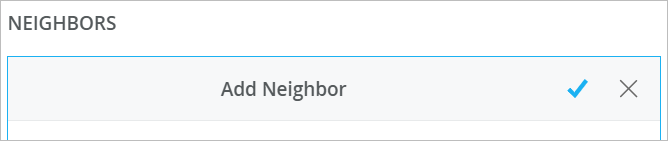
For new entries, click Add Neighbor. Enter the settings, and click the check mark at the top of the Neighbors section.
For help, see the Table 2 table.
Table 2: Settings for Neighbors Field Description Enabled or Disabled Administratively enable or disable a BGP neighbor. IP Address The IP address of the device, or a variable representing the address. Neighbor AS Enter the autonomous system number for this neighbor device. Multihop TTL Enter the number of hops that BGP packets can traverse to reach a remote BGP peer. This setting is necessary if the peers are separated by non-BGP routers.
Valid entries: 0 (no multihopping) to 64
Export or Import Policy Select a routing policy from the drop-down menu, or click the Create Policy link below the menu. If you click the create button, then the Add Routing Policy panel appears. For help with policy settings, see Routing Policies. Note:After entering the required details for a neighbor, click the check mark in the Add Neighbor title bar. (The check mark appears only after the required information is entered).
-