
Solution Architecture
The three fabrics described in the previous section (Frontend, GPU Backend, and Storage Backend), are interconnected together in the overall AI JVD solution architecture shown in Figure 2.
Figure 2: AI JVD Solution Architecture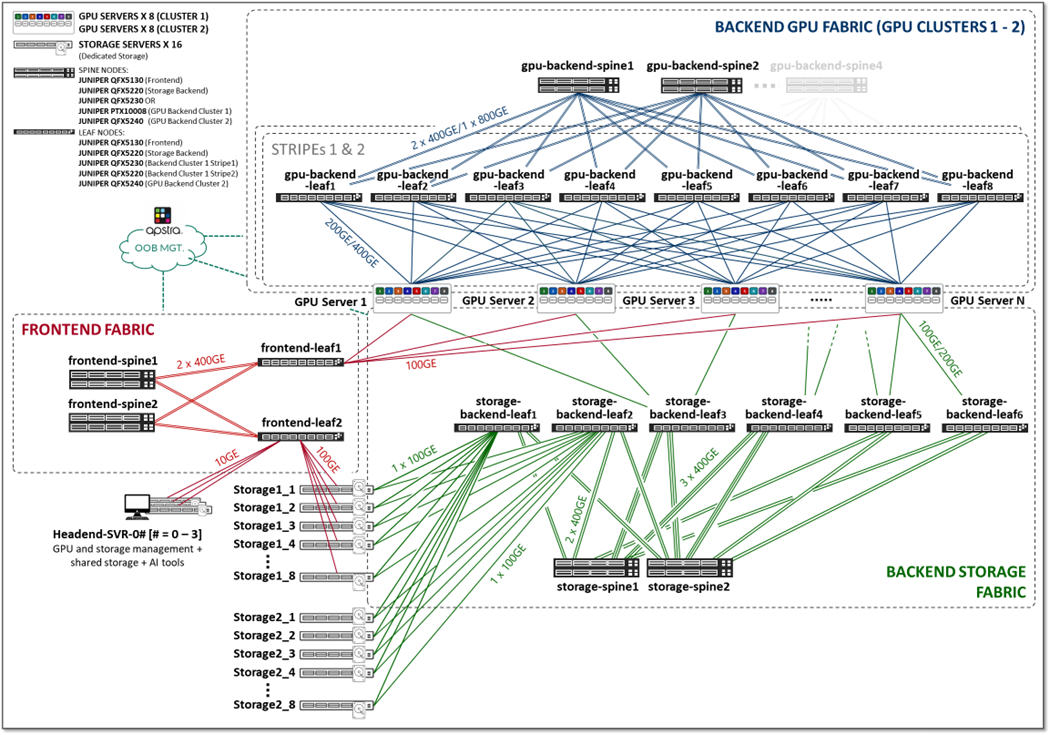
Frontend Fabric
The Frontend Fabric provides the infrastructure for users to interact with the AI systems to orchestrate training and inference tasks workflows using tools such as SLURM, Kubernetes, and other AI workflow managers that handle job scheduling, resource allocation, and lifecycle management.
These interactions do not generate heavy data flows and do not impose strict requirements on latency or packet loss. As a result, control-plane traffic does not place rigorous performance demands on the fabric.
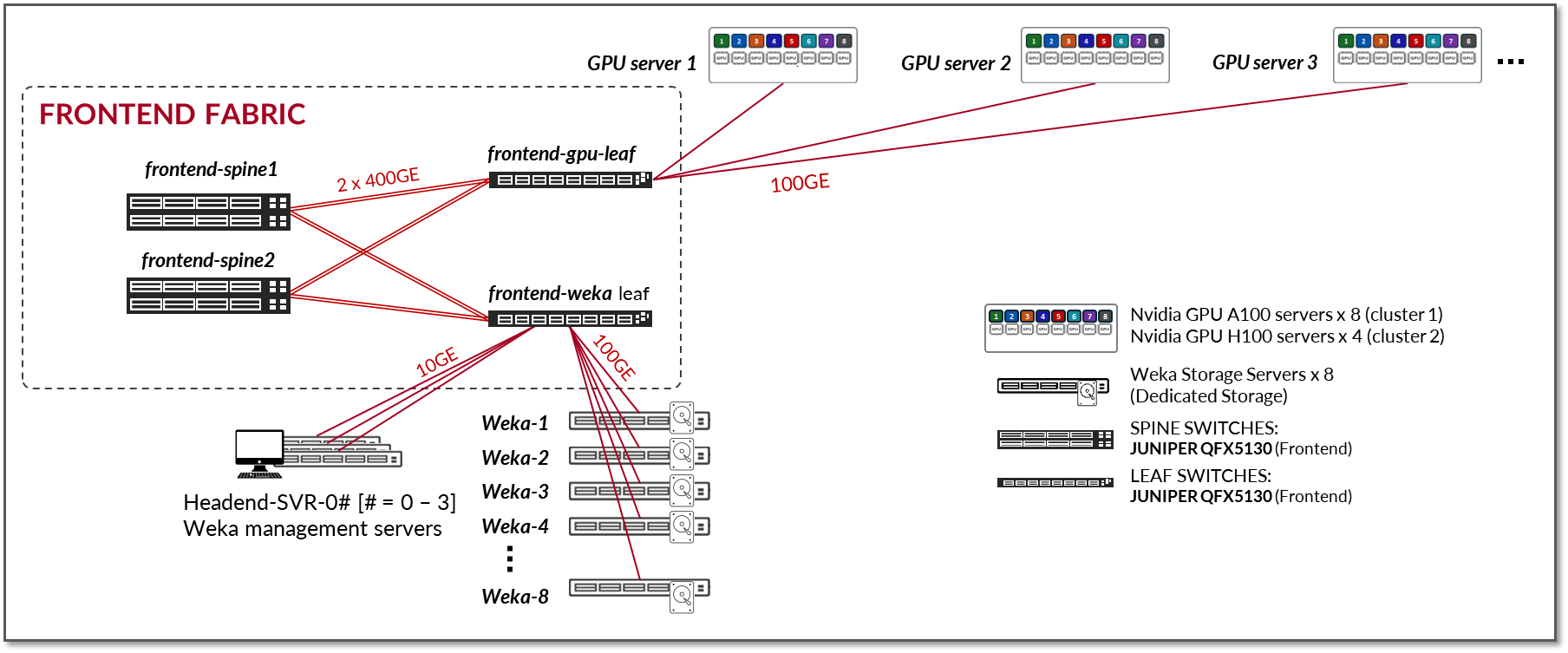
The Frontend Fabric design consists of a 3-stage L3 IP fabric without high availability (HA), as shown in Figure 3. This architecture provides a simple and effective solution for the connectivity required in Frontend. However, any fabric architecture including EVPN/VXLAN, could be used. If an HA-capable Frontend Fabric is required, we recommend following the 3-Stage with Juniper Apstra JVD.
Figure 3: Frontend Fabric Architecture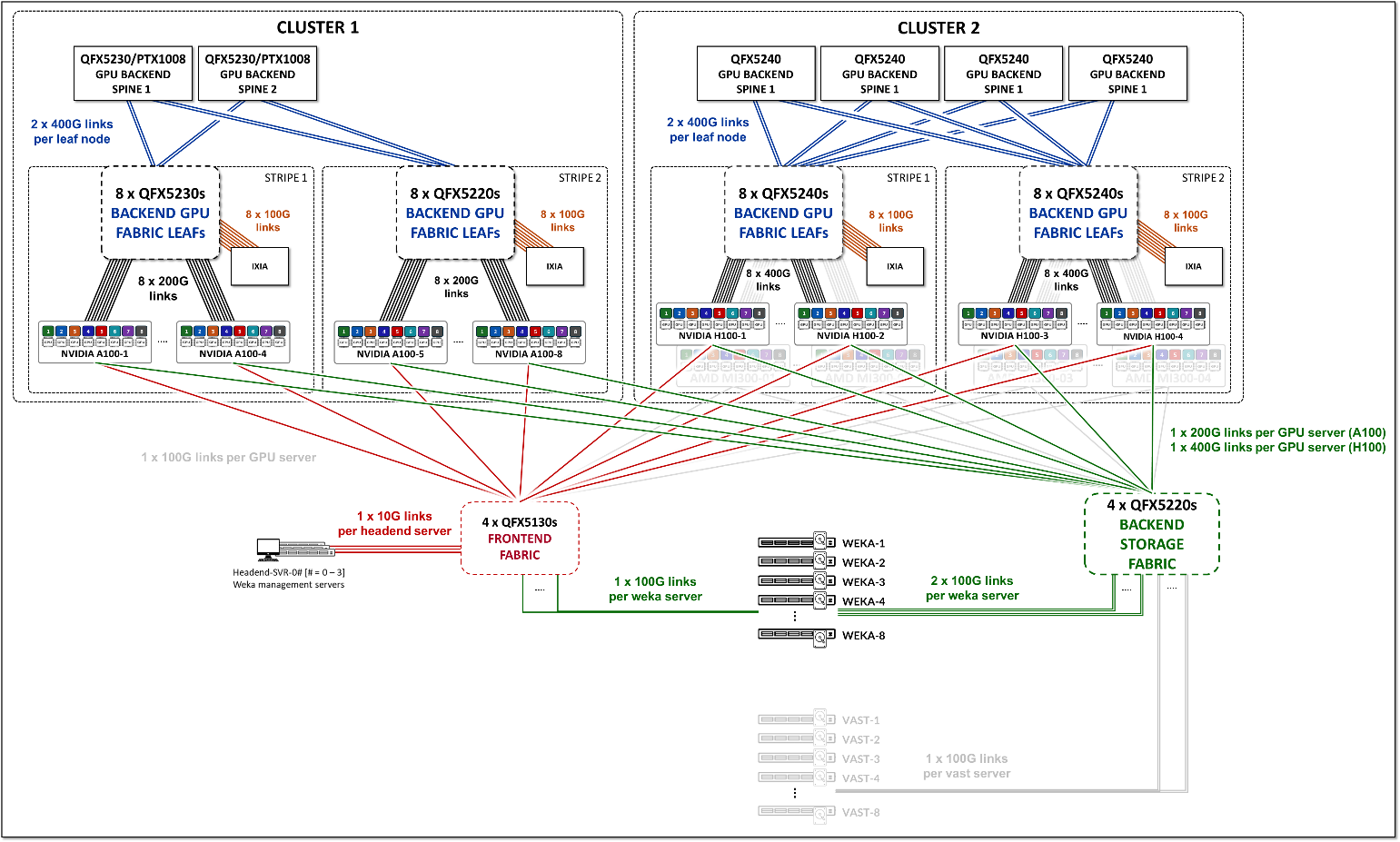
The number of leaf nodes is dependent on the number of servers and storage devices in the AI cluster, as well as any other device used for AI job scheduling, resource allocation, and lifecycle management.
The number of spine nodes is dependent on the subscription factor desired for the design. A 1:1 subscription factor is not required. Moderate oversubscription is acceptable for control-plane traffic, provided the design maintains resiliency and avoids congestion that would impact control-plane stability.
The fabric is an L3 IP fabric using EBGP for route advertisement with IP addressing and EBGP configuration details described in the networking section on this document. No special load balancing mechanism is required. ECMP across redundant L3 paths is typically sufficient.
Given that the control-plane traffic is typically not bandwidth-heavy compared to storage or GPU fabrics, strict QoS mechanisms are optional and only recommended if sharing links with bursty non-control traffic.
The devices and connectivity in the Frontend fabric validated in this JVD are summarized in the following tables:
Table 1: Validated management devices and GPU servers connected to the Frontend fabric
| GPU Servers | Storage Devices | Headend Servers |
|---|---|---|
|
Weka CSE-LB16TS-R860AWP-A |
Supermicro SYS-6019U-TR4 |
Table 2: Validated Frontend Fabric leaf and spine nodes
| Frontend Fabric Leaf Nodes switch model | Frontend Fabric Spine Nodes switch model |
|---|---|
| QFX5130-32CD | QFX5130-32CD |
| QFX5220-32CD | QFX5220-32CD |
Table 3: Validated connections between headend servers and leaf nodes in the Frontend Fabric
| Links per GPU server to leaf connection | Server Type |
|---|---|
| 1 x 10GE | Supermicro SYS-6019U-TR4 |
Table 4: Validated connections between GPU servers and leaf nodes in the Frontend
| Links per GPU server to leaf connection | Server Type |
|---|---|
| 1 x 100GE | NVIDIA A100 |
| 1 x 100GE | NVIDIA H100 |
Table 5: Validated connections between leaf and spine nodes in the Frontend
| Links per leaf and spine connection | Leaf node model | spine node model |
|---|---|---|
| 2 x 400GE | QFX5130-32CD | QFX5130-32CD |
Testing for this JVD was performed using 8 NVIDIA A100 GPU servers and 4 NVIDIA H100 GPU servers connected to two leaf nodes, which in turn were connected to two spine nodes, as shown:
Figure 4: Frontend Fabric JVD Testing Topology
- GPU servers are connected to the Leaf nodes using 100G interfaces (ConnectX-6/ConnectX-7 NICs).
- Weka devices are connected to the Leaf nodes using 100G interfaces
Table 6: Aggregate Frontend GPU Servers <=> Frontend Leaf Nodes Link Counts and bandwidth tested
| GPU Servers <=> Frontend Leaf Nodes | Bandwidth |
|---|---|
|
Number of 100GE links GPU servers ó frontend leaf nodes = 12 (1 per server) |
12 x 100GE = 1.2 Tbps |
|
Number of 100GE links between Storage device ó frontend leaf nodes = 8 (1 per storage device) |
8 x 100GE = 0.8 Tbps |
| Total bandwidth = | 2.0 Tbps |
Table 7: Aggregate Frontend Leaf Nodes <=> Frontend Spine Nodes Link Counts and bandwidth tested
| Frontend Leaf Nodes <=> Frontend Spine Nodes | Bandwidth | |
|---|---|---|
|
Number of 400GE links between frontend leaf nodes and spine nodes = 8 (2 leaf nodes x 2 spines nodes x 2 links per leaf to spine connection) |
8 x 400GE = 3.2 Tbps | |
| Total bandwidth = | 3.2 Tbps | |
| No over subscription. | ||
GPU Backend Fabric
The GPU Backend fabric provides the infrastructure for GPUs to communicate with each other within a cluster, using RDMA over Converged Ethernet (RoCEv2). ROCEv2 boosts data center efficiency, reduces overall complexity, and increases data delivery performance by enabling the GPUs to communicate as they would with the InfiniBand protocol.
Unlike the Frontend Fabric, the GPU Backend Fabric carries data-plane traffic that is both bandwidth-intensive and latency-sensitive. Packet loss, excessive latency, or jitter can significantly impact job completion times and therefore must be avoided. As a result, one of the primary design objectives of the GPU Backend Fabric is to provide a near-lossless Ethernet fabric, while also delivering maximum throughput, minimal latency, and minimal network interference for GPU-to-GPU traffic. RoCEv2 operates most efficiently in environments where packet loss is minimized, directly contributing to optimal job completion times.
The GPU Backend Fabric in this JVD was designed to meet these requirements. The design follows a 3-stage IP Clos, Rail Optimized Stripe architecture , as shown in Figure 5. Details about the Backend GPU Rail Optimized Stripe Architecture are described in a later section.
Figure 5: GPU Backend Fabric Architecture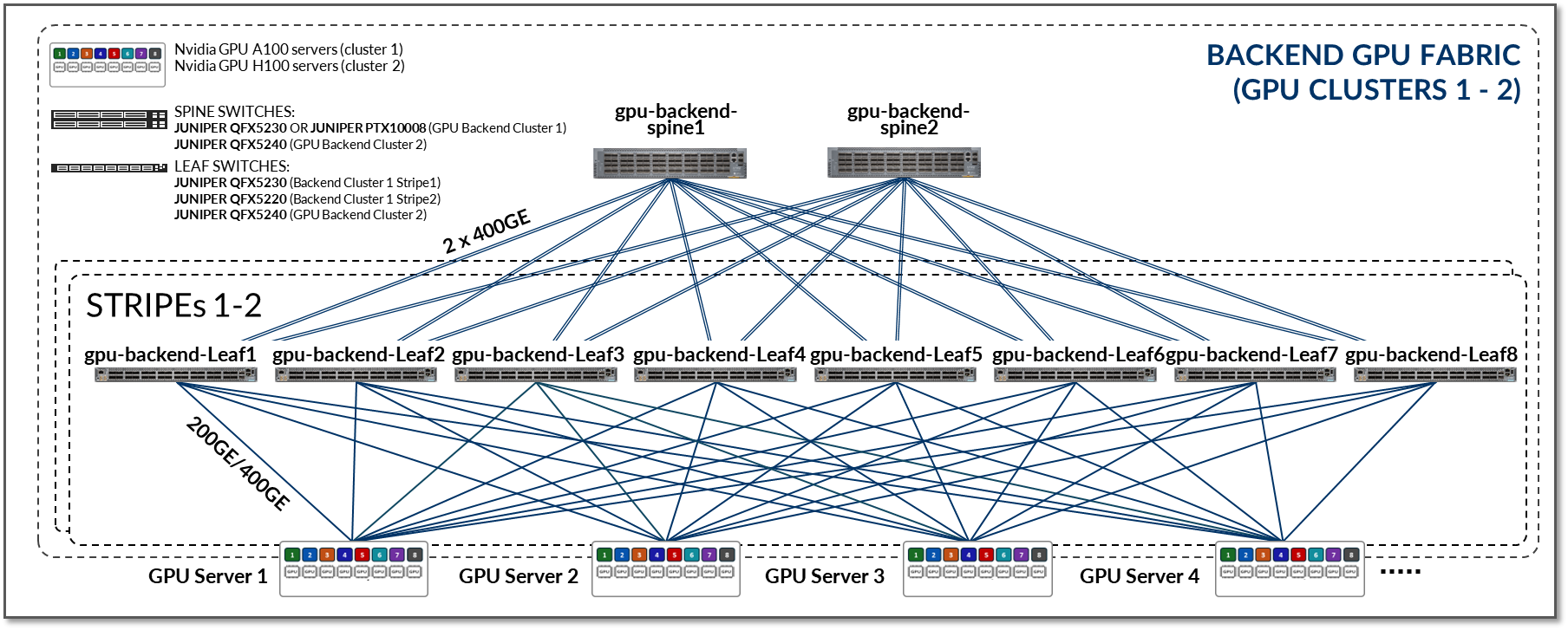
The fabric operates as an L3 IP fabric using EBGP for route advertisement with IP addressing and EBGP configuration details described in the networking section on this document.
In a rail optimized architecture, the number of leaf nodes is determined by the number of GPU per server, which is 8 for the Nvidia servers included in this JVD. The number of spine nodes as well as the speed and number of links between GPU servers and leaf nodes, and between leaf and spine nodes, determines the effective bandwidth and oversubscription characteristics of the GPU Backend Fabric.
In contrast to the Frontend Fabric, the GPU Backend Fabric requires a non-oversubscribed design (1:1 subscription factor) to ensure sufficient bandwidth for the high volume RoCEv2 traffic, and prevent congestion, packet loss and excessive latency.
Traffic distribution within the GPU Backend Fabric relies on ECMP across multiple equal-cost L3 paths combined with advanced Load Balancing techniques such as Dynamic Load Balancing (DLB), Global Load Balancing, and Adaptive Load Balancing (ALB). These are described in the Load Balancing section of this document.
Because the GPU Backend Fabric carries RoCEv2 traffic sensitive to losses and latency, the design incorporates DCQCN (Data Center Quantized Congestion Notification), which leverages ECN (Explicit Congestion Notification) and may optionally use PFC (Priority Flow Control), to achieve lossless or near-lossless behavior for RDMA traffic. These mechanisms are described in detail in the Class of Service section of this document.
The devices and connectivity in the GPU backend fabric validated in this JVD are summarized in the following tables:
Table 8: Validated management devices and GPU servers connected to the GPU Backend Fabric.
| GPU Servers | Storage Devices | Headend Servers |
|---|---|---|
|
Weka CSE-LB16TS-R860AWP-A |
Supermicro SYS-6019U-TR4 |
Table 9: Validated GPU Backend Fabric Leaf Nodes
| GPU Backend Fabric Leaf Nodes switch model |
|---|
| QFX5220-32CD |
| QFX5230-64CD |
| QFX5240-64OD |
| QFX5241-64OD |
Table 10: Validated GPU Backend Fabric Spine Nodes
| GPU Backend Fabric Spine Nodes switch model |
|---|
| QFX5230-64CD |
| QFX5240-64OD |
| QFX5241-64OD |
| PTX10008 LC1201 |
| PTX10008 LC1301 |
Table 11: Validated connections between GPU servers and Leaf Nodes in the GPU Backend Fabric
| Links per GPU server to leaf connection | Server type |
|---|---|
| 1 x 200GE | NVIDIA A100 |
| 1 x 400GE links per GPU server to leaf connection | NVIDIA H100 |
Table 12: Validated connections between leaf and spine nodes in the GPU Backend Fabric
| Links per leaf and spine connection | Leaf node model | spine node model |
|---|---|---|
| 1 x 400GE | QFX5220-32CD | QFX5230-32CD |
| 1 x 400GE | QFX5230-32CD | QFX5230-32CD |
| 2 x 400GE | QFX5240-64OD | QFX5240-64OD |
| 1 x 800GE | QFX5240-64OD | QFX5240-64OD |
| 1 x 400GE | QFX5220-32CD | PTX10008 LC1201 |
| 1 x 400GE | QFX5230-32CD | PTX10008 LC1201 |
| 1 x 800GE | QFX5240-64OD | PTX10008 LC1301 |
| 2 x 800GE | QFX5240-64OD | PTX10008 LC1301 |
Testing for this JVD was performed using 8 NVIDIA A100 GPU servers and 4 NVIDIA H100 GPU servers connected to two stripes as shown:
Figure 6: GPU Backend Fabric JVD Testing Topology
- Each Nvidia A100 server is connected to the Leaf nodes using 200G interfaces (ConnectX-7 NICs).
- Each Nvidia H100 server is connected to the Leaf nodes using 400G interfaces (ConnectX-7 NICs).
Table 13: Per stripe Server to Leaf Bandwidth
| Stripe |
Number of servers per Stripe |
Number of servers <=> leaf links per server (same as number of leaf nodes & number of GPUs per server) |
Server <=> Leaf Link Bandwidth [Gbps] |
Total Servers <=> Leaf Links Bandwidth per stripe [Tbps] |
|---|---|---|---|---|
| 1 | 2 H100 | 8 | 400 Gbps | 2 x 8 x 400 Gbps = 6.4 Tbps |
| 4 A100 | 8 | 200 Gbps | 4 x 8 x 200 Gbps = 6.4 Tbps | |
| 2 | 2 H100 | 8 | 400 Gbps | 2 x 8 x 400 Gbps = 6.4 Tbps |
| 4 A100 | 8 | 200 Gbps | 4 x 8 x 200 Gbps = 6.4 Tbps | |
| Total Server <=> Leaf Bandwidth | 25.6 Tbps | |||
Table 14: Per stripe Leaf to Spine Bandwidth w/ QFX5240 as leaf and spines
| Stripe |
Number of leaf nodes |
Number of spine nodes |
Number of 400 Gbps leaf <=> spine links per leaf node |
Server <=> Leaf Link Bandwidth [Gbps] |
Bandwidth Leaf <=> Spine Per Stripe [Tbps] |
|---|---|---|---|---|---|
| 1 | 8 | 4 | 2 | 400 | 8 x 2 x 2 x 400 Gbps = 12.8 Tbps |
| 2 | 8 | 4 | 2 | 400 | 8 x 2 x 2 x 400 Gbps = 12.8 Tbps |
| Total Server <=> Leaf Bandwidth | 25.6 Tbps | ||||
GPU Backend Fabric Subscription Factor
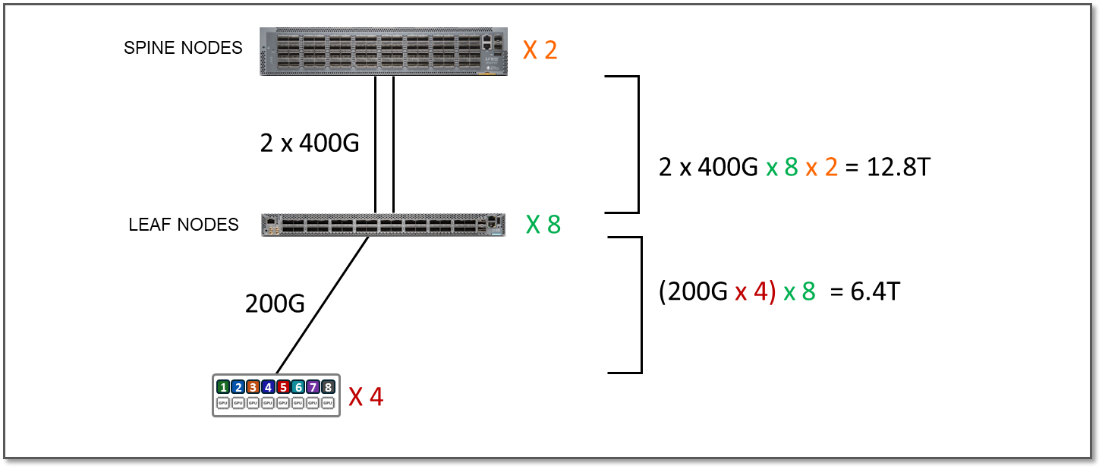
The subscription factor is simply calculated by comparing the numbers from the two tables above:
In the JVD test environment, the bandwidth between the servers and the leaf nodes is 25.6 Tbps per stripe, while the bandwidth available between the leaf and spine nodes is 25.6 Tbps per stripe. This means that the fabric has enough capacity to process all traffic between the GPUs even when this traffic was 100% inter-stripe, but now there is no extra capacity to accommodate additional servers. The subscription factor in this case is 1:1 (no subscription).
Figure 7: 1:1 Subscription Factor
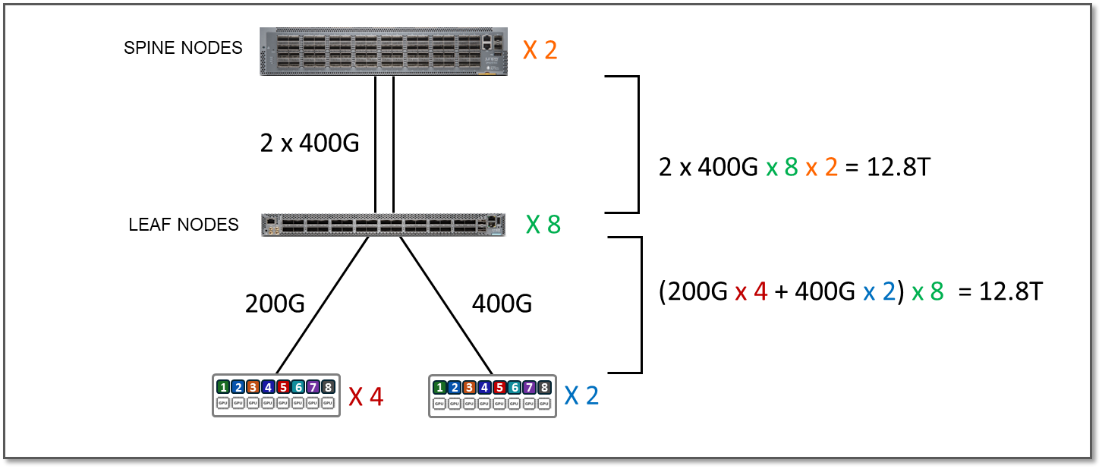
To run oversubscription testing, some of the interfaces between the leaf and spines were disabled, reducing the available bandwidth, as shown in the example in Figure 8:
Figure 8: 2:1 Subscription Factor (Oversubscription)
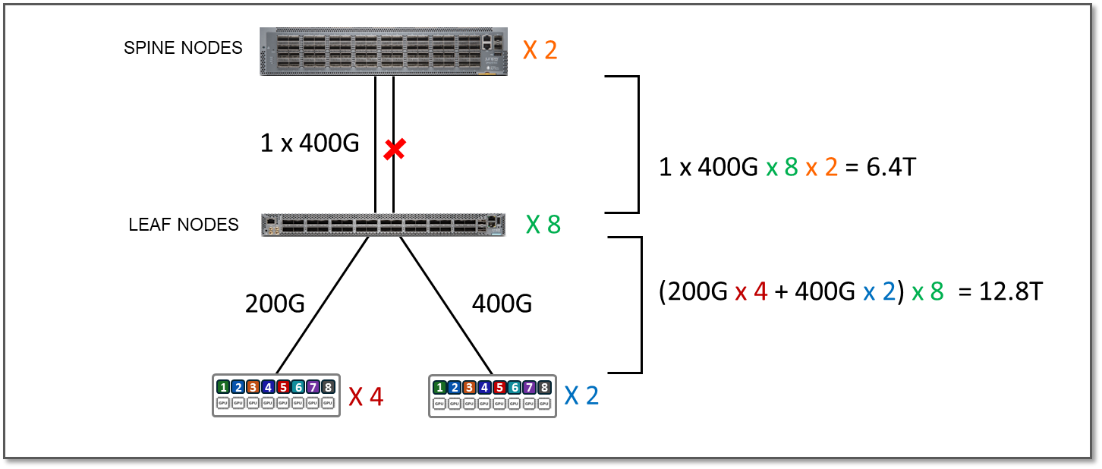
The total Servers to Leaf Links bandwidth per stripe has not changed. It is still 12.8 Tbps as shown in table 15 in the previous scenario.
However, the bandwidth available between the leaf and spine nodes is now only 6.4 Tbps per stripe.
Table 15: Per Stripe Leaf to Spine Bandwidth
| Leaf to Spine Bandwidth per Stripe | |||
| Leaf <=> Spine Links Per Spine Node & Per Stripe |
Speed Of Leaf <=> Spine Links [Gbps] |
Number of Spine Nodes |
Total Bandwidth Leaf <=> Spine Per Stripe [Tbps] |
| 8 | 1 x 400 | 2 | 6.4 |
This means that the fabric no longer has enough capacity to process all traffic between the GPUs even if this traffic was 100% inter-stripe, potentially causing congestion and traffic loss. The oversubscription factor in this case is 2:1.
Congestion and failure testing results are included in the JVD Test Report.
GPU to GPU Communication Optimization
Optimization in rail-optimized topologies refers to how GPU communication is managed to minimize congestion and latency while maximizing throughput. A key part of this optimization strategy is keeping traffic local whenever possible. By ensuring that GPU communication remains within the same rail or stripe, or even within the server, the need to traverse spines or external links is reduced, which lowers latency, minimizes congestion, and enhances overall efficiency.
While localizing traffic is prioritized, inter-stripe communication will be necessary in larger GPU clusters. Inter-stripe communication is optimized by means of proper routing and balancing techniques over the available links to avoid bottlenecks and packet loss.
The essence of optimization lies in leveraging the topology to direct traffic along the shortest and least-congested paths, ensuring consistent performance even as the network scales. Traffic between GPUs on the same servers can be forwarded locally across the internal Server fabric (vendor dependent), while traffic between GPUs on different servers happens across the external GPU backend infrastructure. Communication between GPUs on different servers can be intra-rail, or inter-rail/inter-stripe.
Intra-rail traffic is switched (processed at Layer 2) on the local leaf node. Following this design, data between GPUs on different servers (but in the same stripe) is always moved on the same rail and across one single switch. This guarantees GPUs are 1 hop away from each other and will create separate independent high-bandwidth channels, which minimize contention and maximize performance. On the other hand, inter-rail/inter-stripe traffic is routed across the IRB interfaces on the leaf nodes and the spine nodes connecting the leaf nodes (processed at Layer 3).
Consider the example depicted in Figure 8
- Communication between GPU 1 and GPU 2 in server 1 happens across the server’s internal fabric (1)
- Communication between GPUs 1 in servers 1- 4, and between GPUs 8 in servers 1- 4 happens across Leaf 1 and Leaf 8 respectively (2), and
- Communication between GPU 1 and GPU 8 (in servers 1- 4) happens across leaf1, the spine nodes, and leaf8 (3)
Figure 8: Inter-rail vs. Intra-rail GPU-GPU communication
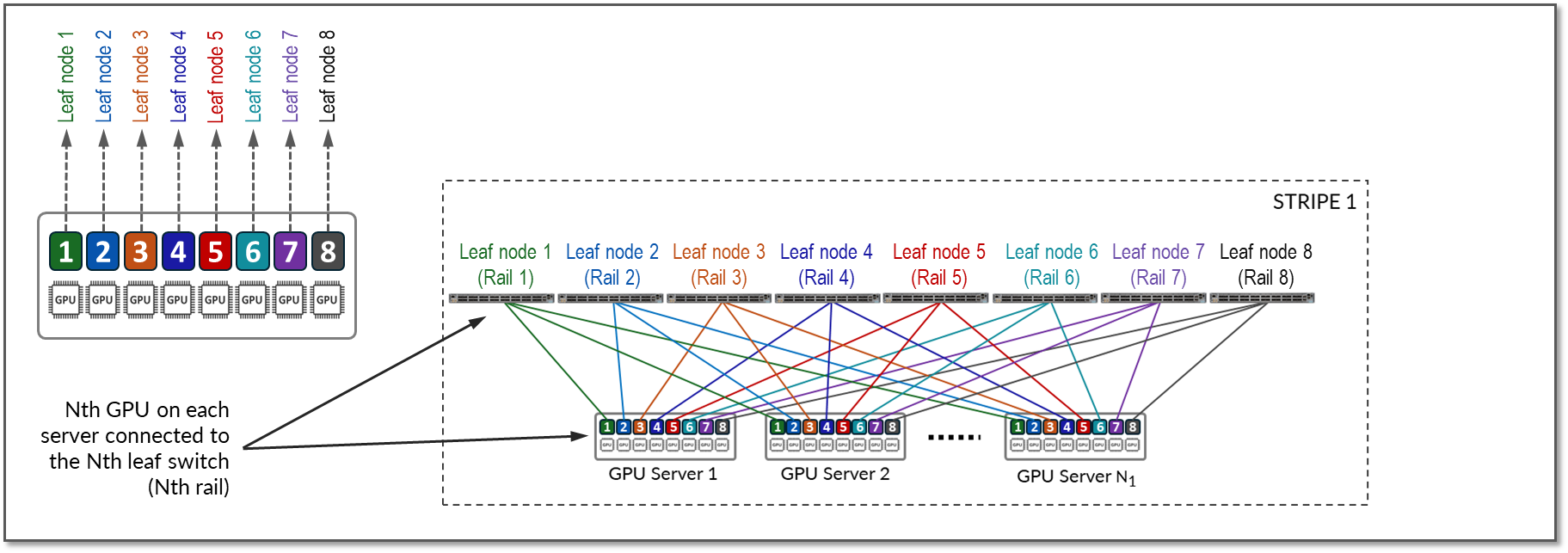
Figure 10 represents a topology with one stripe and 8 rails connecting GPUs 1-8 across leaf switches 1-8 respectively.
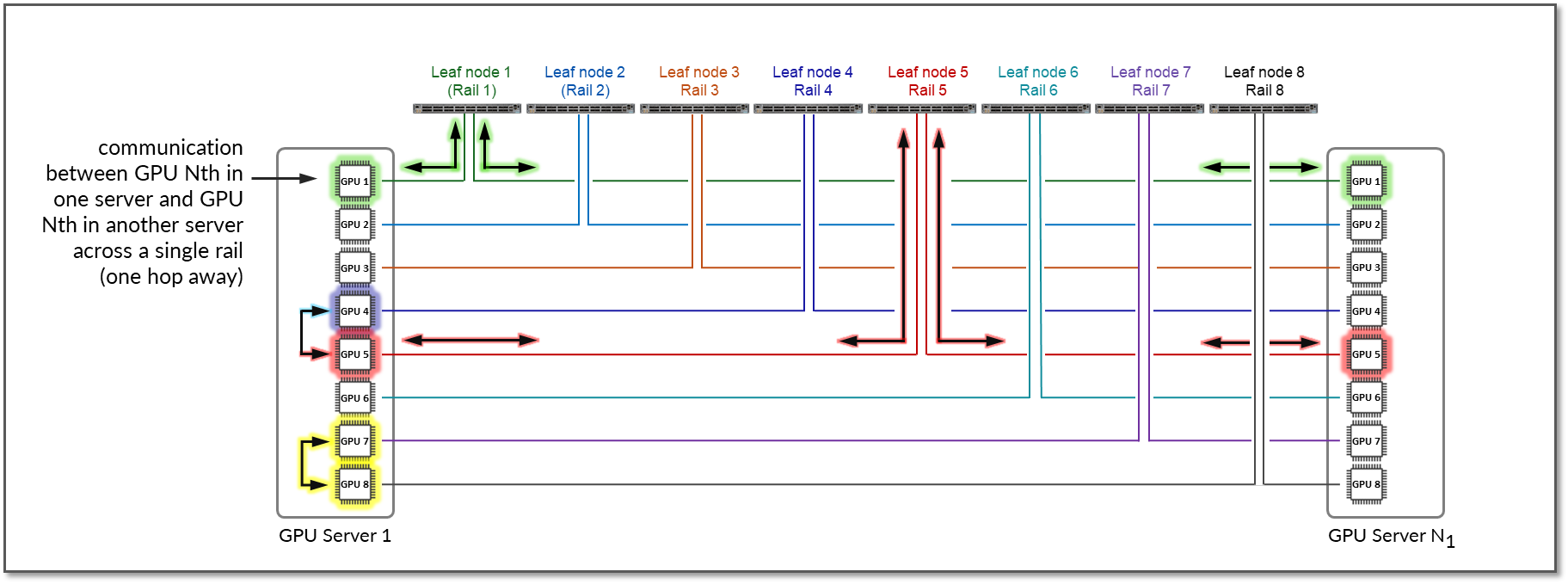
Communication between GPU 7 and GPU 8 in Server 1 happens across the internal fabric, while communication between GPU 1 in Server 1 and GPU 1 in Server N1 happens across Leaf switch 1 (within the same rail).
Notice that if any communication between GPUs in different stripes and different servers is required (e.g. GPU 4 in server 1 communicating with GPU 5 in Server N1), data is first moved to a GPU interface in the same rail as the destination GPU, thus sending data to the destination GPU without crossing rails.
Following this design, data between GPUs on different servers (but in the same stripe) is always moved on the same rail and across one single switch, which guarantees GPUs are 1 hop away from each other and creates separate independent high-bandwidth channels, which minimize contention and maximize performance.
On NVIDIA H100s GPU servers, GPUs are interconnected via NVLink and NVswitches, which provide 400Gbps GPU-to-GPU high-bandwidth, low-latency, bidirectional GPU-to-GPU communication within a single server, as shown in Figure 9.
Figure 9: NVIDIA HGX/DGX GPU interconnect architecture
For more details refer to Introduction to NVIDIA DGX H100/H200 Systems — NVIDIA DGX H100/H200 User Guide
NVIDIA GPUs leverage NVLink and NVSwitch to deliver high-bandwidth, low-latency communication between GPUs, CPUs, and other system components. This interconnect fabric dynamically manages traffic across multiple links, providing optimized paths for intra-node GPU communication and enabling efficient collective operations.
By default, NVIDIA GPU platforms implement topology-aware routing and local optimization, implemented using PXN (Parallel Execution Networks), to minimize latency for GPU-to-GPU traffic. Communication between GPUs on the same servers is forwarded across the Infinity Fabric and remains intra-node and does not traverse the external Ethernet fabric. Traffic between GPUs of the same rank across multiple servers remains intra-stripe.
Figure 12 shows an example where GPU1 in Server 1 communicates with GPU1 in Server 2. The traffic is forwarded by Leaf Node 1 and remains within Rail 1.
Additionally, if GPU4 in Server 1 wants to communicate with GPU5 in Server 2, and GPU5 in Server 1 is available as a local hop in AMD’s Infinity Fabric, the traffic naturally prefers this path to optimize performance and keep GPU-to-GPU communication intra-rail.
Figure 10: GPU to GPU inter-rail communication between two servers with local optimization.
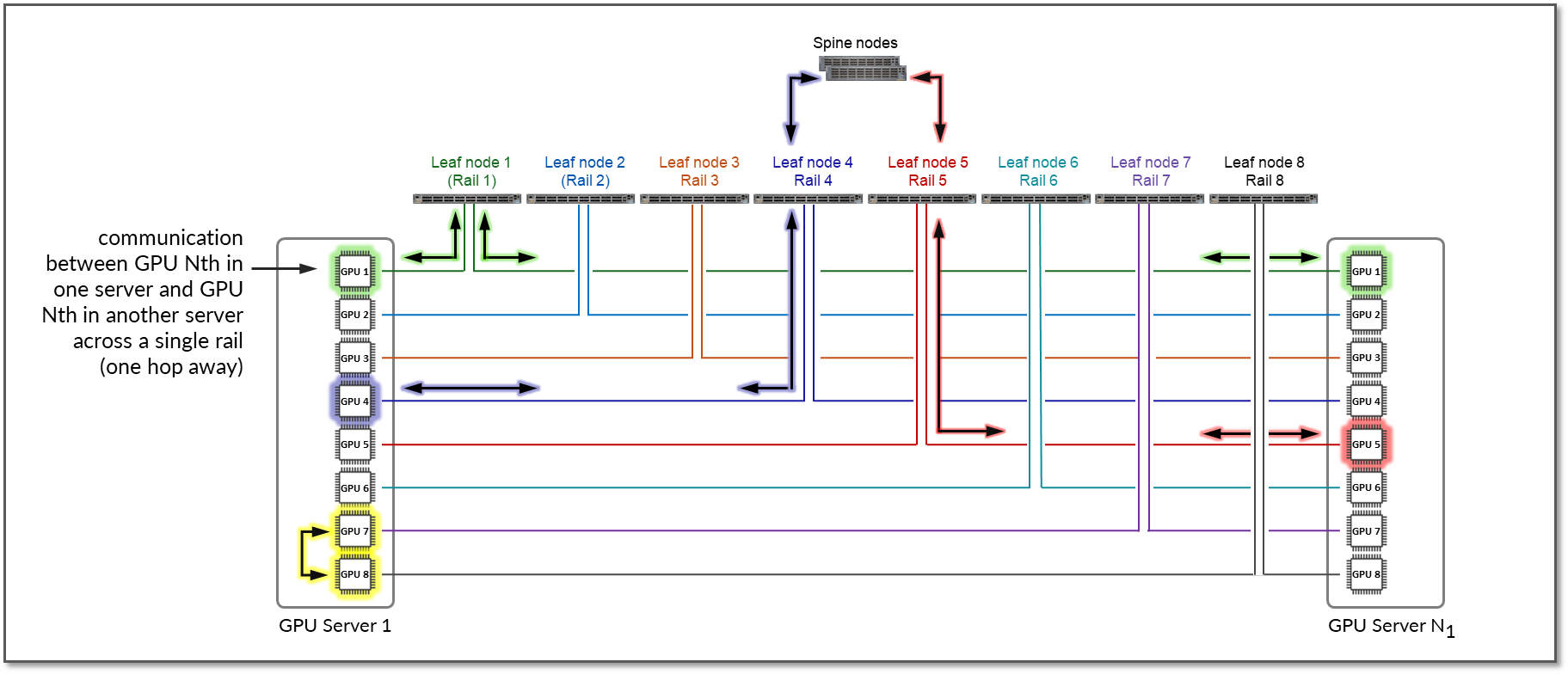
If local optimization is not feasible because of workload constraints, for example, the traffic must bypass local hops (internal fabric) and use RDMA (off-node NIC-based communication). In such a case, GPU4 in Server 1 communicates with GPU5 in Server 2 by sending data directly over the NIC using RDMA, which is then forwarded across the fabric, as shown in Figure 11.
Figure 11: GPU to GPU inter-rail communication between two servers without local optimization.
The example shows that communication between GPU 4 in Server 1 and GPU 5 in Server N1 goes across Leaf switch 1, the Spine nodes, and Leaf switch 5 (between two different rails).
Backend GPU Rail Optimized Stripe Architecture
As previously described, a Rail Optimized Stripe Architecture provides efficient data transfer between GPUs, especially during computationally intensive tasks such as AI Large Language Models (LLM) training workloads, where seamless data transfer is necessary to complete the tasks within a reasonable timeframe. A Rail Optimized topology aims to maximize performance by providing minimal bandwidth contention, minimal latency, and minimal network interference, ensuring that data can be transmitted efficiently and reliably across the network.
In a Rail Optimized Stripe Architecture, there are two important concepts: rail and stripe.
The GPUs on a server are numbered 1-8, where the number represents the GPU’s position in the server, as shown in Figure 6. This number is sometimes called rank or more specifically "local rank" in relationship to the GPUs in the server where the GPU sits, or "global rank" in relationship to all the GPUs (in multiple servers) assigned to a single job.
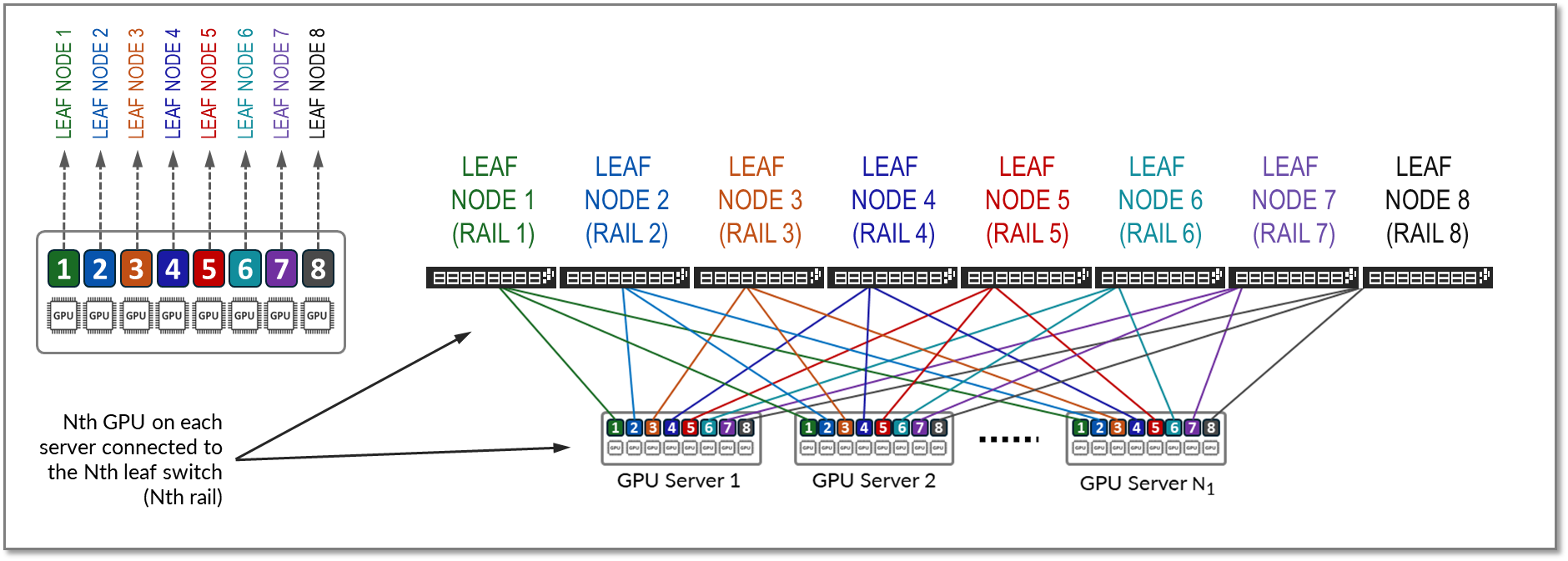
A rail connects GPUs of the same order across one of the leaf nodes in the fabric; that is, rail Nth connects all GPUs in position Nth on all the servers, to leaf node Nth, as shown in Figure 10.
Figure 10: Rails in a Rail Optimized Architecture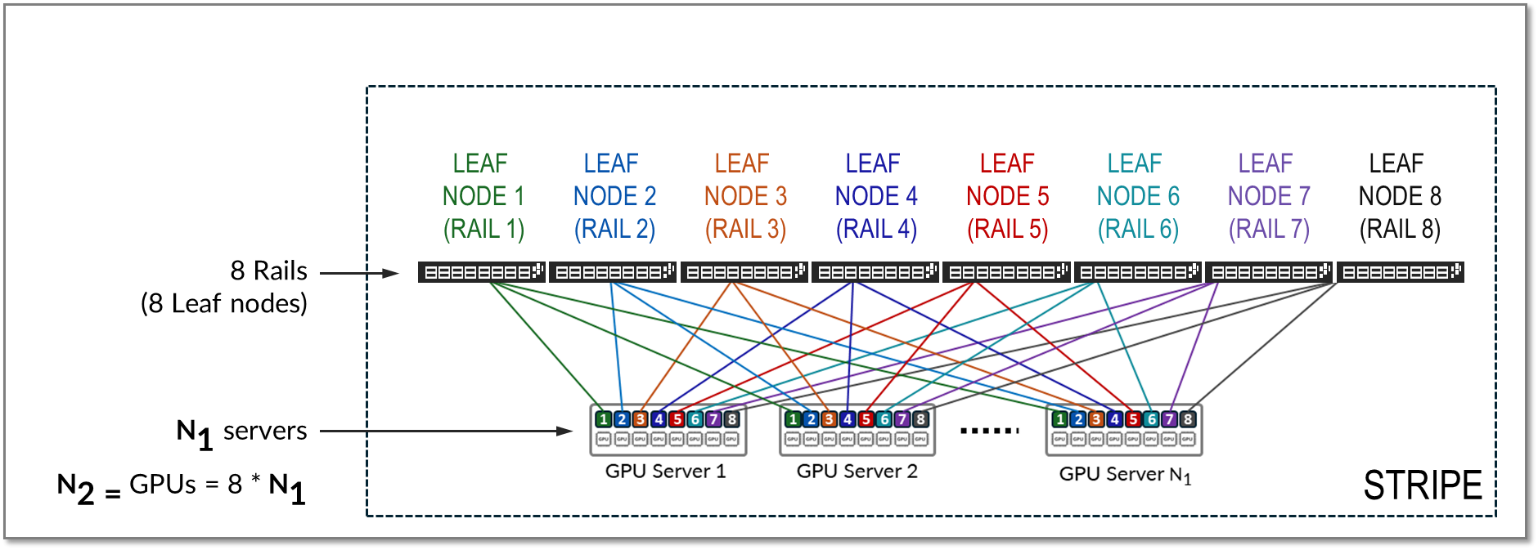
A stripe refers to a design module or building block, comprised of multiple rails, and that includes a number of Leaf nodes and GPU servers, as shown in Figure 11. This building block can be replicated to scale up the AI cluster.
Figure 11: Stripes in a Rail Optimized Architecture
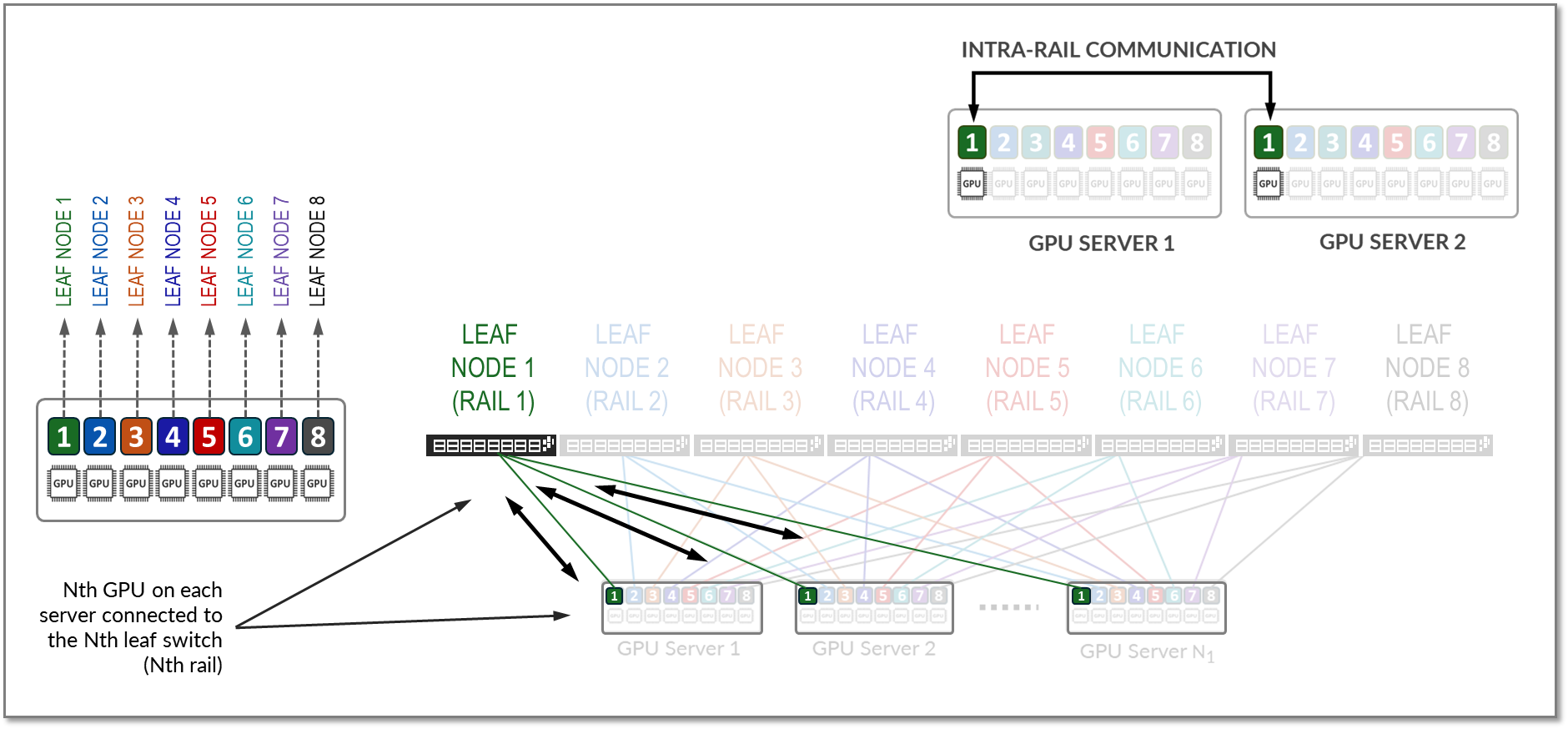
All traffic between GPUs of the same rank (intra-rail traffic) is forwarded at the leaf node level as shown in Figure 12.
Figure 12: Intra-rail GPU to GPU traffic example.
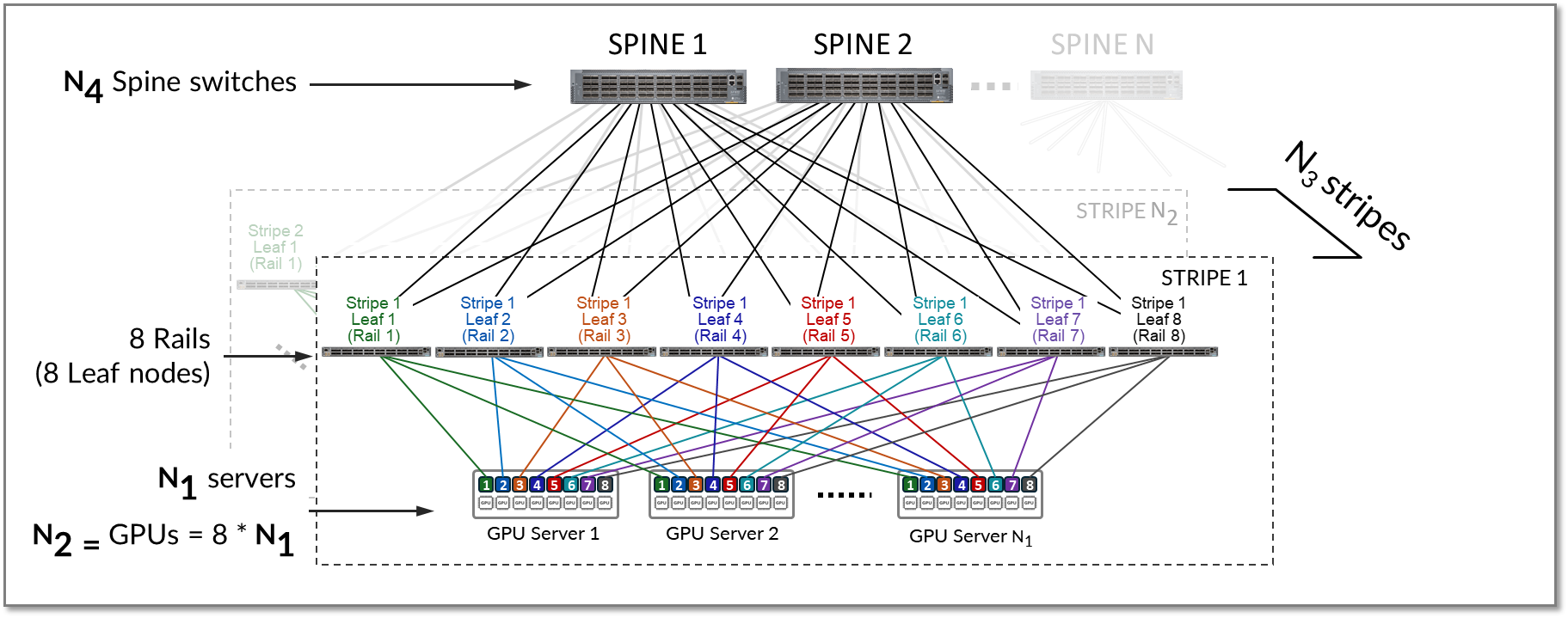
A stripe can be replicated to scale up the number of servers (N1) and GPUs (N2) in an AI cluster. Multiple stripes (N3) are then connected across Spine switches as shown in Figure 13.
Figure 13: Multiple stripes connected via Spine nodes
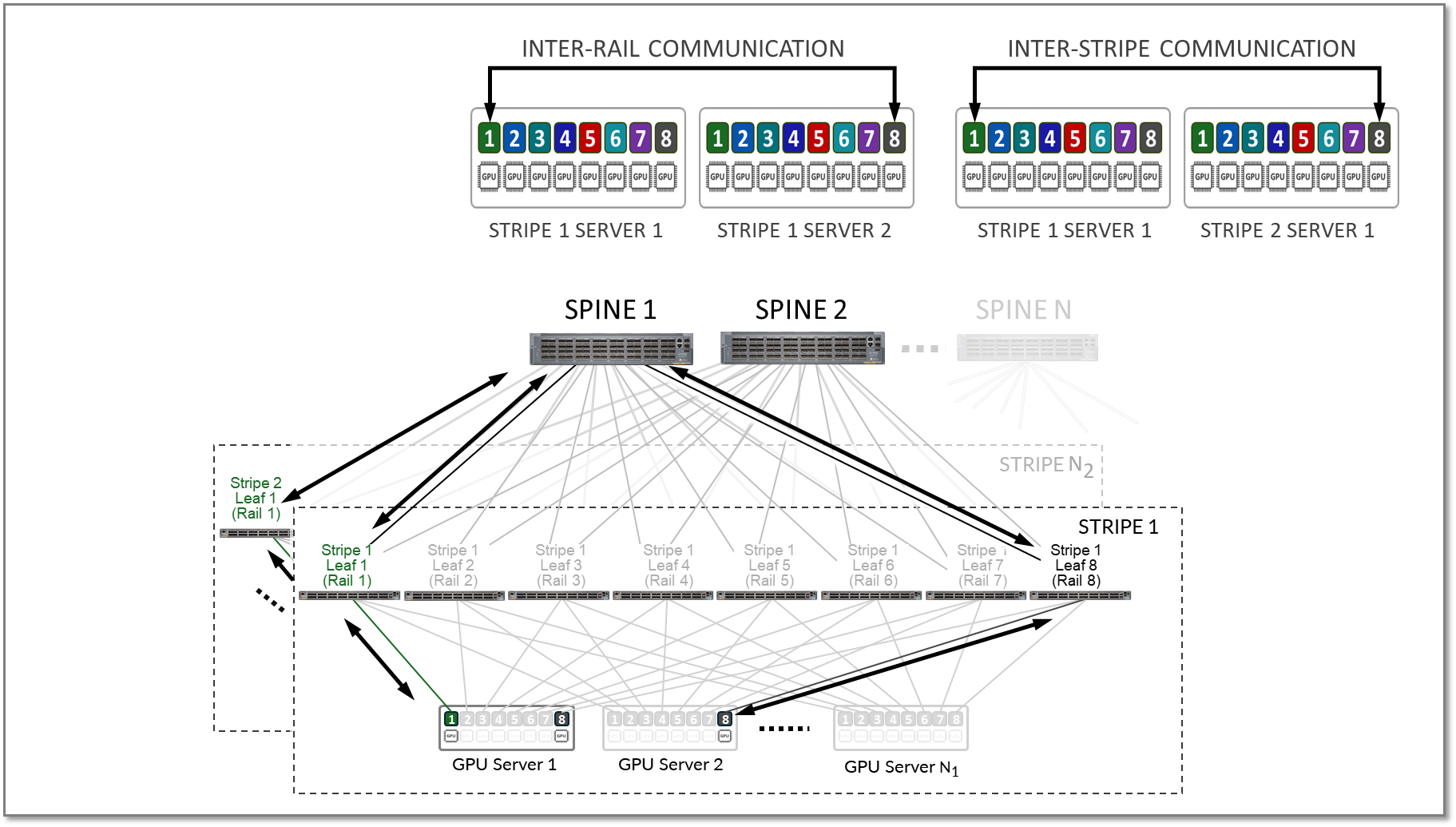
Both Inter-rail and inter-stripe traffic will be forwarded across the spines nodes as shown in figure 14.
Figure 14. Inter-rail, and Inter-stripe GPU to GPU traffic example.
Calculating the number of leaf and spine nodes, Servers, and GPUs in a rail optimized architecture
The number of leaf nodes in a single stripe in a rail optimized architecture is defined by the number of GPUs per server (number of rails). Each NVIDIA DGX H100 GPU server includes 8 NVIDIA H100 Tensor core GPUs. Therefore, a single stripe includes 8 leaf nodes (8 rails).
Number of leaf nodes = number of GPUs per server = 8
The maximum number of servers supported in a single stripe (N1) is defined by the number of available ports on the Leaf node which depends on the switches model.
The total bandwidth between the GPU servers and leaf nodes must match the total bandwidth between leaf and spine nodes to maintain a 1:1 subscription ratio.
Assuming all the interfaces on the leaf node operate at the same speed, half of the interfaces will be used to connect to the GPU servers, and the other half to connect to the spines. Thus, the maximum number of servers in a stripe is calculated as half the number of available ports on each leaf node.
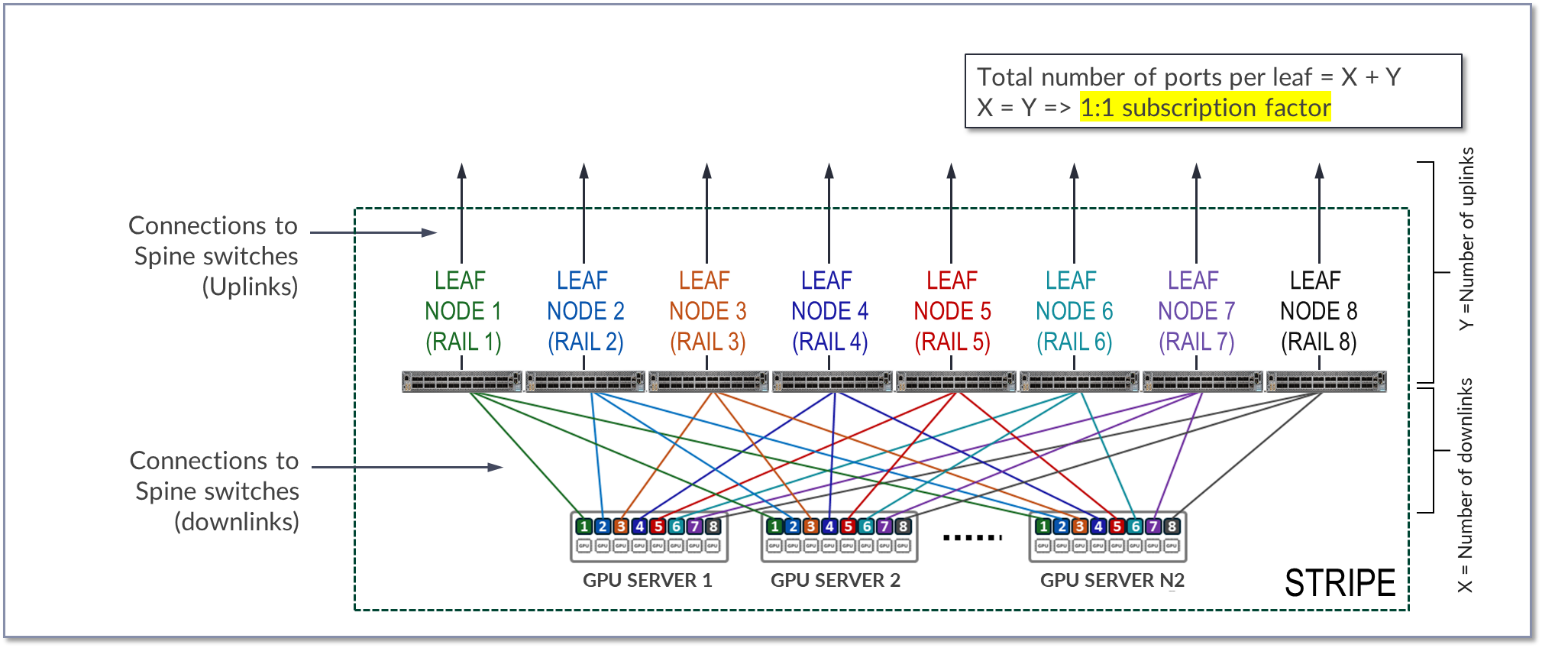
Figure 15. Number of uplinks and downlinks for 1:1 subscription factor
In the diagram, X represents the number of downlinks (links between leaf nodes and the GPU servers), while Y represents the number of uplinks (links between the leaf nodes and the spine nodes). To allow for a 1:1 subscription factor, X must be equal to Y.
The number of available ports on each leaf node is equal to X + Y or 2 * X.
Because all servers in a stripe have one port connected to every leaf in the stripe, the maximum number of servers in the stripe (N1) is equal X.
N1 (maximum number of servers per stripe) = number of available ports ÷ 2
The maximum number of GPUs in the stripe is calculated by simply multiplying the number of GPUs per server.
N2 (maximum number of GPUs) = N1 (maximum number of servers per stripe) * 8
The total number of available ports is dependent on the switch model used for the leaf node. Table 16 shows some examples.
Table 16: Maximum number of GPUs supported per stripe
|
Leaf Node QFX switch Model |
total number of available 400 GE ports per switch |
Maximum number of servers supported per stripe for 1:1 Subscription (N1) |
GPUs per server |
Maximum number of GPUs supported per stripe (N2) |
|---|---|---|---|---|
| QFX5220-32CD | 32 | 32 ÷ 2 = 16 | 8 | 16 servers x 8 GPUs/server = 128 GPUs |
| QFX5230-64CD | 64 | 64 ÷ 2 = 32 | 8 | 32 servers x 8 GPUs/server = 256 GPUs |
|
QFX5240-64OD QFX5241-64OD |
128 | 128 ÷ 2 = 64 | 8 | 64 servers x 8 GPUs/server = 512 GPUs |
- QFX5220-32CD switches provide 32 x 400 GE ports (16 will be used to connect to the servers and 16 will be used to connect to the spine nodes)
- QFX5230-64CD switches provide up to 64 x 400 GE ports (32 will be used to connect to the servers, and 32 will be used to connect to the spine nodes).
- QFX5240-64OD switches provide up to 128 x 400 GE ports (64 will be used to connect to the servers, and 64 will be used to connect to the spine nodes).
To achieve larger scales, multiple stripes (N3) can be connected using a set of Spine nodes (N4), as shown in Figure 10.
Figure 16: Multiple Stripes connected across Spine nodes.
The number of stripes required (N3 ) is calculated based on the required number of GPUs, and the maximum number of GPUs per stripe (N2).
For example, assume that the required number of GPUs (GPUs) is 16,000, and the fabric is using QFX5240-64OD as leaf nodes.
The number of available 400G ports is 128, which means that:
- the maximum number of servers per stripe (N1) = 64
- the maximum number of GPUs per stripe (N2) = 512
The number of stripes (N3) required is calculated by dividing the number of GPUs required, and the number of GPUs per stripe as shown:
N 3 (number of stripes) = GPUs ÷ N 2 (maximum number of GPUs per stripe) = 16000 ÷ 512 = 32 stripes (rounded up)
With 32 stripes & 64 servers per stripe, the cluster can provide 16,384 GPUs.
Knowing the number of stripes required (N 3) and the number of uplinks ports per leaf node (Y) you can calculate how many spine nodes are required.
Remember X = Y = N1
First the total number of leaf nodes can be calculated by multiplying the number of stripes required by 8 (number of leaf nodes per stripe).
Total number of leaf nodes = N3 x 8 = 32 x 8 = 256
Then the total number of uplinks can be obtained multiplying the number of uplinks per leaf node (N1), and the total number of leaf nodes.
Total number of uplinks = N1 x 256 = 64 x 256 = 16384
The number of spines required (N4 ) can then be determined by dividing the total number of uplinks by the number of available ports on each spine node, which as for the leaf nodes, depends on the switch model used for the spine role.
Number of spines required (N4 ) = 16384 / number of available ports on each spine node
For example, if the spine nodes are QFX5240/41, the number of available ports on each spine node is 128.
Table 17: Number of spines nodes for two stripes.
|
Spine Node QFX switch Model |
Maximum number of 400 GE interfaces per switch | Number of spines required (N4) with 32 stripes and 64 servers |
|---|---|---|
| QFX5240-64OD | 128 | 32768 ÷ 128 = 128 |
| PTX10008 LC1201 | 288 | 32768 ÷ 288 ~ 57 |
|
PTX10008 LC1301 |
576 | 32768 ÷ 576 ~ 29 |
Storage Backend Fabric
The Storage Backend fabric provides the connectivity infrastructure for storage devices to be accessible from the GPU servers.
The performance of the storage infrastructure significantly impacts the efficiency of AI workflows. A storage system that provides quick access to data can significantly reduce the amount of time for training AI models. Similarly, a storage system that supports efficient data querying and indexing can minimize the completion time of preprocessing and feature extraction in an AI workflow.
In small clusters, it may be sufficient to use the local storage on each GPU server, or to aggregate this storage together using open-source or commercial software. In larger clusters with heavier workloads, an external dedicated storage system is required to provide dataset staging for ingest, and for cluster checkpointing during training.
Two leading platforms, WEKA and Vast Storage, provide cutting-edge solutions for shared storage in GPU environments. While we have tested both solutions in our lab, this JVD focuses on the Weka Storage Solution. Thus, the rest of this, as well as other sections in this document, will cover details about Weka Storage devices and connectivity to the Storage Backend Fabric.
Details about the Vast storage are included in the AI Data Center Network with Juniper Apstra, AMD GPUs, Broadcom NIC, AMD Pollara NIC, and Vast Storage—Juniper Validated Design (JVD).
The Storage Backend fabric design in the JVD also follows a 3-stage IP clos architecture as shown in Figure 17. There is no concept of rail-optimization in a storage cluster. Each GPU server has a single connection to the leaf nodes, instead of one per GPU.
Figure 17: Storage Backend Fabric Architecture
The number of leaf nodes depends on the GPU number of servers and storage devices in the AI cluster.
The number of spine nodes is dependent on the subscription factor desired for the design. Like the GPU Backend Fabric, the Storage Fabric requires a non-oversubscribed design (1:1 subscription factor) to ensure sufficient bandwidth for the high volume traffic, and to prevent congestion, packet loss and excessive latency.
Storage traffic can use different transport mechanisms, including NFS, POSIX, and RoCEv2. For RoCEv2 the same Load Balancing and Class of Service mechanisms described for the GPU Backend fabric must be implemented. These are described in the Load Balancing and Congestion Management sections of this document.
The devices and connectivity in the Storage fabric validated in this JVD are summarized in the following tables:
Table 18: Validated Storage Fabric leaf and spine nodes
| Storage Fabric Leaf Nodes switch model | Storage Fabric Spine Nodes switch model |
|---|---|
| QFX5130-32CD | QFX5130-32CD |
| QFX5220-32CD | QFX5220-32CD |
| QFX5230-32CD | QFX5230-32CD |
| QFX5230-64CD | QFX5230-64CD |
| QFX5240-64OD | QFX5240-64OD |
Table 19: Validated connections between GPU servers, and storage devices, and leaf nodes in the Storage Fabric
| Links per GPU server to leaf connection | Server Type |
|---|---|
| 1 x 100GE | NVIDIA A100 |
| 1 x 100GE | NVIDIA H100 |
| 1 x 200GE | WEKA |
Table 20: Validated connections between leaf and spine nodes in the Storage Fabric
| Links per leaf and spine connection | Leaf node model | spine node model |
|---|---|---|
| 2 x 400GE, 3 x 400GE | QFX5130-32CD | QFX5130-32CD |
| 2 x 400GE, 3 x 400GE | QFX5130-32CD | QFX5130-32CD |
| 2 x 400GE, 3 x 400GE |
QFX5240-32CD QFX5241-32CD |
QFX5240-32CD QFX5241-32CD |
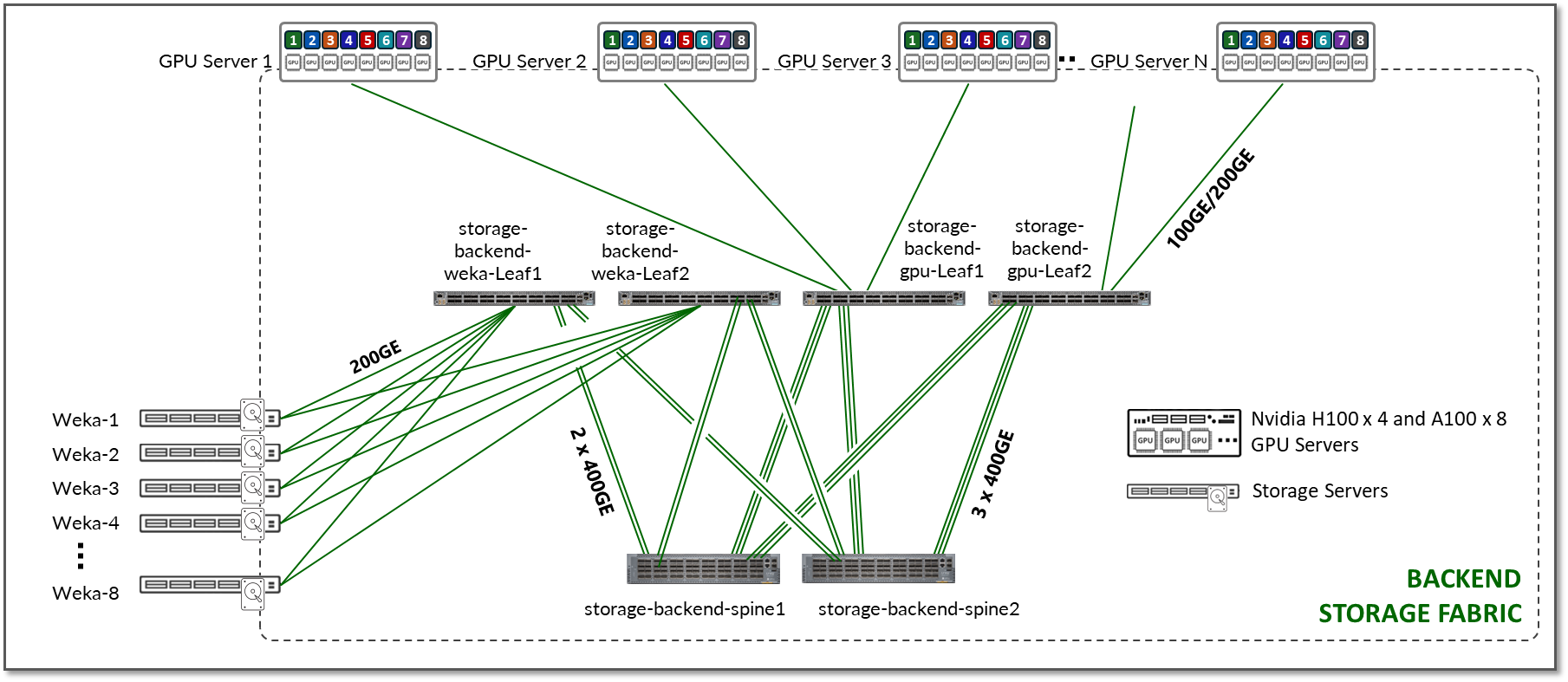
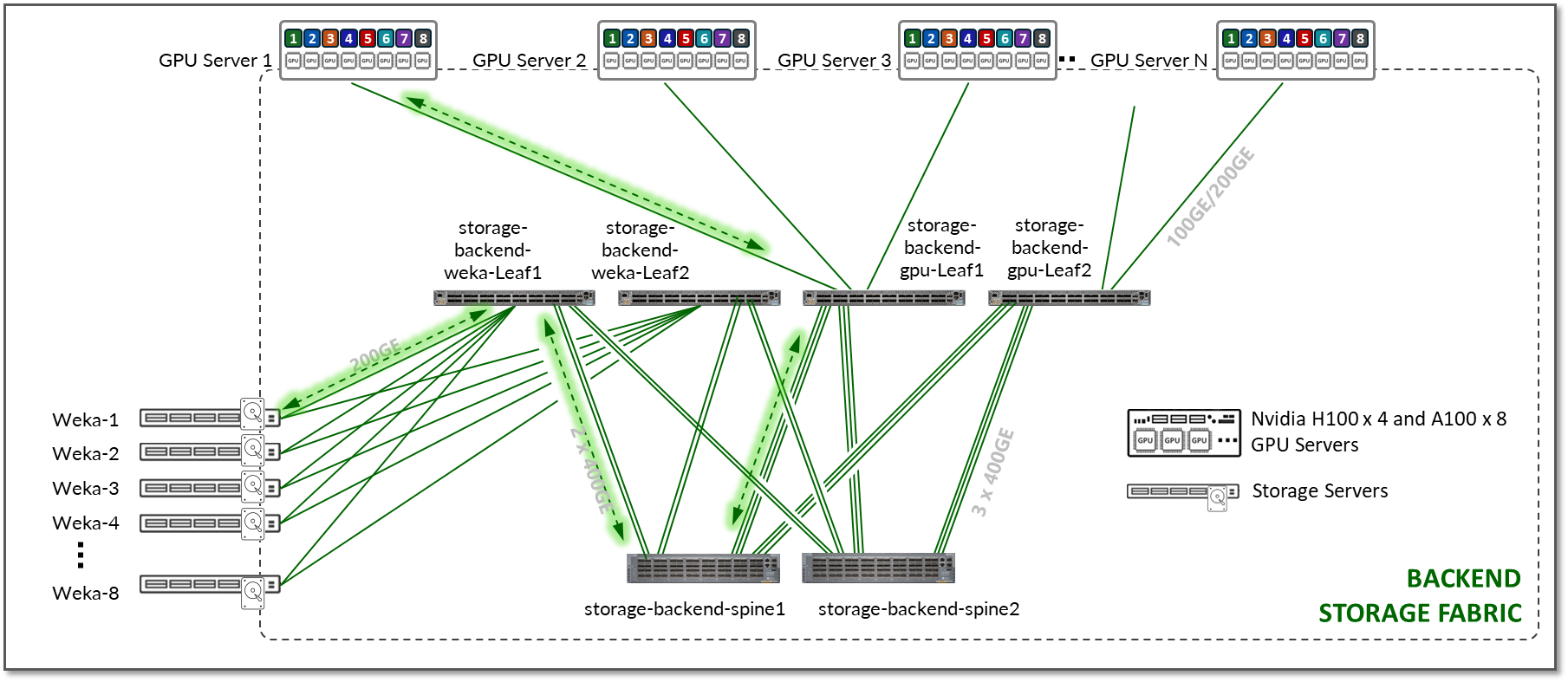
Testing for this JVD was performed using 8 NVIDIA A100 GPU servers, 4 NVIDIA H100 GPU servers, and 8 WEKA storage devices connected to 4 leaf nodes, which in turn were connected to 2 spine nodes as shown in Figure 18.
Figure 18: Storage Fabric JVD Testing Topology
- Each Nvidia A100 server is connected to the Leaf nodes using 200G interfaces (ConnectX-7 NICs).
- Each Nvidia H100 server is connected to the Leaf nodes using 400G interfaces (ConnectX-7 NICs).
- Each Weka device
Table 21: Aggregate Storage Link Counts and bandwidth tested
| GPU Servers <=> Storage Leaf Nodes | Storage Leaf Nodes <=> Frontend Spine Nodes |
|---|---|
|
Total number of 400GE links between frontend leaf nodes and spine nodes = 20 (2-3 links per leaf to spine connection) |
| Total bandwidth = 5.6 Tbps | Total bandwidth = 6.4 Tbps |
| No oversubscription. |
GPU Backend Fabric Scaling
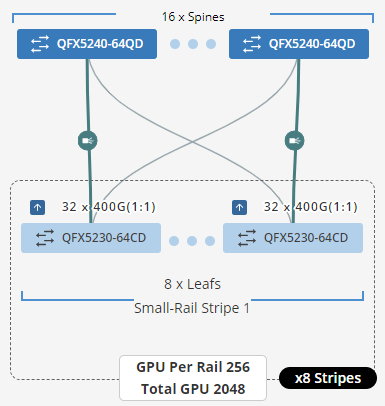
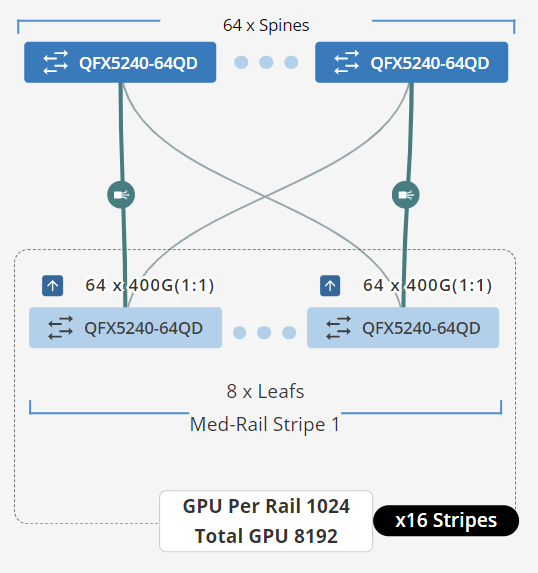
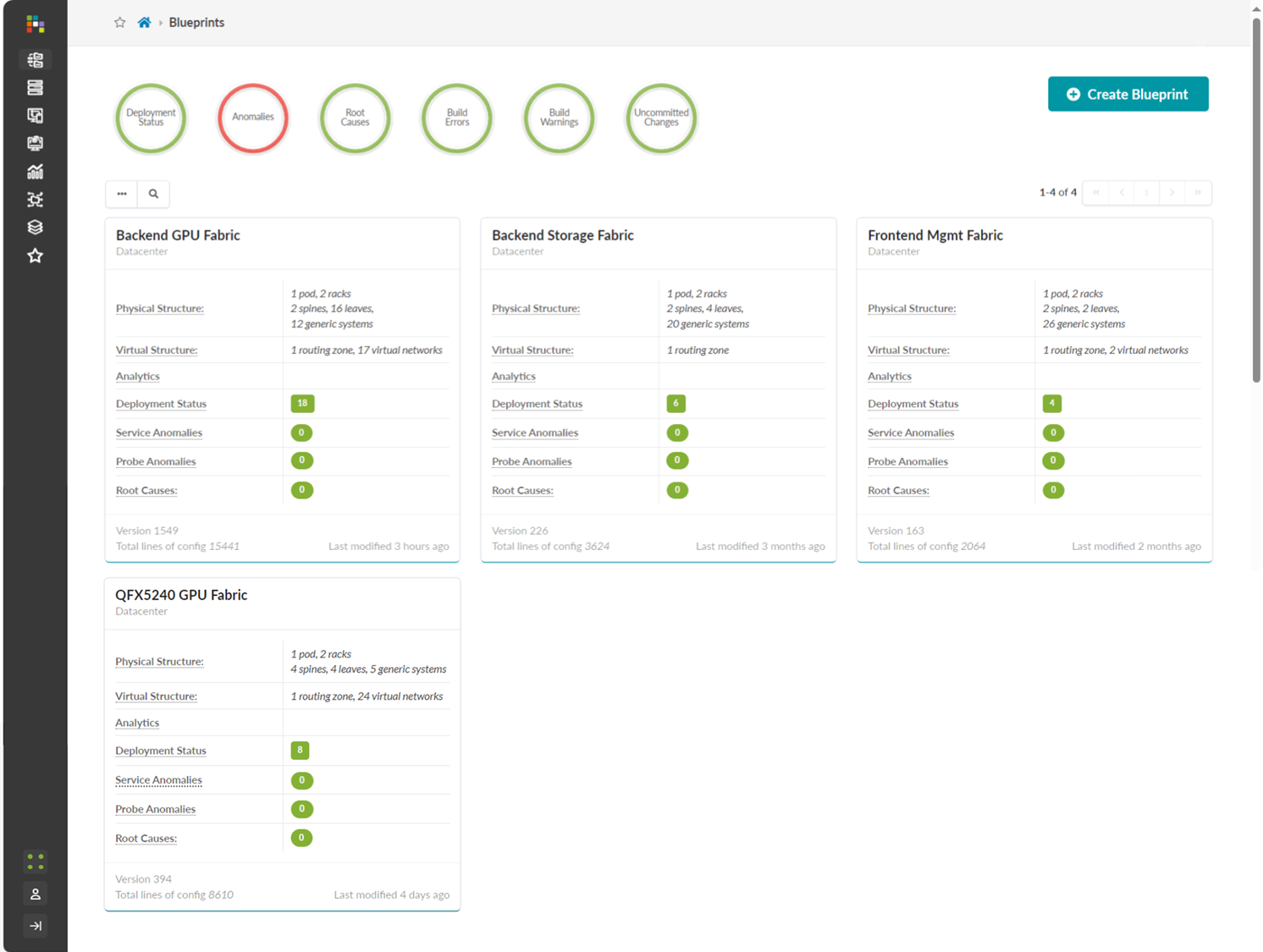
The size of an AI cluster varies significantly depending on the specific requirements of the workload. The number of nodes in an AI cluster is influenced by factors such as the complexity of the machine learning models, the size of the datasets, the desired training speed, and the available budget. The number varies from a small cluster with less than 100 nodes to a data center-wide cluster comprising 10000s of compute, storage, and networking nodes. A minimum of 4 spines must always be deployed for path diversity and reduction of PFC failure paths.
Table 22: Fabric Scaling - Devices and Positioning
| Small | Medium | Large |
|---|---|---|
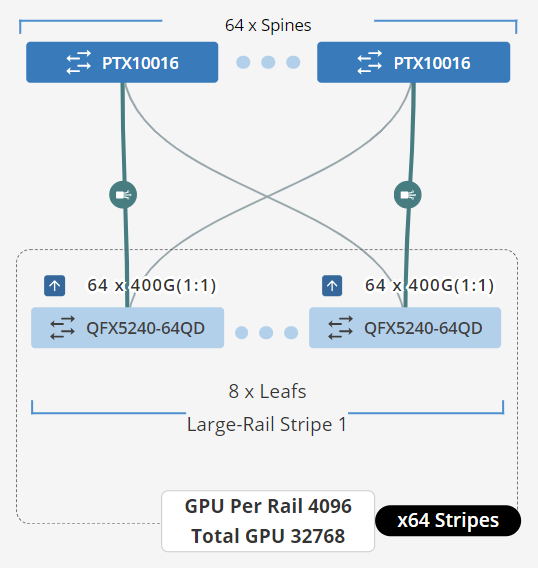
| 64 – 2048 GPU | 2048 – 8192 GPU | 8192 – 32768 GPU |
| With support for up to 2048 GPUs, the Juniper QFX5240-64CD/QFX5240-64OD/QD or QFX5230-64CD can be used as Spine and leaf devices to support single or dual-stripe applications. To follow best practice recommendations, a minimum of 4 Spines should be deployed, even in a single-stripe fabric. | With support for 2048 – 8192 GPUs, the Juniper QFX5240-64CD/QFX5240-64OD/QD can be used as Spine and leaf devices to achieve appropriate scale. This 3-stage, rail-based fabric design provides physical connectivity to 16 Stripes from 64 Spines and 1024 leaf nodes, maintaining a 1:1 subscription throughput model. | For infrastructures supporting more than 8192 GPUs, the Juniper PTX1000x Chassis spine and QFX5240-64CD/QFX5240-64OD/QD leaf nodes can support up to 32768 GPUs. This 3-stage, rail-based fabric design provides physical connectivity to 64 Stripes from 64 Spines and 4096 leaf nodes, maintaining a 1:1 subscription throughput model. |
|
|
|
Juniper Hardware and Software Components
For this solution design, the Juniper products and software versions are below. The design documented in this JVD is considered the baseline representation for the validated solution. As part of a complete solutions suite, we routinely swap hardware devices with other models during iterative use case testing. Each switch platform validated in this document goes through the same rigorous role-based testing using specified versions of Junos OS and Apstra management software.
Validated Juniper Hardware and Software Solution Components
The following table summarizes the validated Juniper devices for this JVD, and includes devices tested for AI Data Center Network with Juniper Apstra, AMD GPUs, and Vast Storage—Juniper Validated Design (JVD)
Table 23: Validated Devices and Positioning
| DEVICE | FRONTEND FABRIC | GPU BACKEND FABRIC | STORAGE FABRIC | |||
|---|---|---|---|---|---|---|
| LEAF | SPINE | LEAF | SPINE | LEAF | SPINE | |
| QFX5130-32CD | X | X | X | X | ||
| QFX5220-32CD | X | X | X | X | X | |
| QFX5230-32CD | X | X | X | |||
| QFX5230-64CD | X | X | X | X | ||
| QFX5240-64OD | X | X | X | X | ||
| QFX5241-64OD | X | X | X | X | ||
| PTX10008 JNP10K-LC1201 | X | |||||
| PTX10008 JNP10K-LC1301 | X | |||||
Juniper Software Components
The following table summarizes the software versions tested and validated by role.
Table 24: Platform Recommended Release
| Platform | Role | Junos OS Release |
|---|---|---|
| QFX5240-64CD | GPU Backend Leaf | 23.4X100-D20 |
| QFX5240-64OD/QD | GPU Backend Spine | 23.4X100-D42 |
| QFX5220-32CD | GPU Backend Leaf | 23.4X100-D20 |
| QFX5230-64CD | GPU Backend Leaf | 23.4X100-D20 |
| QFX5240-64CD | GPU Backend Spine | 23.4X100-D20 |
| QFX5240-64OD/QD | GPU Backend Spine | 23.4X100-D42 |
| QFX5230-64CD | GPU Backend Spine | 23.4X100-D20 |
| PTX10008 with LC1201 | GPU Backend Spine | 23.4R2-S3 |
| QFX5130-32CD | Frontend Leaf | 23.43R2-S3 |
| QFX5130-32CD | Frontend Spine | 23.43R2-S3 |
| QFX5220-32CD | Storage Backend Leaf | 23.4X100-D20 |
| QFX5230-64CD | Storage Backend Leaf | 23.4X100-D20 |
| QFX5240-64CD | Storage Backend Leaf | 23.4X100-D20 |
| QFX5240-64OD/QD | Storage Backend Leaf | 23.4X100-D42 |
| QFX5220-32CD | Storage Backend Spine | 23.4X100-D20 |
| QFX5230-64CD | Storage Backend Spine | 23.4X100-D20 |
| QFX5240-64CD | Storage Backend Spine | 23.4X100-D20 |
| QFX5240-64OD/QD | Storage Backend Spine | 23.4X100-D42 |