
Solution Benefits
Stock exchange networks are among the most latency-sensitive and performance-critical environments. The network must meet stringent requirements to ensure fair, deterministic, and ultra-fast trade execution. Key requirements include:
- Low Latency:
- The stock exchange network must support the lowest possible latency between trading endpoints to maintain competitiveness and avoid arbitrage disadvantages.
- Deterministic Packet Delivery:
- Consistent packet forwarding paths are essential. Variability in path selection, such as through ECMP or load balancing, must be minimized or tightly controlled to avoid unpredictable delays and packet reordering.
- Zero Packet Loss:
- Loss of packets is unacceptable, as it can result in missed trades or inaccurate data. Lossless Ethernet configurations (e.g., Priority Flow Control and Explicit Congestion Notification) are often used.
- No Packet Reordering:
- Packets must arrive in order, particularly for multicast market data and transactional traffic. Reordering can cause trade mismatches or force retransmissions, adding latency.
- High Availability and Redundancy:
- The network must offer continuous uptime through redundant paths, devices, and failover mechanisms. Failovers should be sub-second and ideally hitless.
- Security and Segmentation:
- The network must provide strict isolation between tenants, trading firms, and services, with robust access control and monitoring.
- Scalability and Performance Monitoring:
- As trading volume grows, the infrastructure must be scaled without performance degradation. Real-time telemetry and analytics are needed to monitor jitter, delay, and packet drops.
- Platform Uniformity:
- Using consistent hardware and software platforms helps minimize behavioral differences. For example, in hashing or queuing issues like packet reordering or jitter are reduced.
By implementing advanced networking technologies, EWAN Stock Exchange creates a robust, intelligent network infrastructure capable of handling the most demanding financial transaction environments.
Enterprise WAN of Financial and Stock Exchange JVD considers the following customer reference architectures from engagements with individual customers, account teams, and SE leads. Under consideration includes the infrastructure selection, architecture design implementation and/or concepts, transport underlays, service overlays, and overall solution goals. Customer use cases are strictly confidential!
- APAC Stock Exchange
- EMEA Stock Exchange
The data center network of EWAN Stock Exchange is built on the reference model below ( Figure 1 ) which is categorized into three layers, namely:
- WAN Edges [Rendezvous Point] First Hop Router from Multicast Source.
- Access Point [Far End PEs]
- Access layer [Customer Routers]
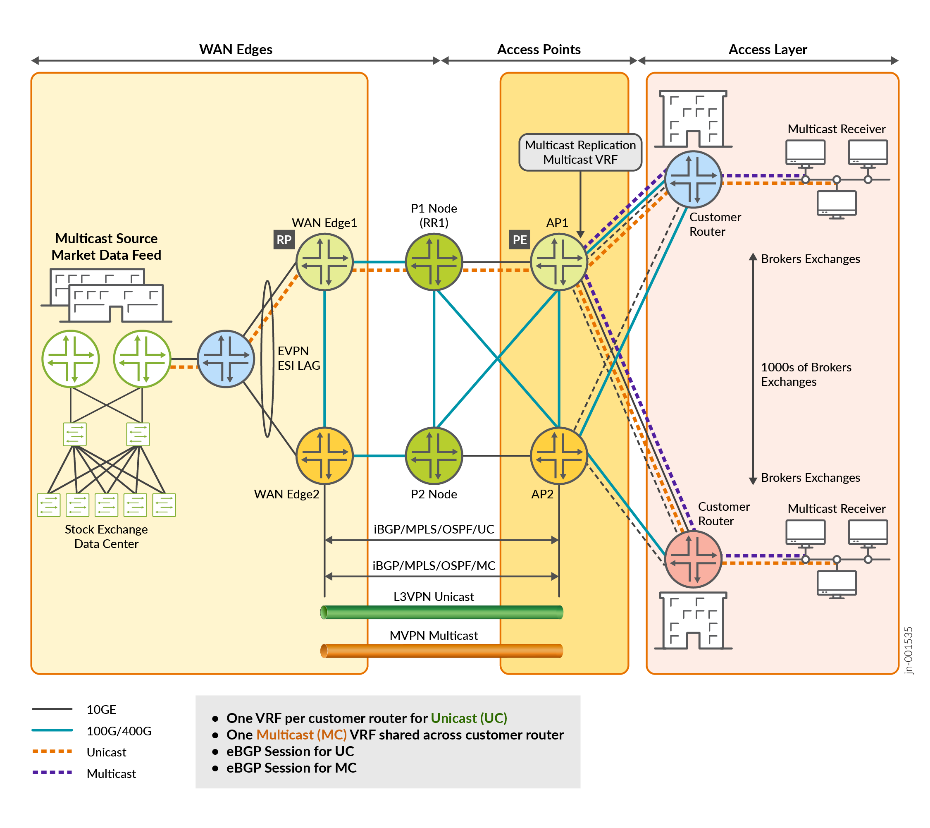
In this JVD, the next generation of ACX and MX platforms is introduced to support the 100G access segment. The ACX7100-48L serves as the Customer Router (CR1), while the MX480 functions as Customer Router (CR2). The MX304 platforms act as Provider Edge (PE) devices positioned at WAN Edge 1 and Access Point 1 (AP1). Additionally, the MX10004 is deployed in the Provider Edge (WAN Edge 2) role, and the MX10008 serves as a Provider Edge (PE) representing the Access Point 2 (AP2) function.
For detailed topology and device placement, see Figure 1 , which illustrates the specific roles and interconnections of these platforms within the 100G access and transport architecture.