
Understanding Hierarchical CoS for Subscriber Interfaces
Hierarchical CoS enables you to apply traffic scheduling and queuing parameters and packet transmission scheduling parameters to an individual subscriber interface rather than to all interfaces configured on a port. Hierarchical CoS enables you to dynamically modify queues when subscribers require services.
Interfaces support up to a five-level CoS scheduling hierarchy that, when fully configured, generally consists of the physical interface (level 1), an interface set or underlying interface (level 2), one or more underlying logical interfaces (level 3), one or more session or customer VLANs (level 4), and one or more queues (level 5). Hierarchical scheduling configurations consist of the type of interfaces you configure—for example, a logical interface or an interface set—and where those interfaces reside in the scheduling hierarchy—level 2, level 3, or level 4. Because many hierarchical scheduling configurations are possible, we use the terms two-level hierarchical scheduling, three-level hierarchical scheduling, four-level hierarchical scheduling in this topic.
Two-Level Hierarchical Scheduling
Two-level hierarchical scheduling limits the number of hierarchical levels in the scheduling hierarchy to two as shown in Figure 1. In this configuration, interface sets are not configured and only the logical interfaces have traffic control profiles (TCPs). Configuring two levels of hierarchy on MPCs that support more levels preserves resources and allows the system to scale higher.
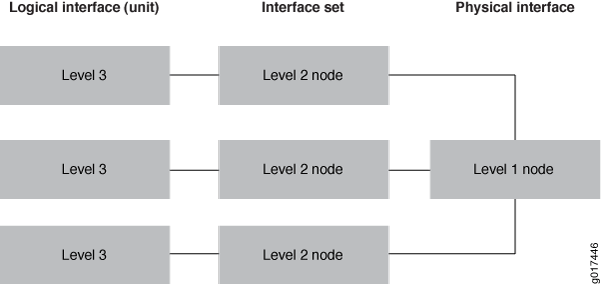
In a two-level scheduling hierarchy, all logical interfaces and interface sets share a single node; no hierarchical relationship is formed.
You control two-level hierarchical scheduling by setting the
maximum-hierarchy-levels option under the [edit interfaces
interface-name hierarchical-scheduler] hierarchy to
2:
-
If the
maximum-hierarchy-levelsoption is not set, then interface sets can be at either level 2 or level 3, depending on whether the member logical interfaces within the interface set have a traffic control profile. -
If any member logical interface has a traffic-control profile, then the interface set is always a level 2 CoS scheduler node.
-
If no member logical interface has a traffic-control profile, the interface set is always a level 3 CoS scheduler node.
-
If the
maximum-hierarchy-levelsoption is set, then the interface set can only be at level 3; it cannot be at level 2. In this case, if you configure a level 2 interface set, you generate Packet Forwarding Engine errors.
Table 1 summarizes the interface hierarchy and the CoS scheduler node levels for two-level hierarchical scheduling.
|
Level 1 |
Level 2 |
Level 3 |
|---|---|---|
|
Physical interface |
Logical interface |
One or more queues |
|
Physical interface |
Interface set |
One or more queues |
To configure two-level hierarchical scheduling, include the
hierarchical-scheduler statement at the [edit interfaces
interface-name] hierarchy level and set the
maximum-hierarchy-levels option to 2.
[edit interfaces]
interface-name {
    hierarchical-scheduler {
        maximum-hierarchy-levels 2;
    }
}
Three-Level Hierarchical Scheduling
Three-level hierarchical scheduling supports up to eight CoS queues. You can configure many different three-level scheduling hierarchies, depending on the location of the interface set or the use of underlying interfaces. In all variations, the physical interface is a level 1 CoS scheduler node and the queues reside at the highest level. Configuring three levels of hierarchy on MPCs that support more levels preserves resources and allows the system to scale higher.
When you use three-level hierarchical scheduling, interface sets can reside at either level 3 or level 4. You can also configure an underlying logical interface at level 3 and a logical interface at level 4. Table 2 summarizes the most common cases of the interface hierarchy and the CoS scheduler node levels for three-level hierarchical scheduling.
|
Level 1 |
Level 2 |
Level 3 |
Level 4 |
|---|---|---|---|
|
Physical interface |
Interface set |
Logical interface |
One or more queues |
|
Physical interface |
Logical interface |
Interface set |
One or more queues |
|
Physical interface |
Underlying logical interface |
Logical interface |
One or more queues |
In three-level hierarchical scheduling, the CoS scheduler nodes at level 1, level 2, and level 3 form a hierarchical relationship.
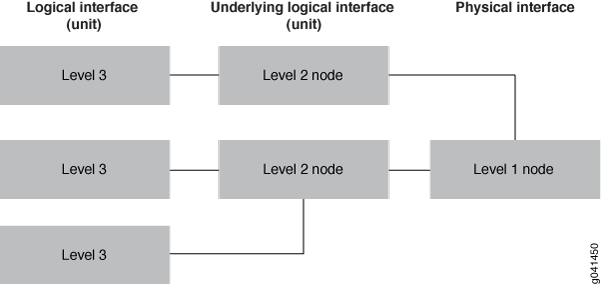
With a three-level hierarchical scheduling, logical interfaces can reside at level 2, or they can reside at level 3 if the logical interface at level 2 is an underlying logical interface. This is shown in Figure 2.
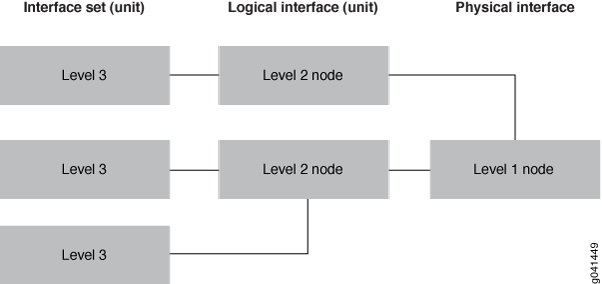
Another possible configuration for three-level hierarchical scheduling is shown in Figure 3. In this configuration, the logical interfaces are located at level 2 and the interface sets are located at level 3.
To configure three-level hierarchical scheduling, include the
implicit-hierarchy option at the [edit interfaces
interface-name hierarchical-scheduler] hierarchy level
and optionally set the maximum-hierarchy-levels option to
3. (The default value for maximum-hierarchy-levels
is 3.)
[edit interfaces]
interface-name {
    hierarchical-scheduler {
        implicit-hierarchy;
        maximum-hierarchy-levels 3;
    }
}
Interface Hierarchy Versus CoS Hierarchy
An interface hierarchy and a CoS scheduling hierarchy are distinctly different.
Interface hierarchy refers to the relationship between the various interfaces—for
example, the relationship between logical interfaces and an interface set, the
relationship between a logical interface and an underlying logical interface, or the
relationship between the physical interface and the logical interface. CoS scheduling
hierarchy refers to the hierarchical relationship between the CoS scheduler nodes. In
two-level hierarchical scheduling, no hierarchy is formed between the CoS scheduler
nodes—the logical interface and interface set share a single level 2 scheduler node.
However, when you use the implicit-hierarchy option for three-level
hierarchical scheduling, the CoS scheduler nodes form a scheduling hierarchy.
Figure 4 and Figure 5 provide two scenarios for this discussion. Figure 4 shows an interface hierarchy where a Gigabit Ethernet interface (ge-1/0/0) is the physical interface. Two logical interfaces (ge-1/0/0.100 and ge-1/0/0.101) are configured on the physical interface:
-
Logical interface ge-1/0/0.100 is a member of a PPPoE interface set and a Demux interface set.
-
Logical interface ge-1/0/0.101 is a member of a demux interface set.
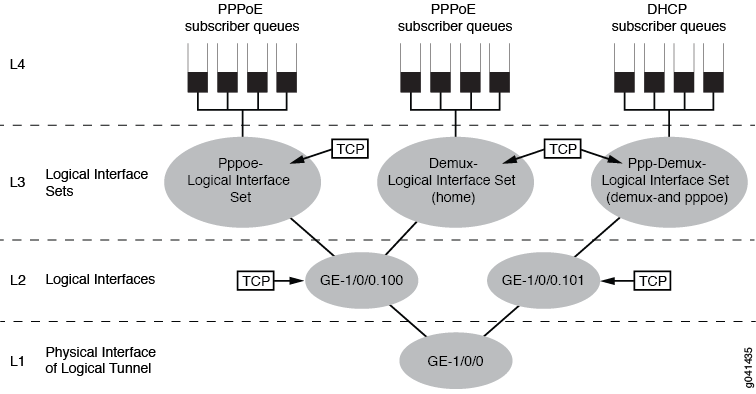
Each interface set has a dedicated queue. The CoS scheduler nodes at level 1 (physical interface), level 2 (underlying logical interfaces), and level 3 (interface sets) form a scheduling hierarchy.
To configure this scenario, you must include the implicit-hierarchy
option under the hierarchical-scheduler statement on physical
interface ge-1/0/0 and configure and apply traffic-control profiles on each interface
set and underlying logical interface.
Figure 5 shows an interface hierarchy where Gigabit Ethernet interface ge-1/0/0 is the physical interface. Three logical interfaces are configured:
-
Two logical interfaces (Pp0.100 and Demux0.100) reside on the underlying logical interface ge-1/0/0.100.
-
A third logical interface (Pp0.101) resides on the underlying logical interface ge-1/0/0.101.
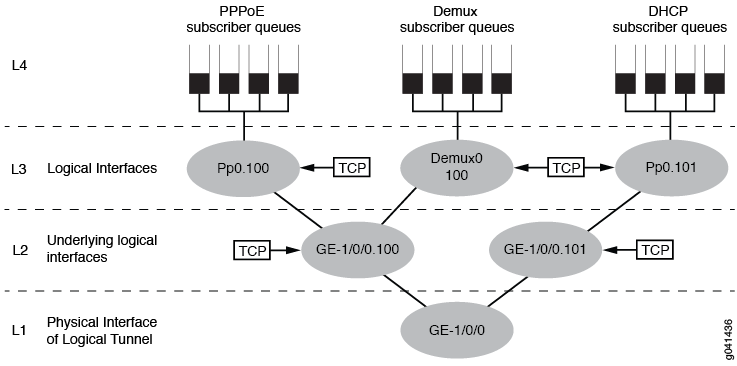
Each logical interface has a dedicated queue. The CoS scheduler nodes at level 1 (physical interface), level 2 (underlying logical interfaces), and level 3 (logical interfaces) form a scheduling hierarchy.
To configure this scenario, you must include the implicit-hierarchy
option under the hierarchical-scheduler statement on physical
interface GE-1/0/0 and configure and apply traffic-control profiles on each logical
interface and underlying logical interface.
You can configure many different three-level scheduling hierarchies; Figure 4 and Figure 5 present just two possible scenarios. Table 2 summarizes the possible interface locations and CoS scheduler nodes.
Four-Level Hierarchical Scheduling
Four-level hierarchical scheduling supports up to eight class of service queues. In four-level scheduling hierarchies, the physical interface is a level 1 CoS scheduler node and the queues reside at level 5.
Four-level hierarchical scheduling is not supported on agent circuit identifier (ACI) or aggregated Ethernet (AE) interfaces.
When you use four-level hierarchical scheduling, interface sets reside at levels 2 and 3 and logical interfaces reside at levels 3 and 4. Table 3 summarizes the most common case of the interface hierarchy and the CoS scheduler node levels for four-level hierarchical scheduling.
|
Level 1 |
Level 2 |
Level 3 |
Level 4 |
Level 5 |
|---|---|---|---|---|
|
Physical interface |
Interface set |
Customer VLAN (C-VLAN) |
Session Logical Interface (ppp or dhcp) |
One or more queues |
In four-level hierarchical scheduling, the CoS scheduler nodes at level 1, level 2, level 3, and level 4 form a hierarchical relationship.
To configure four-level hierarchical scheduling, include the
implicit-hierarchy option at the [edit interfaces
interface-name hierarchical-scheduler] hierarchy level
and set the maximum-hierarchy-levels option to 4.
[edit interfaces]
interface-name {
    hierarchical-scheduler {
        implicit-hierarchy;
        maximum-hierarchy-levels 4;
    }
}
Change History Table
Feature support is determined by the platform and release you are using. Use Feature Explorer to determine if a feature is supported on your platform.