
ON THIS PAGE
SRv6 Network Programming for AI-ML Data Centers
Overview
SRv6 Network Programming Overview
Network programming is the capability of a network to encode a network program into individual network instructions that are then inserted into the IPv6 packet headers. The IPv6 packet carrying the network instructions explicitly tells the network about the precise SRv6 nodes available for packet processing. The network instruction is the SRv6 SID that is represented by a 128-bit IPv6 address. The SIDs are distributed through the network in the IPv6 packet headers. I Along with the addressing, network instructions define a particular task or function for each SRv6-capable node in the SRv6 network.
You can configure segment routing in a core IPv6 network without an MPLS data plane on MX Series devices with MPC7E, MPC8E and MPC9E line cards.
This feature is useful for service providers whose networks are predominantly IPv6 and have not deployed MPLS. Such networks depend only on IPv6 headers and header extensions for transmitting data. This feature also benefits networks that need to deploy segment routing traffic through transit routers that do not have segment routing capability yet. In such networks, the SRv6 network programming feature can provide flexibility to leverage segment routing without deploying MPLS.
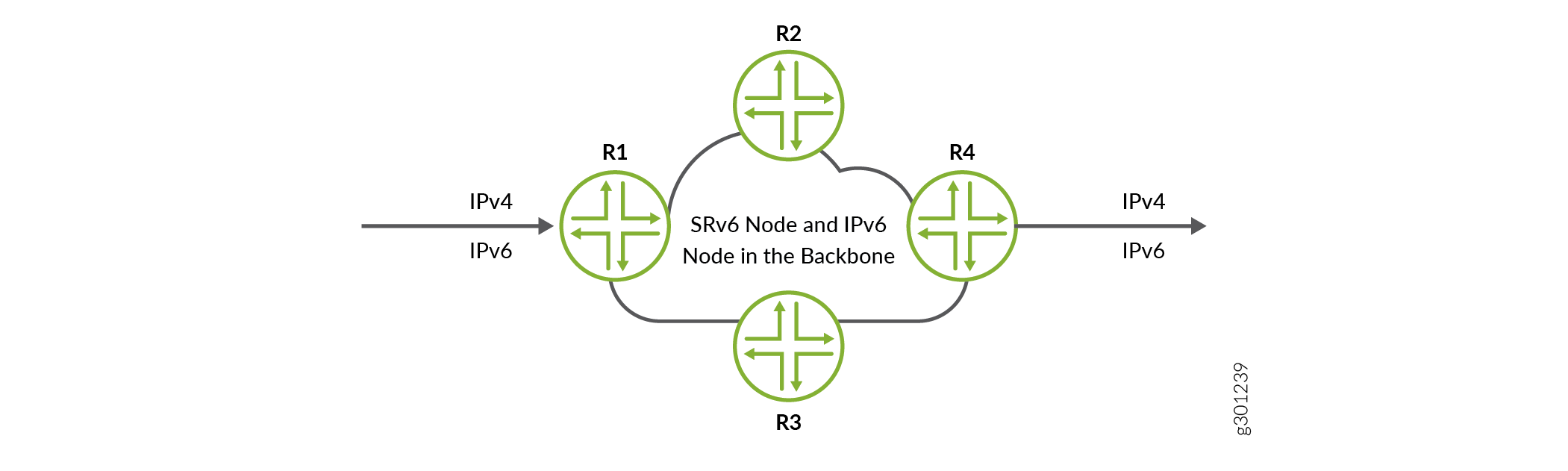
Topology
This figure shows a generic SRv6 topology for conceptual reference. AI-ML data center deployments typically use a Clos fabric topology.
Benefits of SRv6 Network Programming
SRv6 network programming provides the following benefits in an IPv6 network:
-
Seamless deployment: Network programming depends entirely on the IPv6 header and the header extension to transport a packet, eliminating protocols such as MPLS. This eases deployment without the need for any major hardware or software upgrade in a core IPv6 network.
-
Flexible deployment:An SRv6 ingress node can transport packets even if transit routers aren't SRv6-capable. This eliminates the need to deploy segment routing on all nodes in an IPv6 network.
-
Single-device versatality: Junos OS supports multiple functions on a single segment identifier (SID) and can inter-operate in the insert mode and the encapsulation mode. This allows a single device to simultaneously perform the provider (P) router and the provider edge (PE) router roles.
More Information
For more information, see the following:
-
RFC draft-filsfils-srv6ops-srv6-ai-backend-03, SRv6 for Deterministic Path Placement in AI Backends
-
RFC draft-hss-bgp-srv6-routing-planes-00.txt, BGP based SRv6 Routing Planes for DC network
Limitations
The following limitations apply to SRv6 network programming in AI-ML data center deployments:
-
Configurations related to
srv6-adjacency-segmentand theflavor uspoption are not supported. -
End SID functions that require the USP flavor are not supported.
-
Functions that require two-pass packet processing (PFE recirculation) are not supported. This includes standard SIDs beyond four and End.DT SIDs with USP flavor.
-
TI-LFA use cases that require USP are not supported.
-
SRv6 statistics are not supported.
-
Reduced mode is supported only globally and is not supported on a per-locator basis.
Configuration
For AI-ML data center deployments, the srv6-adjacency-segment
configuration and flavor usp option are not supported. Do not
use these statements in the referenced configuration examples. The referenced
configuration examples include these statements; do not use them when
configuring the feature.
To configure this feature, see: