Help us improve your experience.

Let us know what you think.

Do you have time for a two-minute survey?


Create Generic System

Systems that are not managed by Apstra, like external routers and firewalls, are called generic systems. You specify their roles with tags. If the system is part of a rack topology we call it a generic system.

Add Generic System (from Topology View)

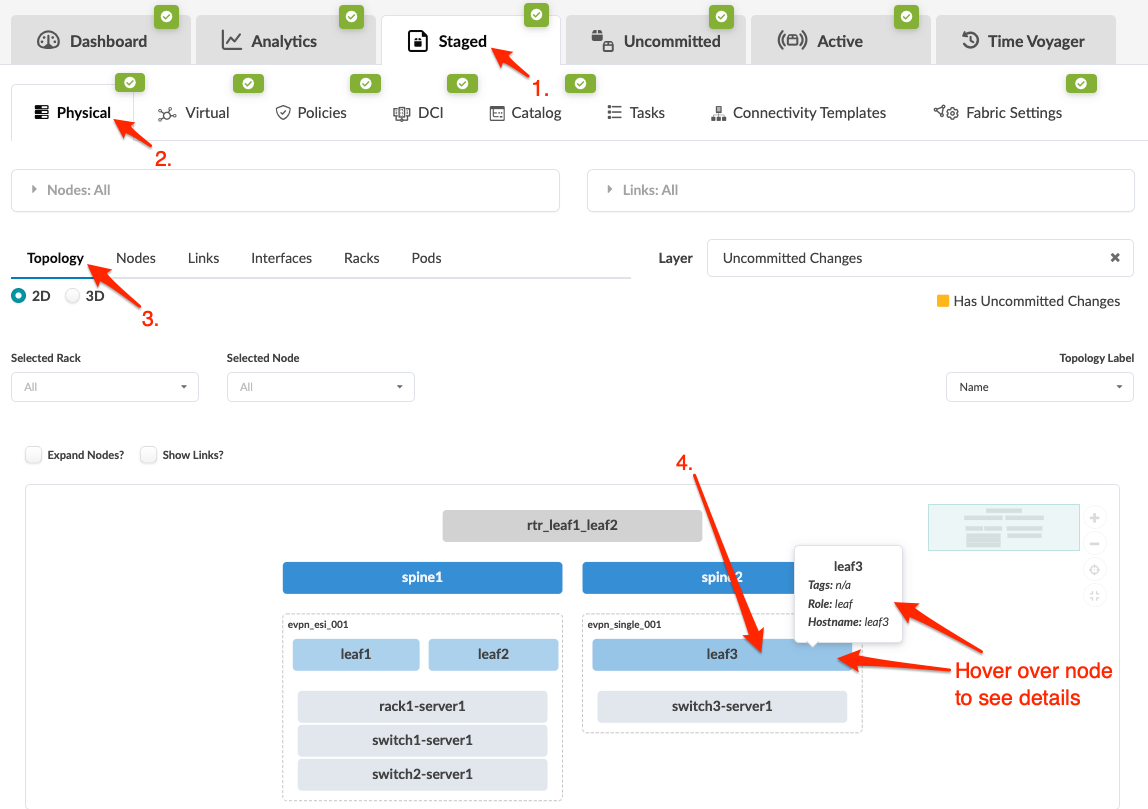
  1. From the blueprint, navigate to Staged > Physical > Topology and select the leaf or access switch to connect to the new generic system.
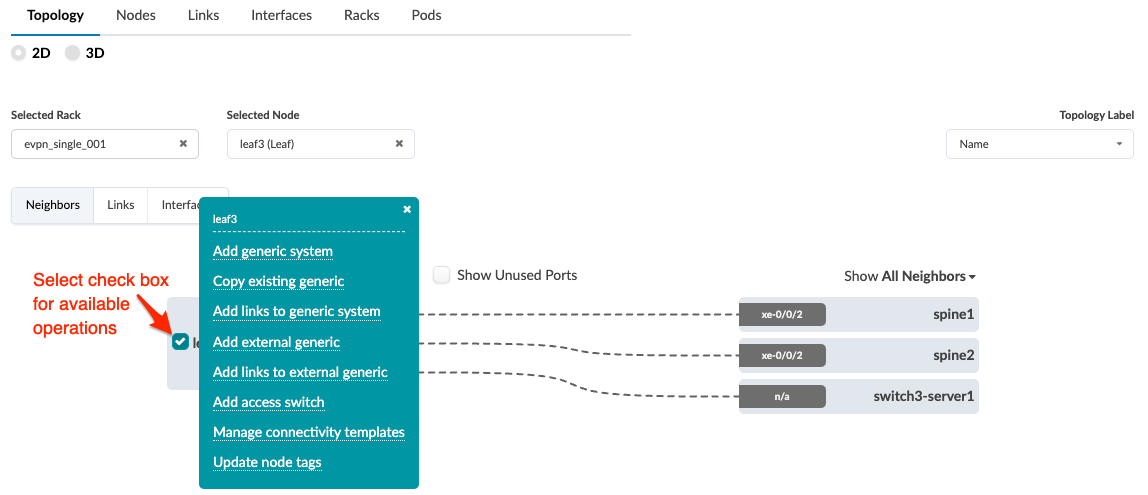
  2. Select the node check box to see the operations available for that node (and that you have permissions for). (Image below is for Apstra version 4.2.0.)
    Note:

    You can also get to the selection page from the Nodes view. From the blueprint, navigate to Staged > Physical > Nodes, click the node name in the table, then click the node name that appears at the top of the Selection panel (on the right side of the page).

  3. If you're using Apstra version 4.2.0, click Add generic system. If you're using Apstra version 4.2.1, click Add internal/external generic system as shown in the 4.2.1 screenshot below.
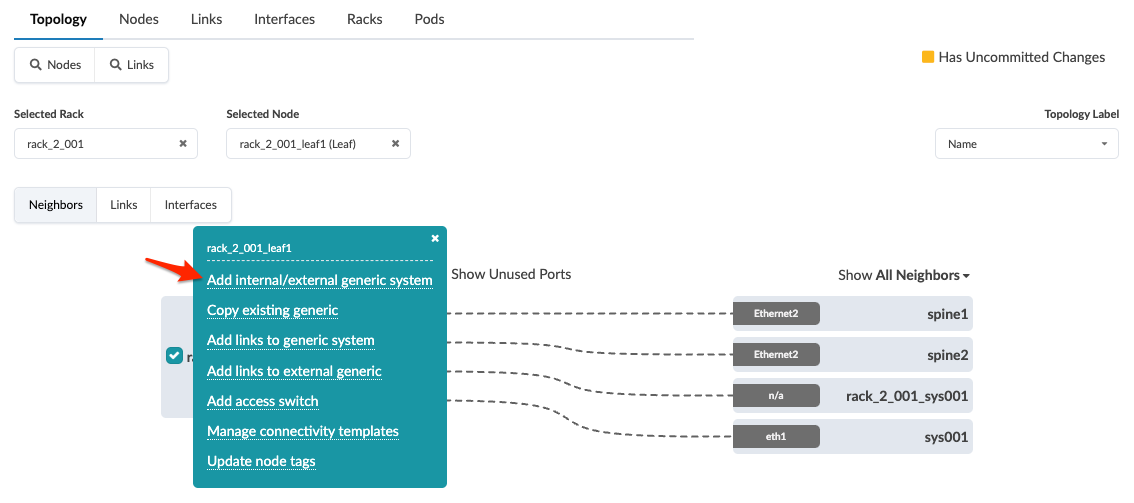
  4. If you're using Apstra version 4.2.1, select Internal generic type.
  5. Enter a unique label and (optional) hostname.
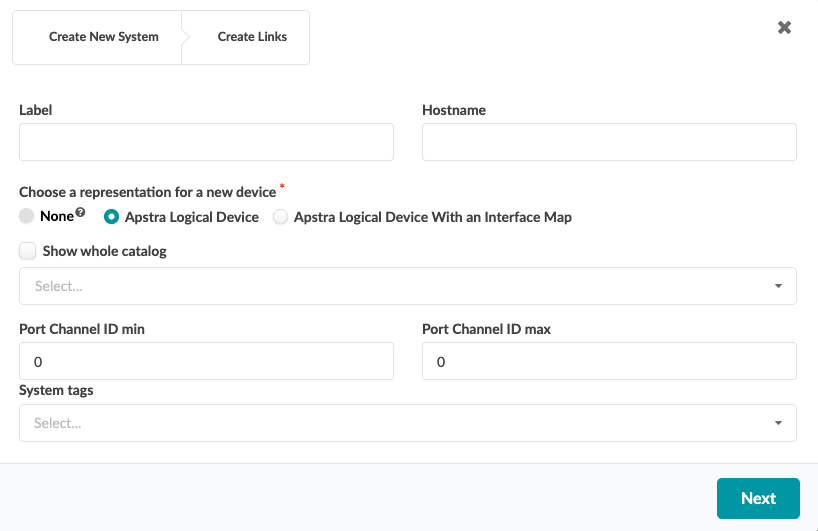
    User interface for creating a new system with fields for Label and Hostname, options for device representation, and a Next button.
  6. Select the representation for the new node (none, logical device, or logical device with interface map), then select the appropriate logical device or interface map from the drop-down list, as applicable. (Logical devices allow you to define port roles.)
  7. Enter the port channel ID min and max. If you leave the values at zero, any available port-channel may be used. (Prior to Apstra version 4.2.0, all non-default port channel numbers had to be unique per blueprint. Port channel ranges could not overlap. This requirement has been relaxed, and now they need only be unique per system).
  8. Enter tags (optional) to identify the role(s) of the new generic system, then click Next.
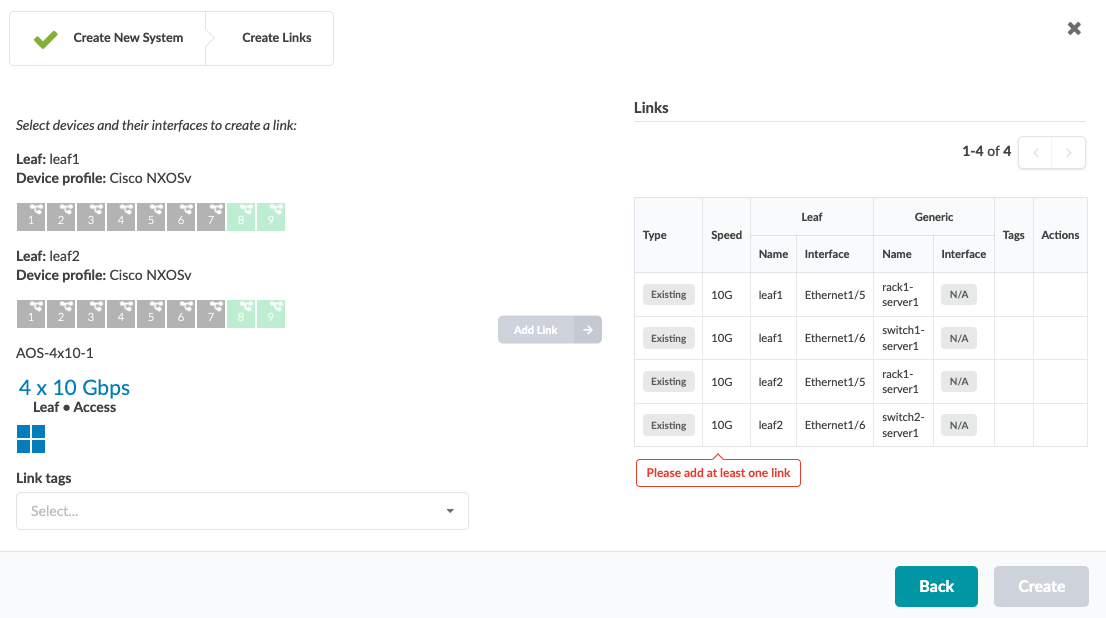
    Network configuration interface with selected Create Links tab. Devices leaf1 and leaf2 with Cisco NXOSv profile, interfaces 1 to 9. Section AOS-4x10⁻¹ with 4 x 10 Gbps Leaf Access description. Link tags dropdown. Links table showing existing 10G links with error message Please add at least one link. Back and Create buttons at bottom right.
  9. Select an available port and transformation. The gray Add Link button turns green.
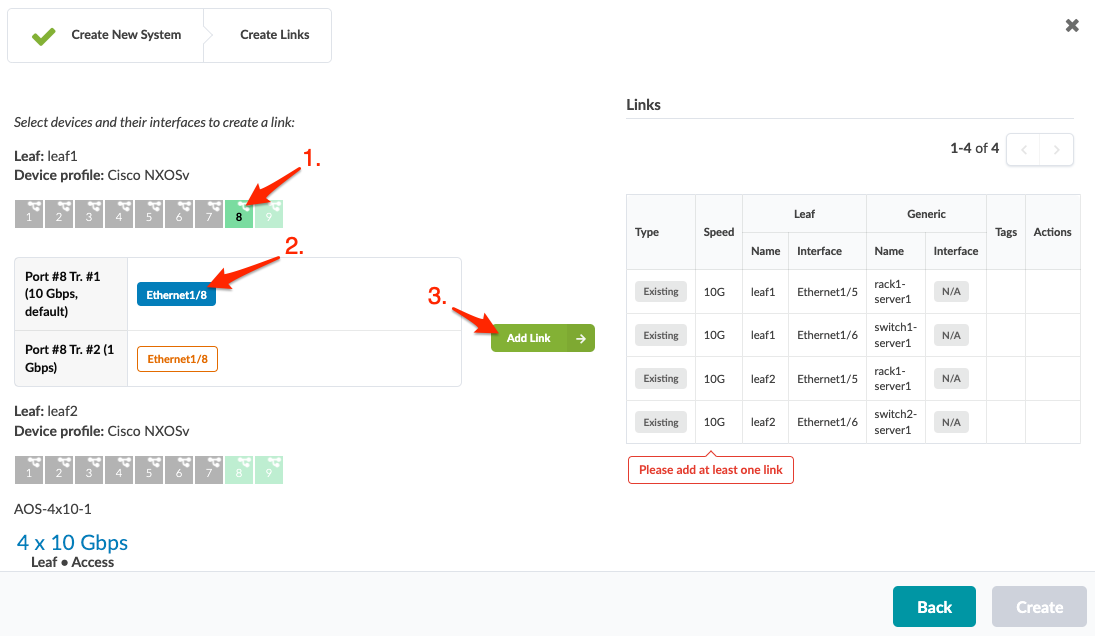
    Network configuration interface screenshot showing device selection for Cisco NXOSv, port selection, and link creation options. Warning: add at least one link.
  10. Click Add Link. The link is added to the link table.
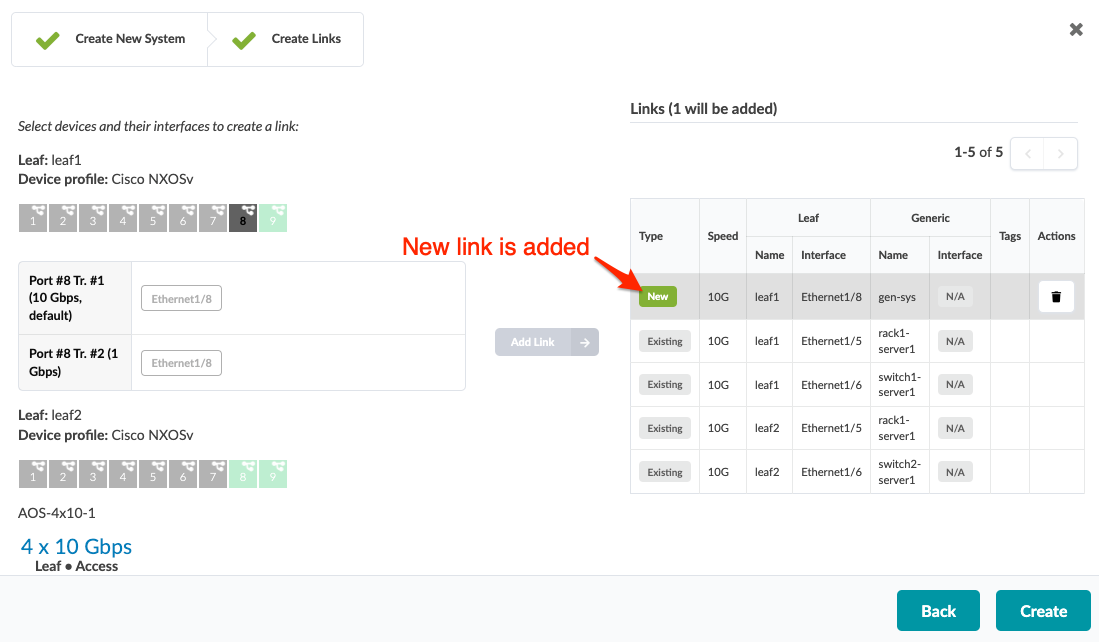
    Screenshot of a network configuration interface showing device selection and link creation between leaf1 and gen-sys. A new link highlighted in the table indicates Ethernet1/8 connection, 10G speed, with options to modify. Navigation buttons at the bottom include Back and Create.
  11. Click Create to stage the change and return to the Topology view.

When you're ready to activate your changes, commit them from the Uncommitted tab.

Copy Existing Generic System (from Topology View)

  1. From the blueprint, navigate to Staged > Physical > Topology and select the leaf or access switch that's connected to the generic system that you want to clone.
  2. Select the node check box to see the operations available for that node (and that you have permissions for).
    Note:

    You can also get to the selection page from the Nodes view. From the blueprint, navigate to Staged > Physical > Nodes, click the node name in the table, then click the node name that appears at the top of the Selection panel (on the right side of the page).

  3. Click Copy existing generic and select the generic system from the drop-down list.
    The link table appears.
  4. Click Select interface to go to ports.
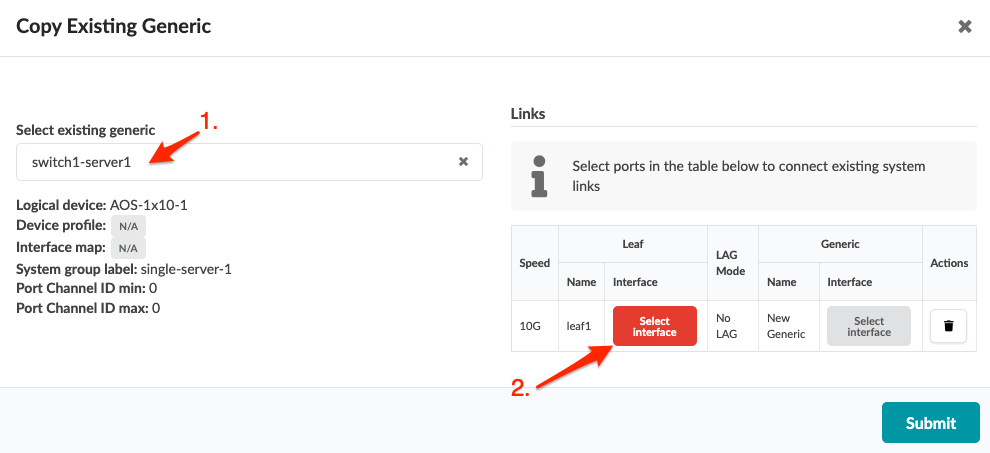
    User interface for configuring network connections, titled Copy Existing Generic. Dropdown shows switch1-server1. Button labeled Select interface is linked to leaf1. Confirm configuration with Submit button.
  5. Select a port and transformation, then click Confirm to return to the dialog.
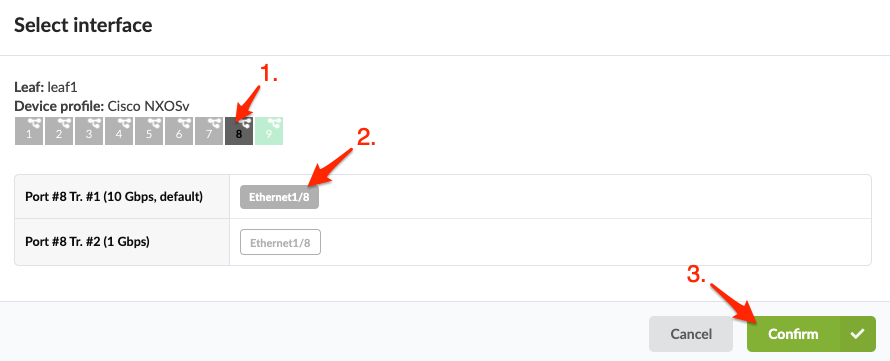
    User interface for selecting a network interface on a Cisco NXOSv device. Port 8 is highlighted with options for 10 Gbps and 1 Gbps configurations. Confirm and Cancel buttons are at the bottom.
  6. Click Submit to stage the change and return to the Topology view.
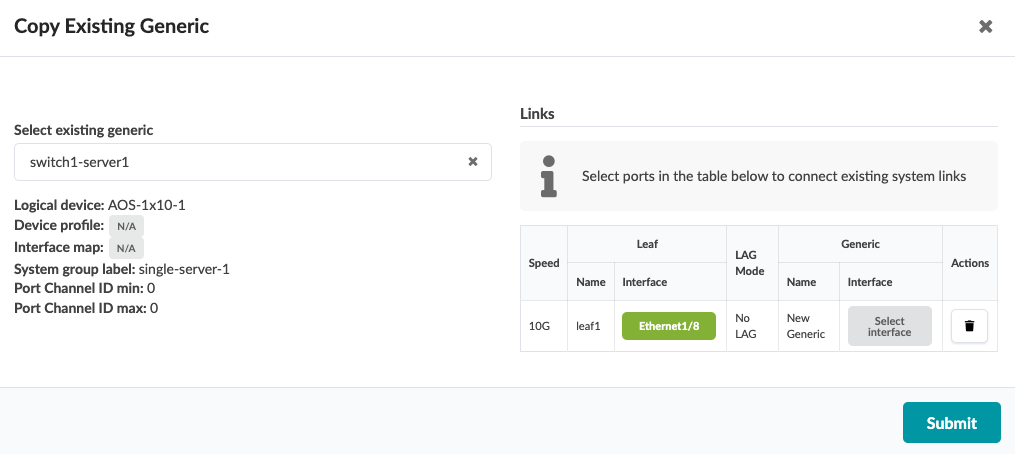
    User interface for configuring network connections titled Copy Existing Generic. Features dropdown to select configuration like switch1-server1, details section with logical device AOS-1x10⁻¹, links table for device connections with speed 10G, leaf name leaf1, and submit button.

When you're ready to activate your changes, commit them from the Uncommitted tab.

Note:

You can also create generic systems when you create rack types during the Design phase.