
AP47 Access Point Overview
The Juniper® AP47 High Performance Access Point is an indoor Wi-Fi 7 access point (AP) that provides virtual Bluetooth® Low Energy (vBLE) for enterprises that require increased channel width and capacity.
The AP47 has three IEEE 802.11be data radios, which deliver up to 4x4 multiple input, multiple output (MIMO) with four spatial streams. The AP47 also has a fourth 802.11be radio that is dedicated for scanning. The AP uses this radio for radio resource management (RRM), wireless security, and analytics.
The AP47 has a vBLE antenna array to enable location services such as asset visibility, wayfinding, and other services without battery-powered beacons. The AP47 includes two 802.15.4 capable radios, a built-in Global Navigation Satellite System/Global Positioning System (GNSS/GPS) radio, as well as Ultra-Wideband (UWB) capabilities.
The AP can operate simultaneously in the 2.4-GHz, 5-GHz, and 6-GHz bands. The AP is backward compatible with the 802.11a, 802.11b, 802.11g, 802.11n, 802.11ac, and 802.11ax wireless standards.
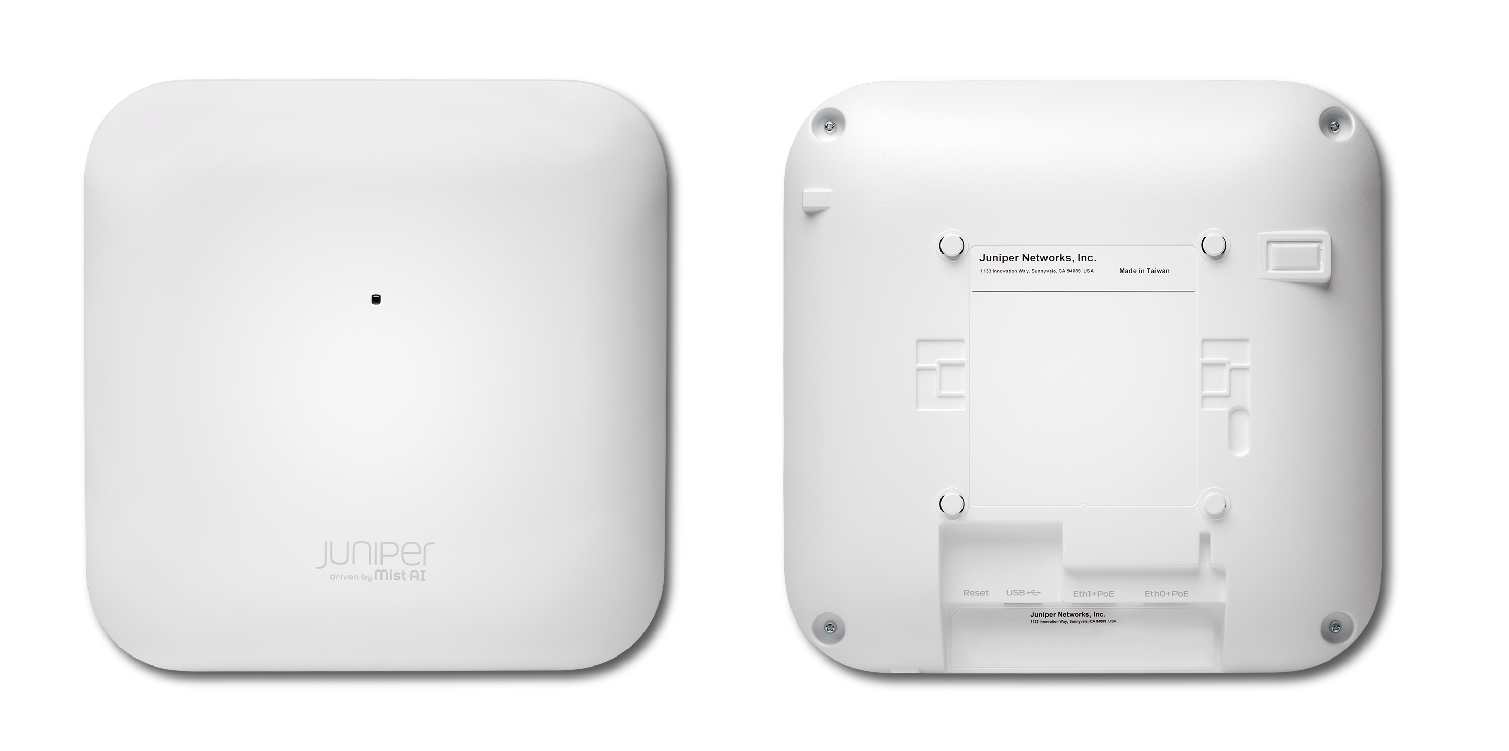
AP47 Access Point Models
| Model | Antenna |
|---|---|
| AP47 | Internal omnidirectional |
| AP47D | Internal directional (60x60) |
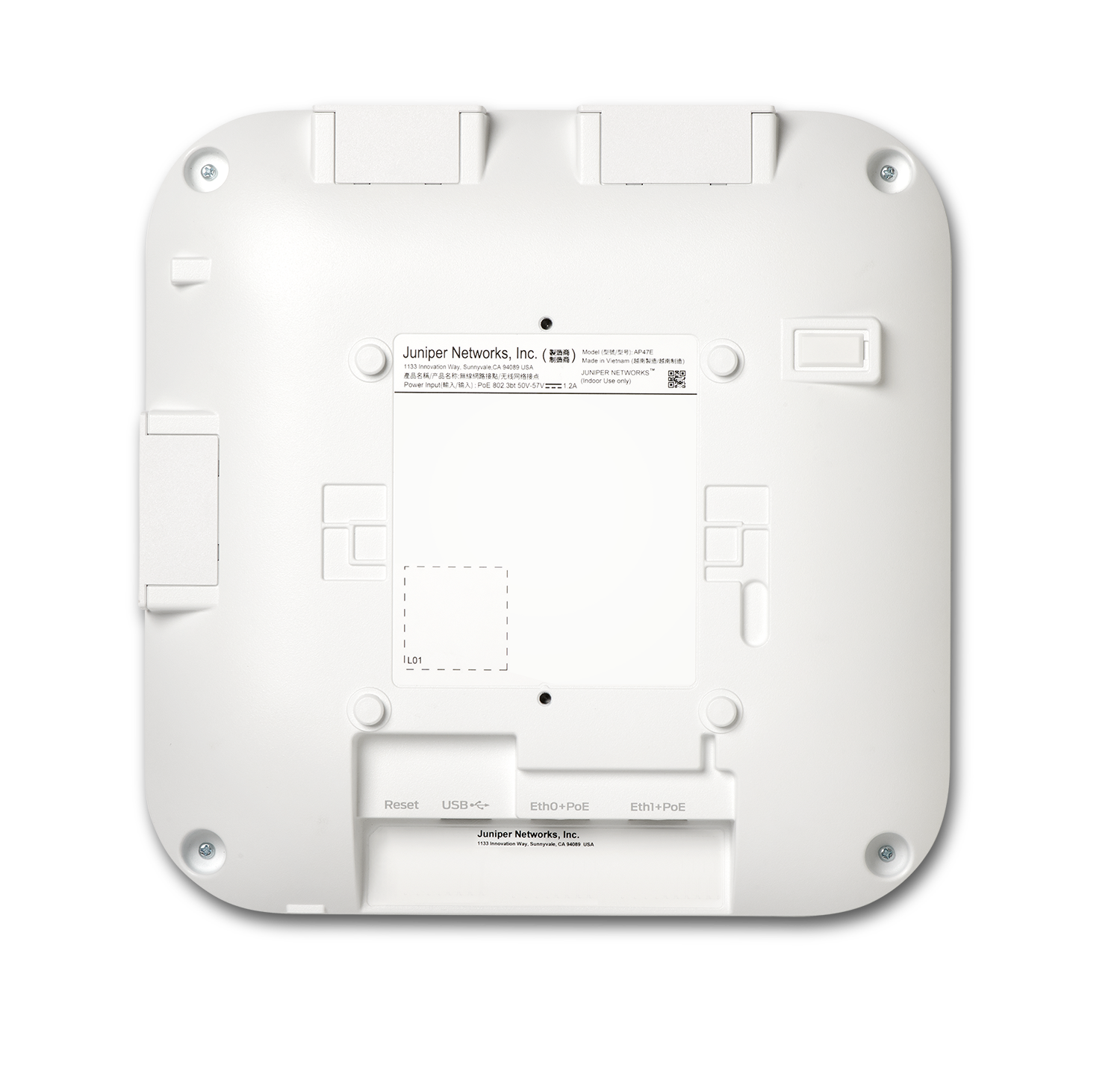
| AP47E | External |
Key Features of AP47 Access Points
-
Wi-Fi 7 support—The AP47 supports Wi-Fi 7, which allows for higher throughput and lower interference. Wi-Fi 7 can support 320 MHz wide radio channels in the 6GHz band and offers 4K QAM.
-
Dual Ethernet—The AP47 can connect to two Ethernet inputs at the same time, allowing for PoE redundancy and hitless failover. These inputs can belong to the same switch or different switches.
Note: Both Ethernet inputs must belong to the same VLAN. -
Tri-band radio—The AP47 supports the following modes of operation:
-
2.4 GHz + 5 GHz + 6 GHz
-
5 GHz (high) + 5 GHz (low) + 6 GHz
-
5 GHz + 6 GHz (high) + 6 GHz (low)
-
-
Advanced location services—The AP47 supports GPS and GNSS for high-precision positioning.
Note: For best results, the AP should be located near the perimeter of the building, near windows, and away from elevators. -
Directional antenna—The AP47D has integrated directional antennas, which provide better signal control and allows you to increase AP density by creating smaller cells without loss in data rates. This reduces AP interference and co-channel contention.
-
Flexible deployment scenarios—The AP47 model (with internal omnidirectional antenna) is used for general deployment. For higher AP density environments, the AP47D provides an alternative to using external antennas. The AP47E is suited for deployment in high AP density areas where the direction of the signal needs to be controlled using different types of antenna.
For details about the key features and deployment of the AP47, see Deploy Wi-Fi 7 with AP47.
Benefits of AP47 Access Points
-
Simple and quick deployment—You can deploy the AP with minimal manual intervention. The AP automatically connects to the Mist cloud after powering on, downloads its configuration, and connects to the appropriate network. Automatic firmware upgrades ensure that the AP runs the latest firmware version.
-
Proactive troubleshooting—The AI-driven Marvis® Virtual Network Assistant leverages the Mist AI to identify issues proactively and provide recommendations to fix issues. Marvis can identify issues such as offline APs and APs with insufficient capacities and coverage issues.
-
Improved performance through automatic RF optimization—Juniper radio resource management (RRM) automates dynamic channel and power assignment, which helps to reduce interference and enhance user experience. The Mist AI monitors the coverage and capacity metrics and optimizes the RF environment.
-
Improved user experience using AI—The AP uses Mist AI to enhance user experience in the Wi-Fi 7 spectrum by ensuring consistent service to multiple connected devices in moderate-density environments.