
예: 스케줄러의 4단계 계층 구축
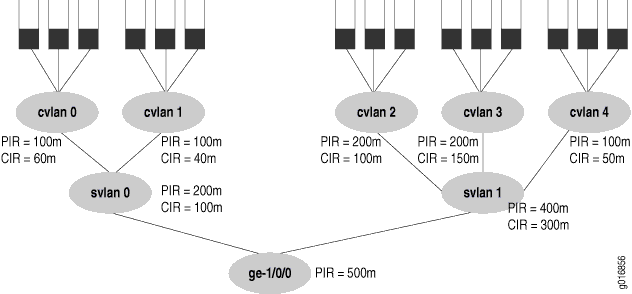
이 섹션에서는 스케줄러의 4단계 계층을 구축하는 자세한 예를 제공합니다. 구성 매개 변수는 그림 1에 표시됩니다. 대기열은 아래 계층의 다른 세 가지 수준과 함께 그림의 상단에 표시됩니다.
 구축
구축
그림의 PIR 값은 셰이핑 속도로 구성되며 CIO는 이더넷 인터페이스 ge-1/0/0에서 보장된 속도로 구성됩니다. PIR는 초과 구독될 수 있습니다(즉, 200 + 200 + 100이 부모 속도 400을 초과하는 경우와 같이 svlan 1하위 PIR의 합계가 부모의 합계를 초과할 수 있습니다). 그러나 모든 서비스 VLAN에 표시된 바와 같이 하위 노드 수준의 CIO의 합계는 상위 노드의 CIR을 초과해서는 안 됩니다(그렇지 않으면 보장된 속도는 모든 경우에 제공될 수 없습니다).
이 구성 예는 그림(ge-1/0/0)의 인터페이스에 대한 CoS 구성의 모든 세부 사항을 제공합니다.
인터페이스 세트 구성
[edit interfaces]
interface-set svlan-0 {
    interface ge-1/0/0 {
        unit 0;
        unit 1;
    }
}
interface-set svlan-1 {
    interface ge-1/0/0 {
        unit 2;
        unit 3;
        unit 4;
    }
}
인터페이스 구성
계층적 스케줄러를 구성하는 키워드는 VLAN 태깅 및 VLAN ID와 마찬가지로 물리적 인터페이스 수준에 있습니다. 이 예에서 인터페이스 세트는 외부 VLAN 태그가 아닌 논리적 인터페이스(단위)로 정의됩니다. 이 예의 모든 VLAN 태그는 고객 VLAN 태그입니다.
[edit interface ge-1/0/0]
hierarchical-scheduler;
vlan-tagging;
unit 0 {
    vlan-id 100;
}
unit 1 {
    vlan-id 101;
}
unit 2 {
    vlan-id 102;
}
unit 3 {
    vlan-id 103;
}
unit 4 {
    vlan-id 104;
}
트래픽 제어 프로필 구성
트래픽 제어 프로필은 스케줄러 계층의 대기열 수준 이상의 수준에 대한 매개 변수를 보유합니다. 이 섹션은 서비스 VLAN 수준(논리적 인터페이스) 및 고객 VLAN(VLAN 태그) 수준 모두에 대한 트래픽 제어 프로필을 정의합니다.
[edit class-of-service traffic-control-profiles]
tcp-500m-shaping-rate {
    shaping-rate 500m;
}
tcp-svlan0 {
    shaping-rate 200m;
    guaranteed-rate 100m;
    delay-buffer-rate 300m; # This parameter is not shown in the figure.
}
tcp-svlan1 {
    shaping-rate 400m;
    guaranteed-rate 300m;
    delay-buffer-rate 100m; # This parameter is not shown in the figure.
}
tcp-cvlan0 {
    shaping-rate 100m;
    guaranteed-rate 60m;
    scheduler-map tcp-map-cvlan0; # Applies scheduler maps to customer VLANs.
}
tcp-cvlan1 {
    shaping-rate 100m;
    guaranteed-rate 40m;
    scheduler-map tcp-map-cvlan1; # Applies scheduler maps to customer VLANs.
}
tcp-cvlan2 {
    shaping-rate 200m;
    guaranteed-rate 100m;
    scheduler-map tcp-map-cvlanx; # Applies scheduler maps to customer VLANs.
}
tcp-cvlan3 {
    shaping-rate 200m;
    guaranteed-rate 150m;
    scheduler-map tcp-map-cvlanx; # Applies scheduler maps to customer VLANs
}
tcp-cvlan4 {
    shaping-rate 100m;
    guaranteed-rate 50m;
    scheduler-map tcp-map-cvlanx; # Applies scheduler maps to customer VLANs
}
스케줄러 구성
스케줄러는 계층의 마지막 수준인 대기열에 대한 정보를 보유합니다. 이 예의 모든 부분에서 반복 요소에 적용되는 일관된 명명 체계를 유의하십시오.
[edit class-of-service schedulers]
sched-cvlan0-qx {
    priority low;
    transmit-rate 20m;
    buffer-size temporal 100ms;
    drop-profile loss-priority low dp-low;
    drop-profile loss-priority high dp-high;
}
sched-cvlan1-q0 {
    priority high;
    transmit-rate 20m;
    buffer-size percent 40;
    drop-profile loss-priority low dp-low;
    drop-profile loss-priority high dp-high;
}
sched-cvlanx-qx {
    transmit-rate percent 30;
    buffer-size percent 30;
    drop-profile loss-priority low dp-low;
    drop-profile loss-priority high dp-high;
}
sched-cvlan1-qx {
    transmit-rate 10m;
    buffer-size temporal 100ms;
    drop-profile loss-priority low dp-low;
    drop-profile loss-priority high dp-high;
}
드롭 프로파일 구성
이 섹션은 예에 대한 드롭 프로필을 구성합니다. 보정 드롭 프로파일에 대한 자세한 내용은 RED Drop Profile 및 패킷 손실 우선순위를 사용하여 혼잡 관리를 참조하십시오.
[edit class-of-service drop-profiles]
dp-low {
    interpolate fill-level 80 drop-probability 80;
    interpolate fill-level 100 drop-probability 100;
}
dp-high {
    interpolate fill-level 60 drop-probability 80;
    interpolate fill-level 80 drop-probability 100;
}
스케줄러 맵 구성
이 섹션은 예제에 대한 스케줄러 맵을 구성합니다. 각 스케줄러는 스케줄러 구성 시 구성된 스케줄러를 참조합니다.
[edit class-of-service scheduler-maps]
tcp-map-cvlan0 {
    forwarding-class voice scheduler sched-cvlan0-qx;
    forwarding-class video scheduler sched-cvlan0-qx;
    forwarding-class data scheduler sched-cvlan0-qx;
}
tcp-map-cvlan1 {
    forwarding-class voice scheduler sched-cvlan1-q0;
    forwarding-class video scheduler sched-cvlan1-qx;
    forwarding-class data scheduler sched-cvlan1-qx;
}
tcp-map-cvlanx {
    forwarding-class voice scheduler sched-cvlanx-qx;
    forwarding-class video scheduler sched-cvlanx-qx;
    forwarding-class data scheduler sched-cvlanx-qx;
}
트래픽 제어 프로필 적용
이 섹션은 트래픽 제어 프로파일을 계층의 적절한 수준에 적용합니다.
셰이핑 속도는 물리적 인터페이스에 직접 적용할 수 있지만 계층 스케줄러는 트래픽 제어 프로파일을 사용하여 이 매개 변수를 유지해야 합니다.
[edit class-of-service interfaces]
ge-1/0/0 {
    output-traffic-control-profile tcp-500m-shaping-rate;
    unit 0 {
        output-traffic-control-profile tcp-cvlan0;
    }
    unit 1 {
        output-traffic-control-profile tcp-cvlan1;
    }
    unit 2 {
        output-traffic-control-profile tcp-cvlan2;
    }
    unit 3 {
        output-traffic-control-profile tcp-cvlan3;
    }
    unit 4 {
        output-traffic-control-profile tcp-cvlan4;
    }
}
interface-set svlan0 {
    output-traffic-control-profile tcp-svlan0;
}
interface-set svlan1 {
    output-traffic-control-profile tcp-svlan1;
}
존재하지 않는 서비스 클래스 논리적 인터페이스를 show interfaces queue 참조하는 명령을 사용할 때는 주의해야 합니다. 여러 논리적 인터페이스(단위)가 동일한 인터페이스 세트 또는 물리적 인터페이스에서 구성되지 않지만 또는 show interfaces queue ge-10/0/1.13 forwarding-class be (논리적 장치 12 및 13이 서비스 등급 인터페이스로 구성되지 않은 경우) 와 같은 show interfaces queue ge-10/0/1.12 forwarding-class be 명령에 의해 참조되는 경우, 이러한 인터페이스는 각 논리적 인터페이스에 대해 동일한 트래픽 통계를 표시합니다. 즉, 동일한 인터페이스 집합 또는 물리적 인터페이스 아래에서 하나 이상의 다른 구성되지 않은 논리적 인터페이스가 트래픽을 통과하는 한 특정 구성되지 않은 논리적 인터페이스를 통과하는 트래픽이 없더라도, 이 특정 논리 인터페이스는 함께 구성된 다른 모든 논리적 인터페이스를 통해 전달된 총 트래픽 양을 보여주는 통계 카운터를 표시합니다.