
Packet Forwarding Engine Architecture
Learn about the Packet Forwarding Engine architecture on the ACX7000 family of routers. The ACX7000 family of routers includes ACX7020, ACX7024, ACX7024X, ACX7100, ACX7332, ACX7348, and ACX7509 routers.
A Packet Forwarding Engine can have multiple pipelines. The ingress pipeline receives packets and frames from the Network Interfaces (NIFs) and passes cells to a fabric interface. On the other hand, an egress pipeline receives cells from the fabric interface and pushes packets or frames to the appropriate NIF.
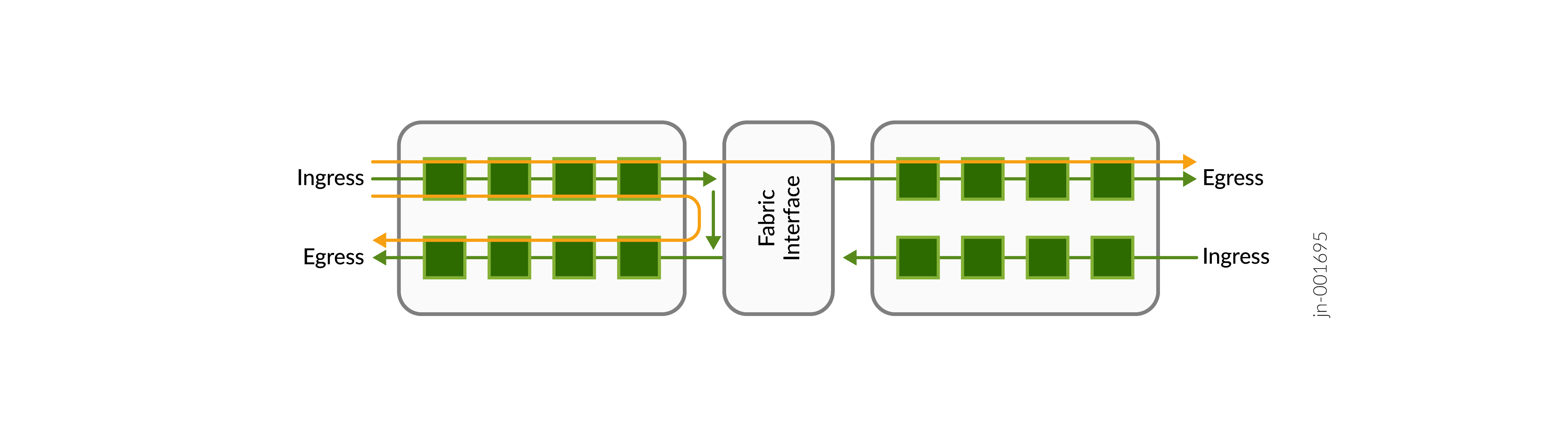
Both ingress and egress paths are made of:
-
Receive and transmit packet processor blocks that include the following:
-
Ingress Receive Packet Processor (IRPP)
-
Ingress Transmit Packet Processor (ITPP)
-
Egress Receive Packet Processor (ERPP)
-
Egress Transmit Packet Processor (ETPP)
-
-
Traffic manager blocks managing packet buffering and queues that include the following:
-
Ingress Traffic Manager (ITM)
-
Egress Traffic Manager (ETM)
-
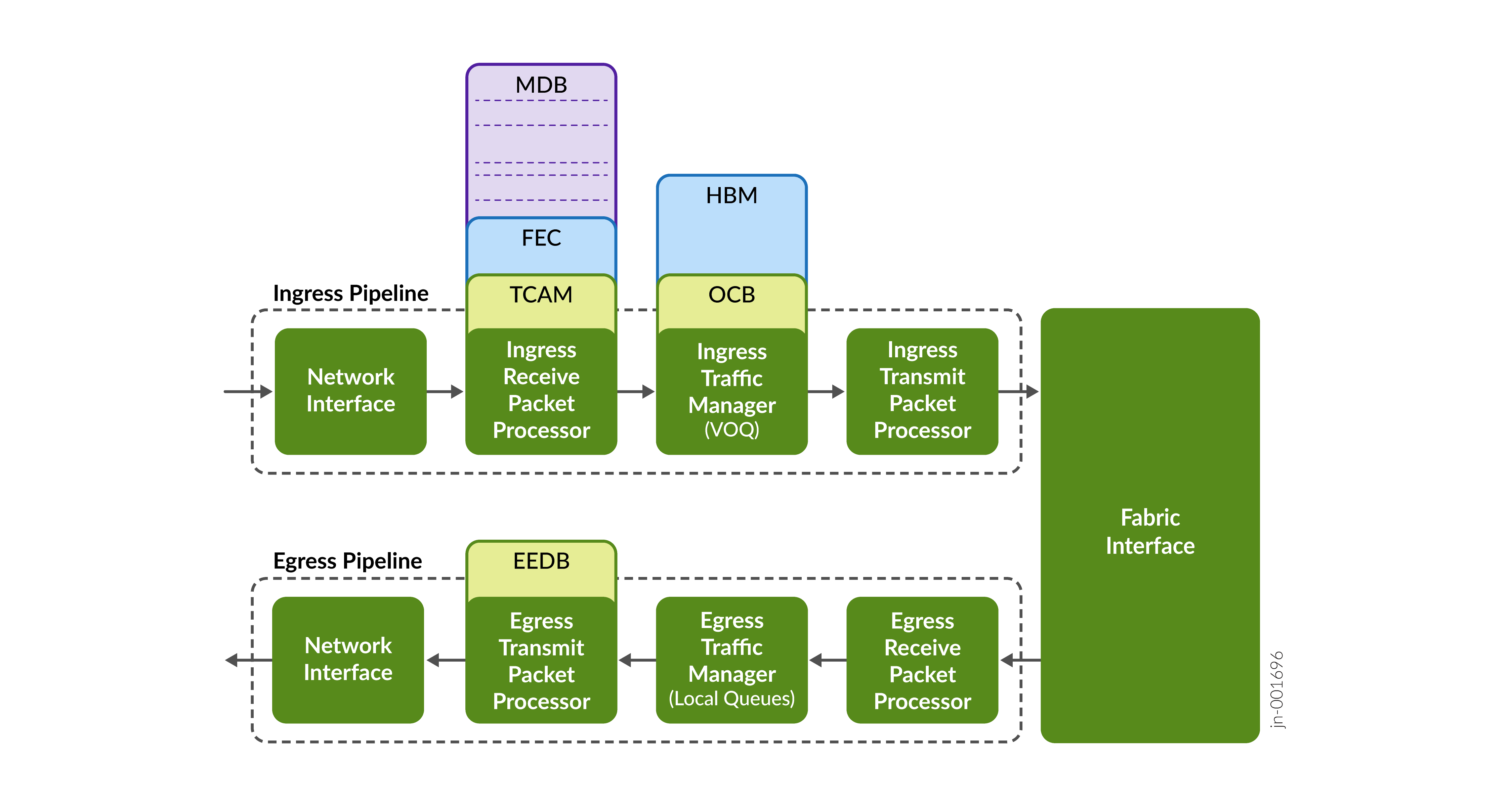
The components of the ingress and egress paths offer several capabilities including:
-
Additional blocks in IRPP and ETPP, enabling greater flexibility in packet processing
-
Support for larger packet headers, facilitating deeper packet parsing
-
A broader range of resources
-
Increased database sizes
-
Flexible resource allocation at boot-up with MDB
-
A programmable elastic pipeline architecture
These Packet Forwarding Engine features collectively result in:
-
Increased bandwidth and packets-per-second (PPS) capacity.
-
Support for more interfaces and ports.
-
Ability to process a larger set of features in a single pass, reducing the need for packet recycling.