
Standard Power, Low Power, and AFC
HPE Juniper Mist has access points that support 6-GHz radio using standard power and low power indoor operating modes.
In the United States, the Federal Communications Commission (FCC) allows wireless access points (APs) to operate the 6-GHz radio band under Low Power Indoor (LPI) operating class and Standard Power (SP) operating class. In Canada, Great Britain, and Saudi Arabia similar allowances are also available. See Regulations Enabling 6-GHz Wi-Fi for more information about which countries have allowed for 6-GHz operation.
To operate under standard power, the FCC requires 6-GHz APs to consult a cloud-based lookup service called the Automated Frequency Coordination (AFC). The AP reports its geolocation, and the AFC identifies any occupied frequencies in the vicinity. If there are any incumbent 6-GHz license holders in the broadcast area of the AP, the AFC service responds with the allowed channels and maximum operating power. The AP must adjust its radio power and channels to avoid interference with the existing 6-GHz license holders.
Low Power Indoor and Standard Power are 6-GHz–only power classifications. Juniper APs with 5-GHz radios use RRM on active radio bands to set their power level based on the minimum/maximum threshold setting in the RRF template and device profile. You can set the radio transmit power as positive dBm to the regulatory max.
HPE Mist Networking APs
As part of the Mist AI-native networking platform, the architecture of HPE Mist Networking APs is cloud-based. APs routinely send telemetry to the HPE Mist Networking cloud, and the Radio Resource Management (RRM) system routinely sends back performance optimizations. Inter-operation with the FCC's AFC lookup database is a natural extension of the native cloud-based architecture.
AFC support requires AP firmware version 0.15.x or later.
HPE Mist Networking APs that are equipped with an onboard GPS relay their geographic coordinates, the antenna height above ground level (AGL), and a unique identifier. APs that don't have GPS, such as the AP45E, AP34, and AP24, can meet the AFC geolocation requirements by leveraging GPS data from a neighboring Juniper AP that is equipped with GPS. For this to work, both APs need to belong to the same site, and the neighboring AP must be within RF-signal range to share their location and uncertainty distance between them.
Low Power Indoor and Standard Power
Low Power Indoor is the default power mode for indoor APs with 6-GHz radios. These do not require AFC. However dual mode and outdoors APs are required to use standard power operation mode to extend their range, if the AFC lookup allows it.
Low Power Indoors
- LPI is allowed on all four 6-GHz U‑NII bands: 5, 6, 7, and 8.
-
Full 1200-MHz of spectrum available.
-
6-GHz–only power class, intended for indoor/home/enterprise.
- No AFC or GPS required.
- Low Power Indoor must be:
- Indoors
- Non‑weatherized (no outdoor/harsh‑environment enclosures)
- Non‑battery operated
- Without external antennas
US and EU Regulatory limits
-
Effective Isotropic Radiated Power (EIRP) is derived from PSD and channel width:
-
EIRP= PSD + 10log(channel width in MHz)
-
-
USA: AP Low Power Indoor: 5 dBm/MHz PSD or,
-
EU: AP Low Power Indoor: 10 dBm/MHz PSD
-
Clients must stay 6 dB below the controlling AP’s max EIRP
| PSD | EIRP 20 MHz | EIRP 40 MHz | EIRP 80 MHz | EIRP 160 MHz | EIRP 320 MHz | |
| Access Point | 5 dBm/MHz |
18 dBm |
21 dBm | 24 dBm | 27 dBm | 30 dBm |
| Client | -1 dBm/MHz |
12 dBm |
15 dBm |
18 dBm |
21 dBm |
24 dBm + 6 dBm below AP |
Standard Power
- 6-GHz–only power class for higher power control with AFC.
- Allowed in USA; not allowed in EU.
- Requires Automated Frequency Coordination (AFC) using AFC.
- U‑NII‑5 and U‑NII‑7 only in the US
- Can be used by:
- Outdoor/weatherized APs.
- APs with external antennas.
- High‑ceiling indoor environments such as warehouses and auditoriums, provided the AP is using AFC.
-
Portable battery operation is not allowed.
-
-
The actual PSD/EIRP and frequency is assigned per location by the AFC.
- The client must operate at least 6 dB below the controlling AP.
-
| PSD | EIRP | |
| Access Point | 23 dBm/MHz | 36 dBm |
| Client | 17 dBm/MHz | 30 dBm + 6 dB below AP |
Power Modes per 6-GHz AP
Table 3 shows the GPS, radio bands, and power modes available for Juniper APs with a 6-GHz radio.
For Juniper APs that support both Standard Power and Low Power Indoor, LPI is the default power mode. Weatherized (outdoor) APs such as AP64, AP66, and APs with an external antenna, such as AP47E and AP45E, don't have LPI mode. For these, when radio is enabled and an SSID is configured for operation, the default power mode for the 6-GHz radio is Standard Power.
- Juniper APs running SP check the AFC daily. You can see the status of the AFC check in the Mist dashboard under RRM Radio Events. Look for AFC.
- If an AP that is allowed to operate in LPI and SP is configured for SP, but then it does not receive an AFC response, the AP will continue using its active 6-GHz radio, but will fall back to LPI.
Juniper APs with only Wi-Fi 5 (802.11ac) or Wi-Fi 6 (802.11ax) do not have 6-GHz radios and therefore operate under LPI only.
| Model | Type | GPS | 6-GHz Power |
| Wi-Fi 7 (802.11be) | |||
| AP27 | Indoor | Yes | Supports both LPI and SP |
| AP27E | Indoor | Yes | Standard Power |
| AP17 | Indoor (wall plate) | No | Low Power Indoor |
| AP66/D/E | Outdoor (hardened) | Yes | Supports both LPI and SP |
| AP36 | Indoor | Yes | Supports both LPI and SP |
| AP36M without external antennas | Indoor | Yes | Supports both LPI and SP |
| AP36M with external antennas | Indoor | Yes | Standard Power |
| AP37 | Indoor | Yes | Supports both LPI and SP |
| AP47/D | Indoor | Yes | Supports both LPI and SP |
| AP47/E | Indoor | Yes | Standard Power |
| AP723H | Indoor | No | Low Power Indoor |
| Wi-Fi 6E (802.11ax) | |||
| AP64 | Outdoor | Yes | Standard Power |
| **AP24 | Indoor | No | Low Power Indoor |
| **AP34 | Indoor | No | Supports both LPI and SP |
| **AP45/E | Indoor | No | Supports both LPI and SP |
*AP36M defaults to the integrated directional antenna and Low Power Indoor. Uses Standard Power when equipped with an external antenna.
** These APs require a nearby Juniper AP with GPS for their geolocation.
AP47/D/E has a flexible 4x4 radio that can serve 2.4-GHz, 5-GHz, or 6-GHz.
More Information About AFC
Automated Frequency Coordination (AFC) is a control system that protects existing licensed users in the 6-GHz band, while at the same time allowing Wi‑Fi 6E/7 APs to operate. With standard power, AFC lets APs with 6-GHz Wi‑Fi operate outdoors, and over larger areas. It uses the AFC lookup service to dynamically protect license incumbents by coordinating device location, radio frequency, and power assignments.
To leverage the AFC service, the AP sends its geolocation (plus location confidence), antenna height, FCC ID, and device serial number to the AFC operator. The AFC service performs a lookup in the FCC Universal Licensing System (ULS). It uses an attenuation model to calculate an interference-to-noise (I/N) power ratio according to the distance. The I/N value determines what output power, and what frequencies are allowed for the AP.
AFC also prevents microwave interference. Figure 1 shows the number, distribution, and types of active licenses across UNII 5, 6, 7, and 8 spectrum (satellite excluded).
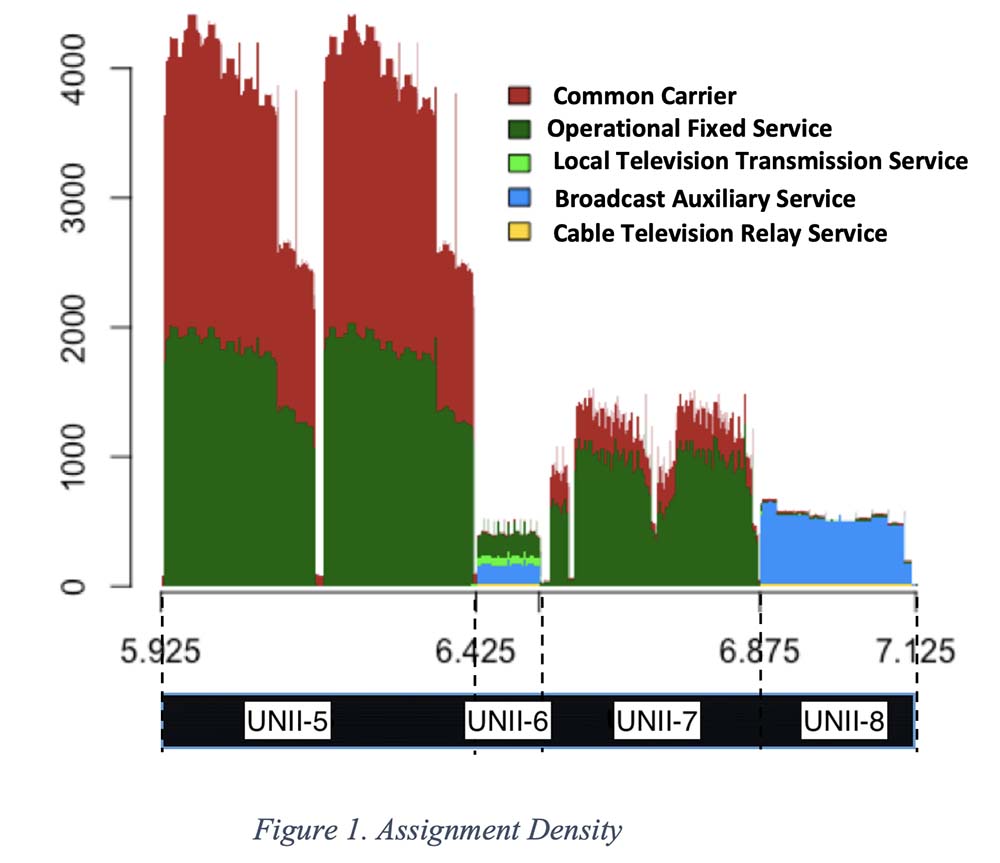
Source: https://docs.fcc.gov/public/attachments/FCC-18-147A1_Rcd.pdf.
A good resource for locating microwave links is the FCC Universal Licensing System. You can search by state and county, and filter on active licenses between 5925-MHz to 7125-MHz.
In the USA, incumbent use of the 6 GHz radio band is widespread. Examples of fixed-services include private and common carriers, public utilities, and public safety, such as the back-haul for emergency and police dispatch, back-haul for cell towers, long distance telephone links (especially microwave links), and satellite service.
- Fixed Service is by far the heaviest user group of 6-GHz, usually in the form of fixed microwave links. There are nearly 50,000 registered 6-GHz microwave links in the US. Most links are in the UNII-5 band, followed by UNII-7. Microwave links aren’t as common in UNII-8, but they do exist. Fixed microwave links are not allowed in UNII-6 as to prevent overlap with television and broadcast services. Microwave links are regarded as extremely reliable and some are designed to allow less than 30 seconds of downtime in a year. That’s 99.999% to 99.9999% reliability.
- Satellite Service includes fixed Earth-to-Space which is allowed across UNII-5 through UNII-8, except the upper 150-MHz of UNII-8. It utilizes UNII-5 the most and is part of the “conventional c-band.” Common uses include TV and Radio uplink for distribution and back-haul for voice and data communications. Satellite service also includes mobile Space-to-Earth satellite links in portions of UNII-7 and UNII-8.
- Television and Broadcast Services predominates in UNII-6 and UNII-8. There are a wide range of uses, from the transmission-and-relay of video signals, to electronic news gathering for broadcast and cable TV entities. For this incumbent, use is also granted in the lower part of UNII-8 for special large scale audio usage by broadcast entities, venue and sounds production companies.
- Existing unlicensed use includes Ultra Wide Band across UNII-5, 6, 7, and 8, and was previously allowed unlicensed use of 6-GHz, which is unchanged.
| Band | Allowed Unlicensed Usage | Incumbents |
|---|---|---|
| UNII-5 | Low Power Indoor | Fixed Service, Satellite Service |
| UNII-6 | Low Power Indoor, Standard Power AP | Satellite Service, TV and Broadcast Services |
| UNII-7 | Low Power Indoor | Fixed Service, Satellite Service |
| UNII-8 | Low Power Indoor, Standard Power AP | Satellite Service, TV and Broadcast Services |
To protect radio astronomy from 6650-6675-MHz, the AFC includes and exclusion zones near observatories.
Note that you can influence client devices to prefer 5-GHz over 6-GHz by configuring 80-MHz on the 5-GHz radio, and 20-MHz on the 6-GHz radio.