
Add Custom URLs for Marvis Minis Validation
To expand Marvis Minis validations to include additional applications, add the details of applications that you want to validate. For example, add Amazon Web Services and Microsoft Azure workload application URLs to verify service reachability.
You can configure Marvis Minis to run validations on custom applications that you define. For each application, you can specify the network segment to monitor by defining the source VLAN or interface. This enables Marvis Minis to run targeted validation tests for your custom applications. You can also specify whether the target is an application or a network endpoint. These settings ensure that Marvis Minis runs the appropriate tests, improving diagnostic accuracy and validation efficiency.
To add custom applications:
From the left menu, select Organization > Admin > Settings.
Navigate to the Marvis Minis section on the Organization Settings page.
Scroll to the Marvis Minis section and click Add Application to add the details for the applications that need to be validated.
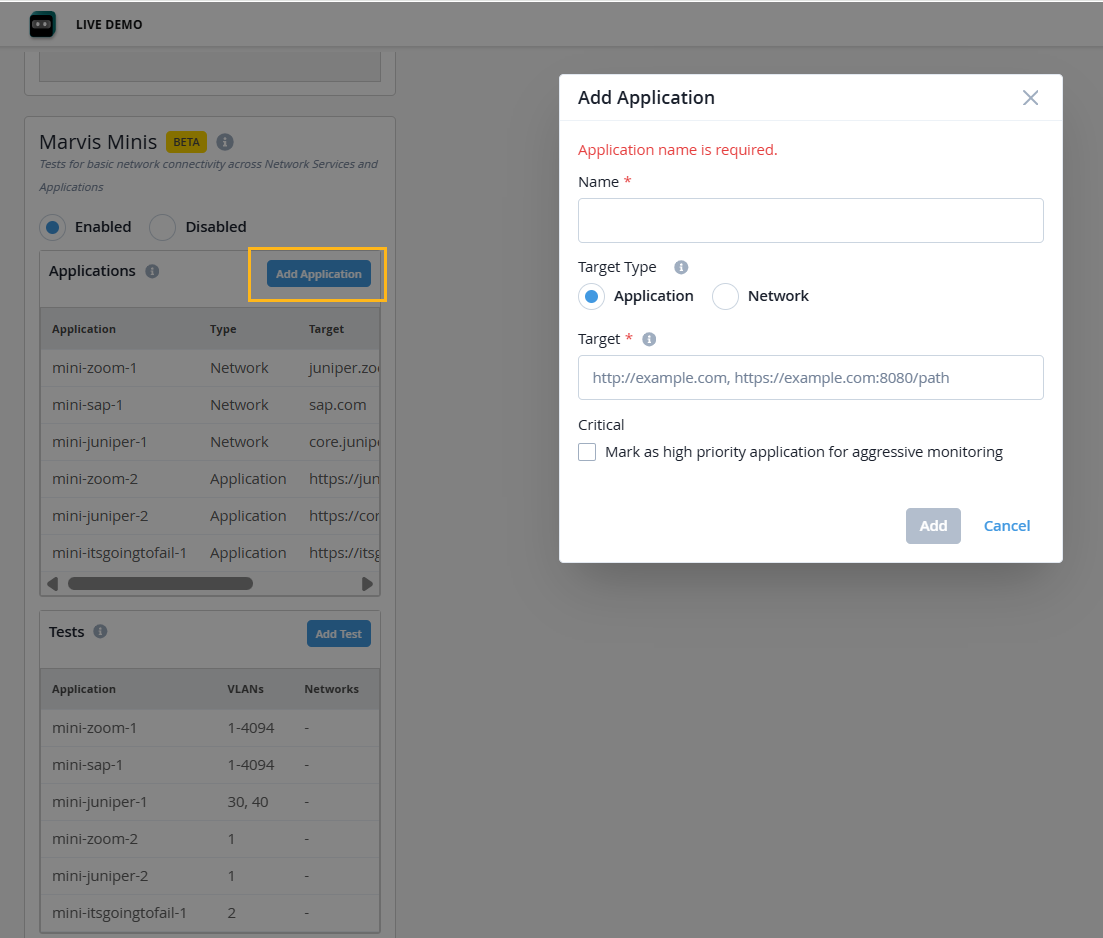
Enter a name for the application.
Application names cannot be edited after creation. If you want to change the application name, you’ll need to delete the entry and add it again with the updated name.
Select the Target Type:
If you select Application (default), Marvis Minis runs the hourly validation on APs. It validates web applications by using curl to measure application response latency and ensure that the endpoints are reachable.
If you select Network, Minis runs the hourly validations on the WAN Edges and APs. It validates the availability of network endpoints. Using these checks, Marvis Minis monitors network latency and packet loss.
Note: Network endpoint validations on APs and WAN Edges are currently supported as part of the BETA program with limited visibility and access. The validations also include traceroute analysis for network path visibility, enabling you to identify potential delays or routing issues that might degrade the network performance.Enter the URL or fully qualified domain name (FQDN) of the application. When adding a URL for validation, note that
If you include https://, Marvis Minis will use HTTPS.
If you don’t specify a protocol, Marvis Minis will consider HTTP.
You can also use site variables. Marvis Minis uses the URL or IP address associated with each variable to validate application and network reachability. Ensure that you define the variables in the Site Variables section of each site's settings. For information about site variables, see Configure Site Variables.
Marvis Minis considers an application reachable if the response status code is either 200 (OK) or 408 (for default apps).
Note:Remember that Marvis Minis learns all the APs, WLANs, switches, and active VLANs in a site and automatically creates the tests to run. Marvis Minis doesn’t restrict the validations to the VLANs that you specify for a custom URL. Marvis Minis runs the validations on all the active VLANs in a site in addition to the VLANs that you specify for a custom URL. If you want to exclude any VLANs from the validation scope, you’ll need to add them to the Excluded VLANs list. See Exclude VLANs from Marvis Minis Validation.
Select the Mark as a high priority application for aggressive monitoring check box if the application is a critical one for your organization. You can only mark five apps for critical monitoring.
Note: This functionality is also part of the Beta program and is supported only on APs running firmware version 0.15 and later.Click Add.
Click Add Test to schedule the Minis validations.
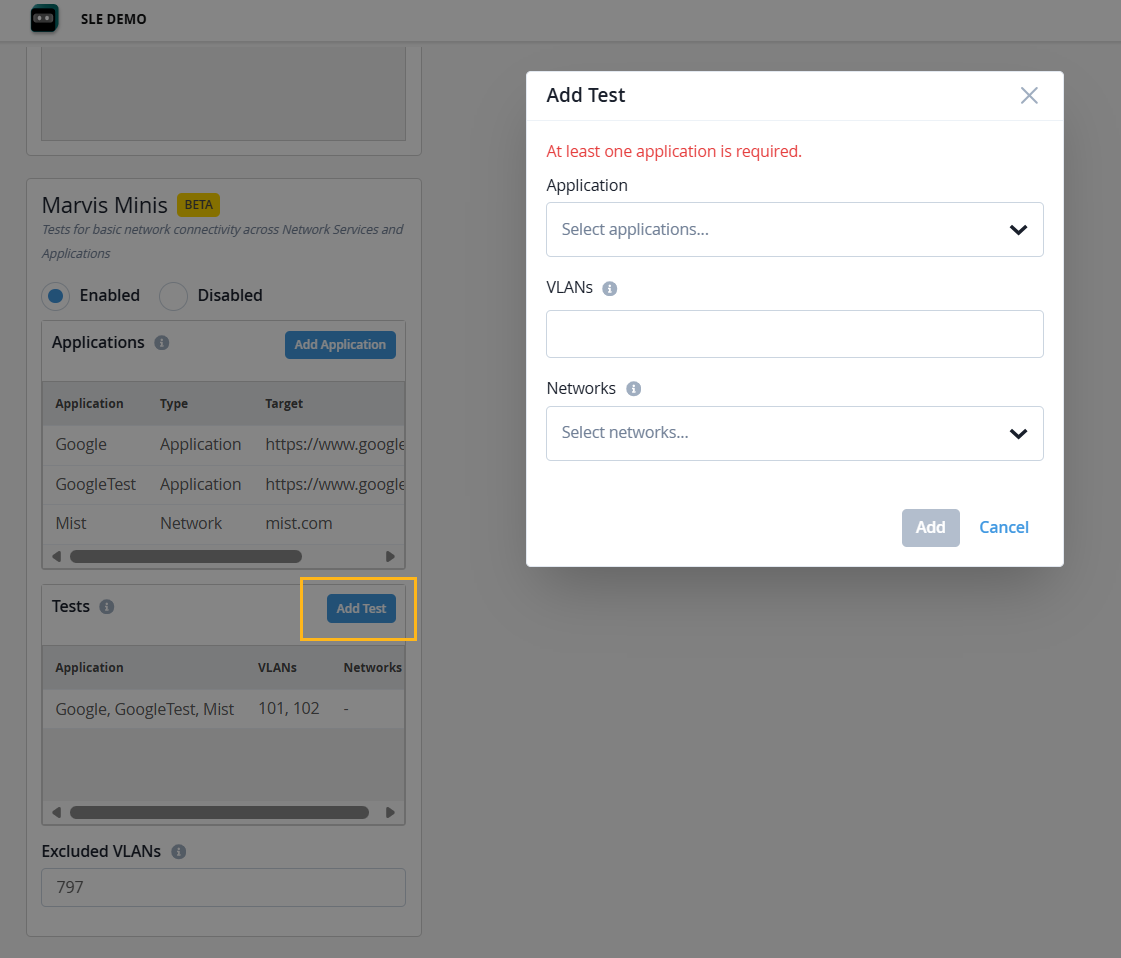
Select the applications to be validated.
Add the WAN network or wireless VLANs on which the validations need to be run.
You can also use site variables to define the VLAN scope. Ensure that you define the variables in the Site Variables section of each site's settings. For information about site variables, see Configure Site Variables.
Click Add.
Click Save in the top-right corner of the Organization Settings page.
For site-level validations, you can schedule the tests on the Organization>Admin>Site Configuration page. Ensure to select the OVERRIDE ORGANIZATION SETTING check box.
Migration of Custom URL Information to the Updated UI
If you previously added custom URL information using the earlier UI, your data is automatically and seamlessly migrated to the updated format. Since the changes apply only to the interface and do not affect the underlying APIs, no action is required on your part during migration.
In the updated UI, each application requires a name. To support this requirement, Mist assigns a default name to every migrated custom URL. These names begin with the prefix mini, as shown in the following example:
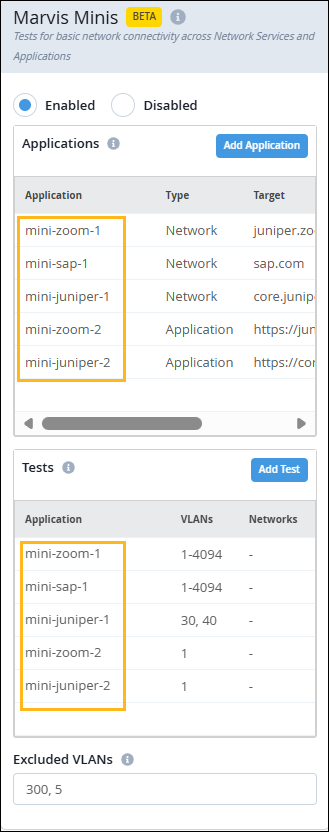
You can update the name assigned during migration. Note that this is a one-time action permitted only for migrated entries. After you save the updated name, it cannot be modified again. You will also need to review and edit the Application and Test details to provide the required information for the Target Type and Network