
Validation Framework
Test Bed
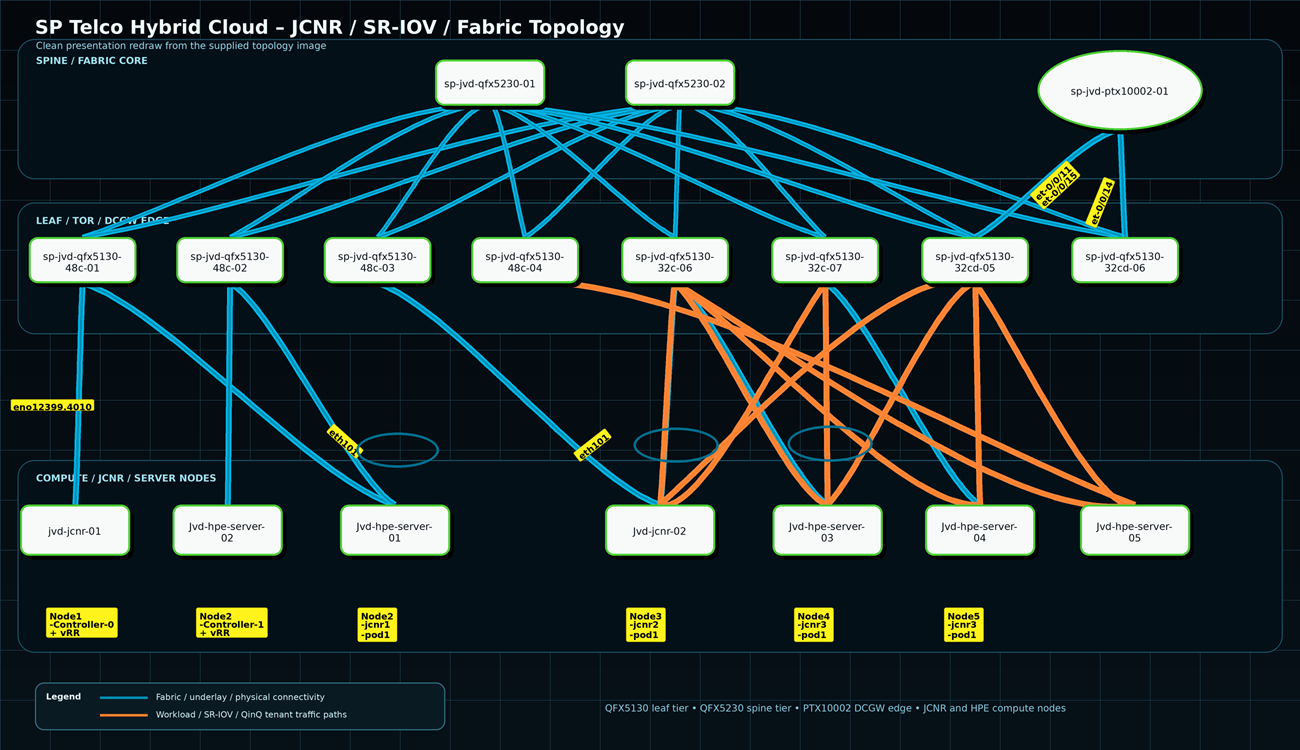
The test bed environment consists of a 3-stage EVPN/VXLAN fabric managed by Apstra Data Center Director, with six server leaf switches of which two switches are configured as redundant pairs, four single (non-redundant) server leaf switch(non-ESI), and one border leaf switch connected to two spines. An external offramp gateway is also connected to the border leaf switches. A traffic generator is connected to the test ports to the server leaf switches. For the Kubernetes setup, two Kubernetes controllers with virtual route reflectors are configured as master and backup controller. And four worker nodes with JCNR and SR-IOV workload are deployed. And a separate server with SR-IOV is also deployed.
Figure 41: Telco Cloud Test Bed
Platforms and Devices Under Test (DUT)
Table 9: Devices Under Test
| Server Leaf Switches | Border Leaf Switches | Spine | Offramp Routers | Bare Metal Servers (SR-IOV and JCNR) |
|---|---|---|---|---|
| QFX5130-48C | QFX5130-32CD | QFX5230-64CD | PTX10002-36QDD | HPE DL360 Gen DELL PowerEdge R750 |
Table 10: Tested Optics
| Part number | Optics Name | Device Role | Device Model |
|---|---|---|---|
| 740-061405 | QSFP-100GBASE-SR4 | Server Leaf | QFX5130-32CD |
| 740-058734 | QSFP-100GBASE-SR4 | Server Leaf | QFX5130-32CD |
| 740-089468 | QSFP56-DD-4X100G-LR | Spine | QFX5230-64CD |
| 740-061405 | QSFP-100GBASE-SR4 | Spine | QFX5230-64CD |
| 740-058734 | QSFP-100GBASE-SR4 | Spine | QFX5230-64CD |
| 740-031980 | SFP+-10G-SR | Server Leaf | QFX5130-48C |
| 740-061405 | QSFP-100GBASE-SR4 | Server Leaf | QFX5130-48C |
| 740-058734 | QSFP-100GBASE-SR4 | Server Leaf | QFX5130-48C |
| 740-021308 | SFP+-10G-SR | Server Leaf | QFX5130-48CM QFX5130-48C |
| 740-067442 | QSFP+-40G-SR4 | Server Leaf | QFX5130-48CM |
| 740-061405 | QSFP-100GBASE-SR4 | Server Leaf | QFX5130-48CM |
| 740-032986 | QSFP+-40G-SR4 | Border Leaf | QFX5130-32CD |
| 740-031980 | SFP+-10G-SR | Border Leaf | QFX5130-32CD |
| 740-061405 | QSFP-100GBASE-SR4 | Border Leaf | QFX5130-32CD |
| 740-058734 | QSFP-100GBASE-SR4 | Border Leaf | QFX5130-32CD |
Note: The optics qualified are with respect to the lab setup. The list of optics is not limited to the ones listed in this validated design. For more information on optics and supported platforms refer HPE Juniper Network Hardware compatibility tool.
Test Bed Configuration
Contact HPE Juniper Networking or your HPE Juniper Networking account representative to obtain the full archive of the test bed configuration used for this validated design.
Test Objectives
This validated design focusses on testing the Telco Cloud Solution that combines EVPN-VXLAN based fabrics with host-based networking (JCNR/HBR) and SR-IOV based high-performance workload connectivity. The objective is to verify end-to-end functionality, tenant isolation, scalability and operational behavior of the solution that are the key aspects of the Telco Cloud Solution. The qualification is performed using Juniper products listed in Table 9: Devices Under Test and with software products listed in Table 11: Juniper Software and Version.
Table 11: Juniper Software and Version
| HPE Juniper Networking Products | Software or Image Version |
|---|---|
| Apstra Data Center Director | 6.2 |
| Juniper OS Evolved | 25.2X100-D30 |
| JCNR | 25.2 |
Test Goals
Following are the testing goals for this solution:
Apstra Deployment Validation
- Validate 3-stage Service Provider EVPN/VXLAN Datacenter deployment using Apstra Data Center Director.
- Validate IPV6 underlay in the fabric with Apstra 6.2
- Validate solution supports overlay and underlay eBGP built using Apstra Data Center Director.
- Validate Solutions supports IRB configuration on Border leaf switches
- Provision Offramp Gateway - PTX10002-36QDD
Hardware Validation
- Validate all the required Juniper Platforms are suitable for the role as shown in Table 2: Telco Cloud Service Provider Devices and Positioning and support the features required for Service Provider 3-stage EVPN-VXLAN deployment.
- Validate the optics described in Table 10: Tested Optics
Feature Validation
- Validate all features listed in this validated design and as listed in Table 4: Apstra Intent Based DC Reference.
- Validate EBGP sessions are established between Leaf and Spine nodes
- Validate BFD sessions are established for all EBGP sessions. Validate sub-second convergence
- Validate solution supports Overlapping VLAN, VNIs across the fabric
- Validate solution support Multiple VLAN-Aware, VLAN Bundle MAC-VRF routing instance for Layer 2
- Validate solution supports EVPN Type 5 and Type2 routes with IRB only configured on Border leaf switches.
- Validate all the scenarios listed in Traffic Workflow Scenarios
- Validate EVPN-VXLAN control-plane behavior, including MAC-VRF and IP-VRF creation, route propagation and tenant isolation across the fabric.
- Validate host-based routing using JCNR, including correct establishment of MPLS-over-UDP tunnels between JCNR instances and offramp gateway devices over the IP fabric.
- Validate tenant Layer 3 overlay connectivity using JCNR (intra-tenant communication) and confirm strict isolation between different tenants.
- Validate SR-IOV-based workload connectivity on bare-metal servers, including direct Virtual function (VF) attachment VLAN tagging, and correct forwarding into the EVPN-VXLAN fabric.
- Validate Q-in-Q based tenant isolation for SR-IOV workloads, allowing overlapping C-VLAN and IP assignments across tenants while maintaining strict separation using S-VLANs.
- Validate correct VXLAN transport of S-VLAN/C-VLAN traffic across the fabric and proper handoff at border leaves and offramp gateway devices.
- Validate controlled inter VRF, inter-subnet via designated Policy Enforcement Points.
- Validate north–south traffic flows via DCGW/off-ramp to external networks or simulated hyperscaler environments.
Resiliency Validation
- Validate operational consistency across mixed traffic profiles (JCNR overlay traffic and SR-IOV traffic operating simultaneously).
- Verify resiliency and convergence behavior under failure scenarios, including link failures, node reloads, and offramp gateway or JCNR restarts, while preserving tenant isolation.
Test Non-Goals
The following items are explicitly considered out of scope for this validated design:
- Hybrid Telco Cloud validation, which is a non-goal for this deployment and will be covered in a future release.
- Advanced security policy validation, including firewall rule correctness and threat detection beyond ensuring traffic passes through the designated Policy Enforcement Point.
- Kubernetes application workload validation, including performance testing on the compute infrastructure.
- Juniper Cloud Native Router (JCNR) supports the addition of a cSRX container. This capability is out of scope for Phase 1 of this Validated Design and was not deployed.
- Apstra Freeform and the terraform resources for Freeform although used to deploy Offramp-gateway is a non-goal.