
Use Case and Reference Architecture
The Telco cloud solution simplifies the design, deployment, and operation of modern, cloud-native software. The solution enables Private Telco Providers to build multi-tenant environment without compromising on security, scale or performance. Hybrid Telco architecture is shown in Figure 1: Hybrid Telco Cloud Solution Architecture which covers broadly two uses cases:
Private Telco Cloud Solution
A private Telco cloud utilizes a dedicated, on-premises infrastructure to run applications that are time sensitive low latency 5G workloads that require minimal latency. Also, sensitive customer data often remain on-premises environment to ensure regulatory and security compliance.
In Phase 1, the Private Telco cloud solution is deployed and qualified. This deployment validates the integration between the QFX Series-based Data Center fabric and Telco cloud workload compute. The compute platform consists of bare-metal nodes utilizing SR-IOV, Kubernetes pods running application workloads, and Juniper Cloud-Native Router (JCNR) as secondary CNI along with meta-CNI Multus to provision multiple pod interfaces. The JCNR CNI leverages virtio (Virtual Input/Output) interfaces to forward high-throughput traffic directly into the DPDK-accelerated Cloud-Native vRouter data plane. Finally, an Offramp Gateway is integrated to manage inter-tenant routing and facilitate bidirectional traffic between SR-IOV workloads and JCNR.
Hybrid (Private-Public) Telco Cloud Solution
Hybrid Telco cloud integrates the on-premises infrastructure with public cloud resources to efficiently manage mission critical applications and predictable on-demand high intensity workloads. Apart from that, public cloud can be used as disaster recovery (DR) site or for backups of non-sensitive data. During peak congestion, public clouds can offer respite by sharing the workloads with private cloud. And since public clouds are adopting Artificial Intelligence (AI), private clouds are leveraging these AI services to run complex AI training jobs that are cost effective to run on public cloud.
Figure 1: Hybrid Telco Cloud Solution Architecture
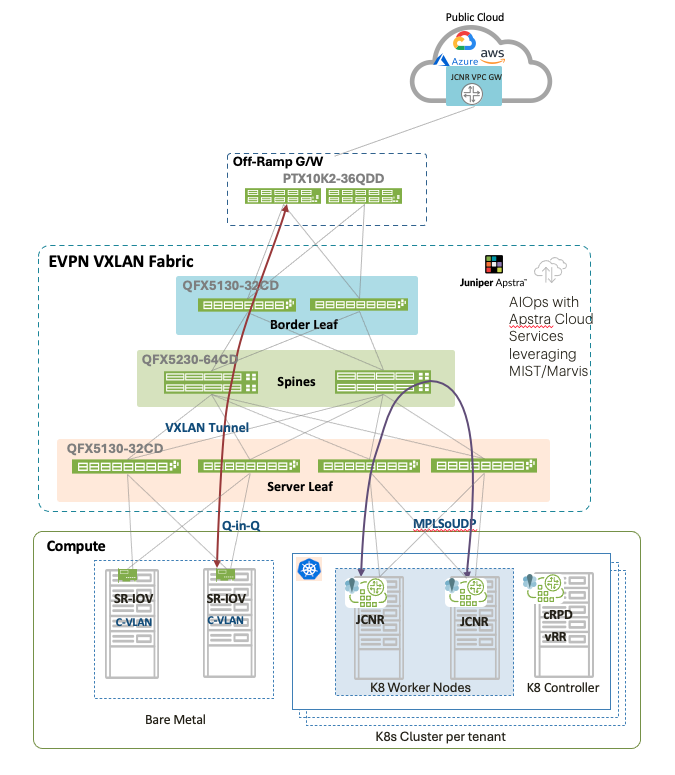
Figure 1: Hybrid Telco Cloud Solution Architecture, shows a high-level architecture of Hybrid Telco Cloud components which consists of the private telco components - Data center fabric as transport layer, compute shows the SR-IOV bare metal servers and the Kubernetes cluster for each tenant hosting the workload and JCNR pods with DPDK vRouter. The compute layer also consists of the storage servers that may be assigned to a particular tenant or shared. The offramp gateway allows for inter-tenant communications and for SR-IOV to JCNR workload.
Apstra provides the intent-based management of the multi-tenant EVPN Private cloud Fabric using QFX5130-32CD as Server and Border leaf switches, QFX5230-64CD as Spines. On the private Telco side, Service Providers can bring their own compute and deployment framework to host applications without worrying about the Fabric.