
Overview
Multicast traffic is fundamental to stock exchange networks, primarily used for the efficient and simultaneous distribution of real-time market data such as quotes, trades, and order book updates to a large number of trading participants. This ensures fairness, as all clients receive the same data at nearly the same time, supporting synchronized decision-making and competitive parity. Given the extremely high volume and velocity of market data, multicast traffic provides a scalable solution by avoiding an overhead of duplicate data streams for each recipient, unlike unicast traffic. However, as multicast typically uses UDP, which lacks retransmission, packet loss must be minimized through a reliable and lossless network design. Figure 1 illustrates an overview of the finance and stock exchange network. In the stock exchange, typically two identical multicast data feeds are sent to brokerage clients. This is commonly referred to as the primary and secondary feeds over separate multicast groups and often across diverse network paths. Brokerage clients subscribe to both feeds simultaneously, with their feed handlers continuously checking packet sequence numbers to detect and correct any loss. If a packet is missing from one stream, it can be instantly recovered from the alternate feed, ensuring no data gaps in trading applications.
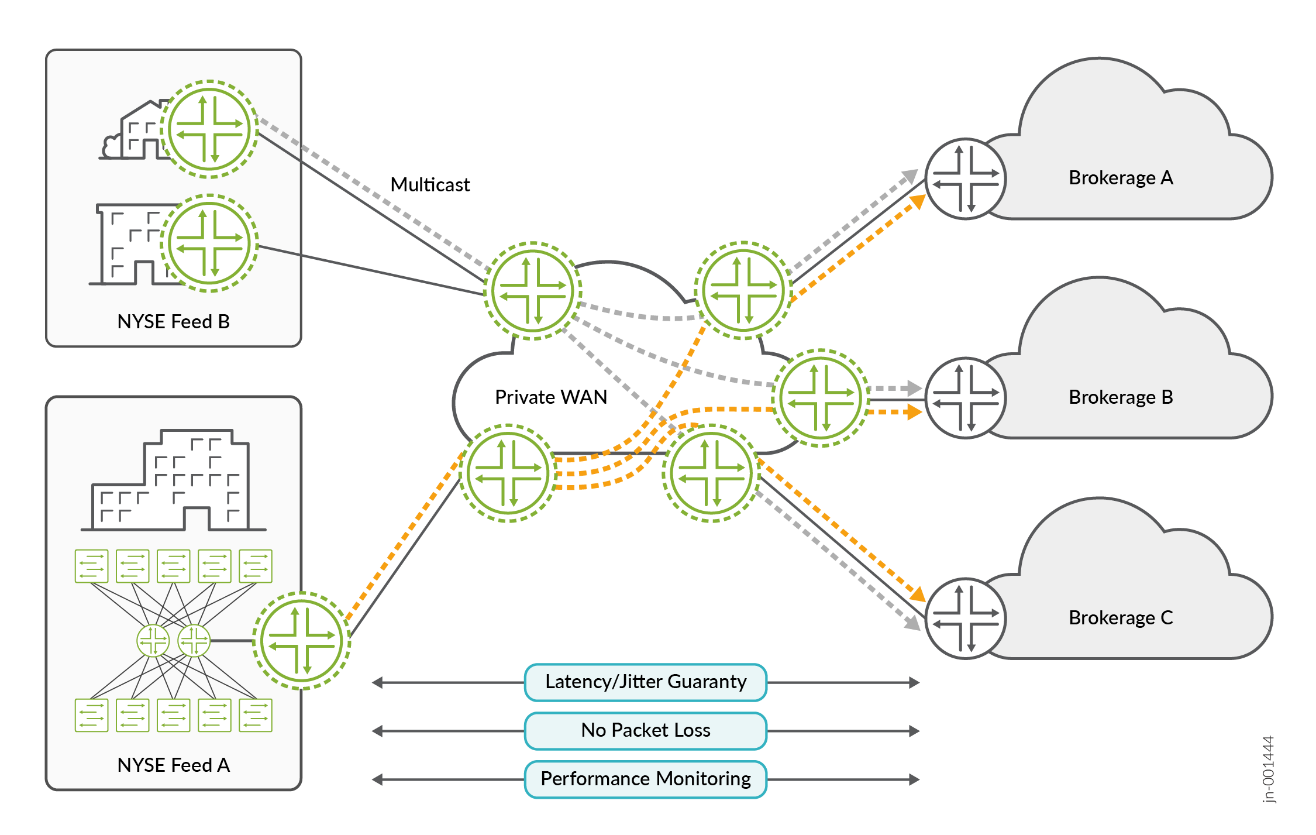
Low latency and jitter are critical requirements for finance and stock exchange networks. Protocols such as Internet Group Management Protocol (IGMP) and Protocol-Independent Multicast (PIM) handle multicast group membership and route traffic efficiently. IGMP snooping and hardware-based multicast replication ensure high performance and minimal network strain traffic. Next-Generation Multicast VPN (NG-MVPN), which utilizes MPLS as its transport data plane and delivers a more scalable, resilient, and bandwidth-efficient approach for multicast distribution over MPLS backbones. This model enables market exchanges and data providers to replicate multicast streams closer to the subscriber edge, reducing the burden on the network core while ensuring predictable and reliable delivery of real-time multicast. Strict quality of service (QoS) policies prioritizes multicast traffic, and access control mechanisms prevent unauthorized access to sensitive data streams. Continuous monitoring helps ensure the integrity and performance of multicast delivery, making it a cornerstone of modern stock exchange infrastructure.
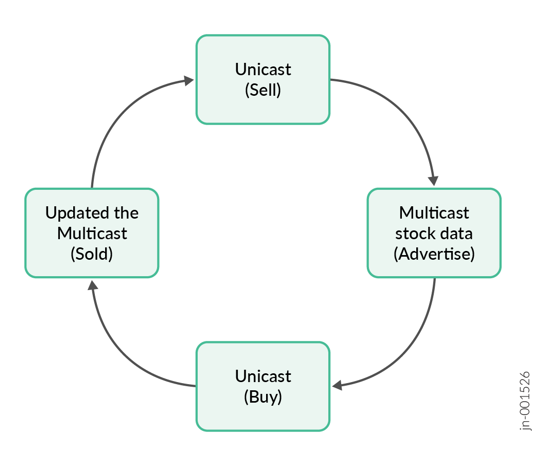
In stock exchange market when the participant wants to buy or sell on an exchange, they send a unicast traffic towards the exchange's servers. The participants do not communicate directly and there is a firewall policy that prevents the participants from communicating with each other (in another words, the participants can only send packets between the exchange's servers). Exchange is basically like an auction where participants post things they want to sell on the exchange for a certain price (this is unicast), then the exchange advertises it (this is multicast), and if someone wants to buy it, they tell the exchange that they want to buy it (this is unicast). Then the exchange advertises that the item is sold (this is multicast).
Transaction part: unicast (sell) --> multicast (advertise ) --> unicast (buy ) ---> updated multicast (sold).
In this JVD, the next generation of ACX Series and MX Series platforms introduces support for the 100G access segment. The Juniper Networks ACX7100-48L Cloud Metro Router acts as a CPE device, and the MX480, the MX304, the MX10004, and the MX10008 function as PE devices.