AI Use Case and Reference Design
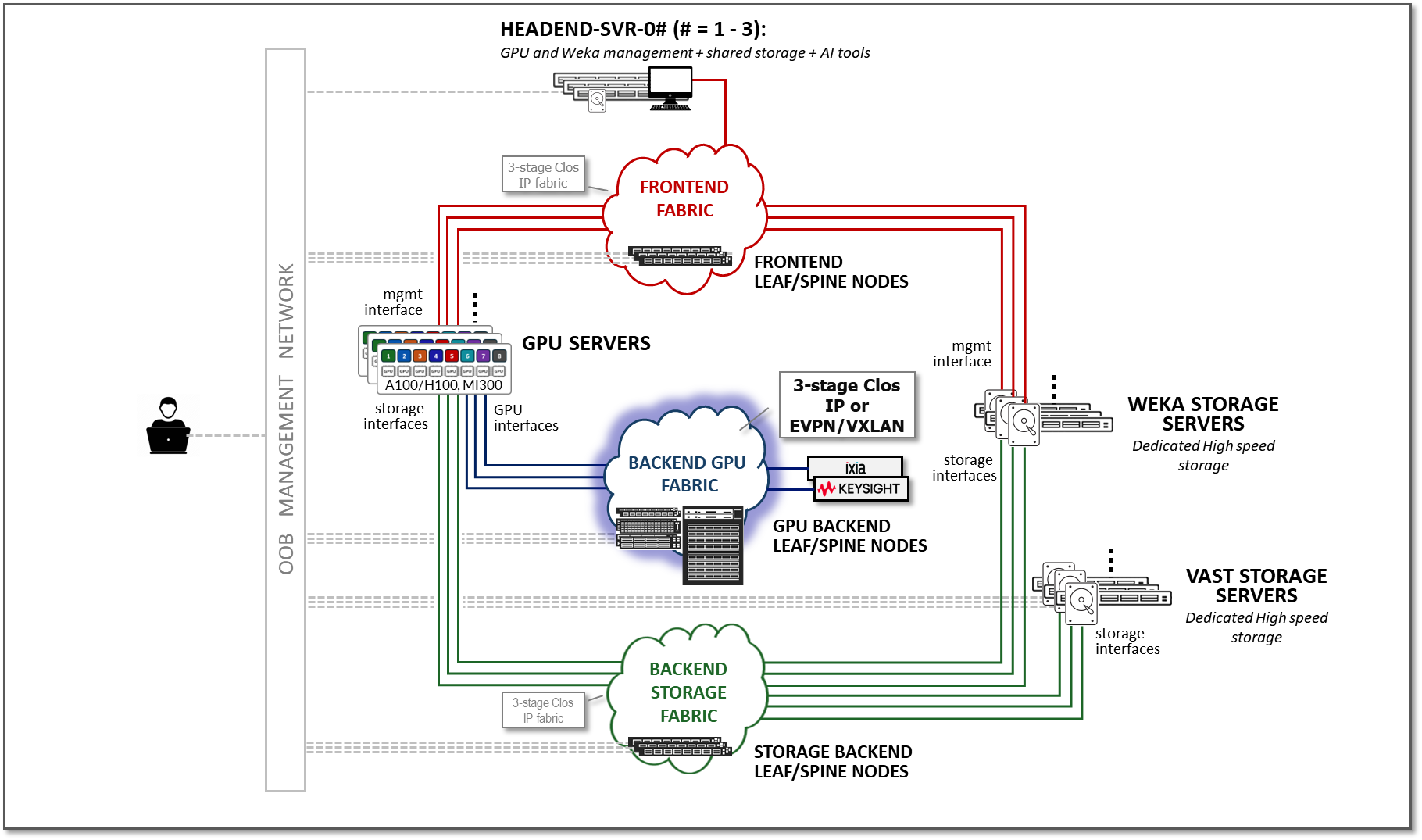
The AI JVD Reference Design covers a complete end-to-end ethernet-based AI infrastructure, which includes the Frontend fabric, GPU Backend fabric and Storage Backend fabric. These three fabrics have a symbiotic relationship, while each provides unique functions to support AI training and inference tasks. The use of Ethernet Networking in AI Fabrics enables our customers to build high-capacity, easy-to-operate network fabrics that deliver the fastest job completion times, maximize GPU utilization, and use limited IT resources.
The AI JVD reference design shown in Figure 1: AI JVD Reference includes:
- Frontend Fabric: This fabric is the gateway network to the GPU nodes and storage nodes from the AI tools residing in the headend servers. The Frontend GPU fabric allows users to interact with the GPU and storage nodes to initiate training or inference workloads and to visualize their progress and results. It also provides an out-of-band path for NCCL ( NVIDIA Collective Communications Library ) collective communication.
- GPU Backend Fabric: This fabric connects the GPU nodes (which perform the computations tasks for AI workflows). The GPU Backend fabric transfers high-speed information between GPUs during training jobs, in a lossless manner. Traffic generated by the GPUs is transferred using RoCEv2 (RDMA over Ethernet v2).
- Storage Backend Fabric: This fabric connects the high-availability storage systems (which hold the large model training data) and the GPUs (which consume this data during training or inference jobs). The Storage Backend fabric transfers high volumes of data in a seamless and reliable manner.
Figure 1: AI JVD Reference Design