
Flexible Algorithm and Flexible Algorithm Prefix Metrics Leaking across IS-IS Multi-Instance
We've added support to readvertise flexible algorithm (flex algo) prefix-segment identifiers (SIDs) and Flexible Algorithm Prefix Metrics (FAPMs) across interior gateway protocol (IGP) instances. We’ve also added support to readvertise prefixes from other protocols and assign flex algo prefix-SIDs via policy to those prefixes.
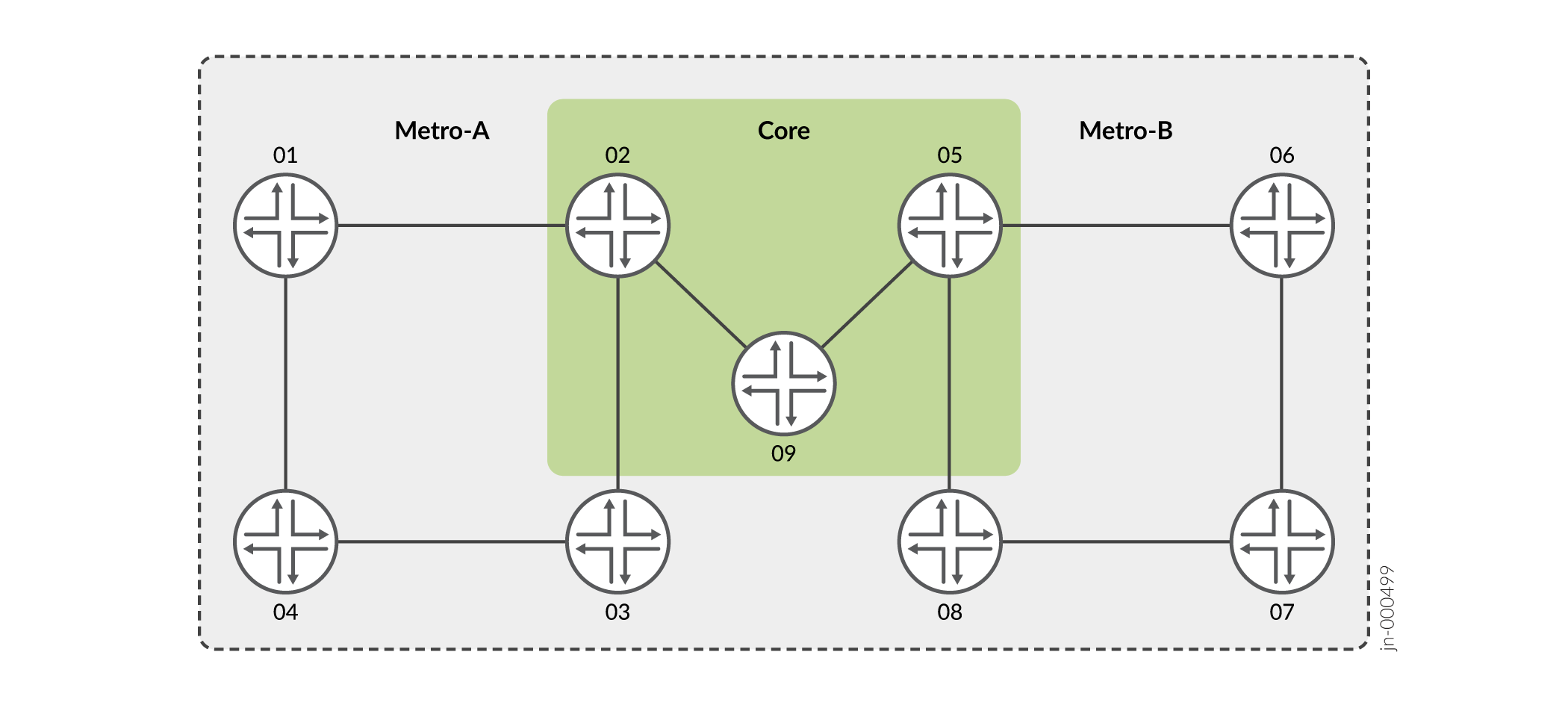
In the sample topology shown in #id-understanding-isis-flexible-algorithm-for-segment-routing__fig_flex_algo_1, different IS-IS domains, metro-A, metro-B, and the core, constitute a single-segment routing domain. For an end-to-end segment routing flex algo path, nodes 02 and 05 must readvertise flex algo prefix-SIDs and FAPMs across IGP instances.
Flex algo routes are installed in inet(6)color.0 tables. They could also be
installed in colored RIBs, such as junos-rti-tc-<color>.inet(6).3 when
use-transport-class statement is configured under routing-options
flex-algorithm <id>. To support leaking flex algo prefix-SIDs across IGP
instances, the use-transport-class statement must be configured for that flex
algo. Leaking of flex algo prefix-SIDs across IGP instances is policy driven. A sample policy
configuration is as follows:
[edit policy-options policy-statement name]
user@host# show
from {
    igp-instance <x>; (optional)
    protocol isis; (optional)
    rib <transport-class-rib>;
    route-filter 10.10.10.0/24 orlonger; (optional)
    route-filter 10.20.20.0/24 orlonger; (optional)
    prefix-segment; (optional)
}
then {
    prefix-segment {
        redistribute;
    }
}
When flex algo prefix-SIDs are leaked across IGP instances, FAPM sub-TLV will be advertised with the metric derived from the export policy or the route’s own metric. The metric defined in the export policy has higher precedence over the route’s own metric. Additionally, IS-IS installs a stitched route in the mpls.0 tables to stitch incoming MPLS traffic from one IGP instance to the other.
For information on how to apply export policy on multi-instance IS-IS, see export.