
Security Policies for VXLAN
Configure Security Policies for VXLAN
Use this example to configure security policies for EVPN (Ethernet VPN) Virtual Extensible LAN (VXLAN) tunnel inspection.
Requirements
VXLAN support on SRX Series Firewalls provides the flexibility to bring an enterprise grade firewall to connect end points in their campus, data center, branch and public cloud environments while providing embedded security.
This example uses the following hardware and software components:
SRX4600 device
Junos OS Release 20.4R1
Before you begin:
Make sure you understand how EVPN and VXLAN works.
Overview
The EVPN solution provides large enterprises a common framework used to manage their campus and data center networks. An EVPN-VxLAN architecture supports efficient Layer 2 and Layer 3 network connectivity with scale, simplicity, and agility. Figure 1 shows an simplified VXLAN traffic flow topology.
Topology
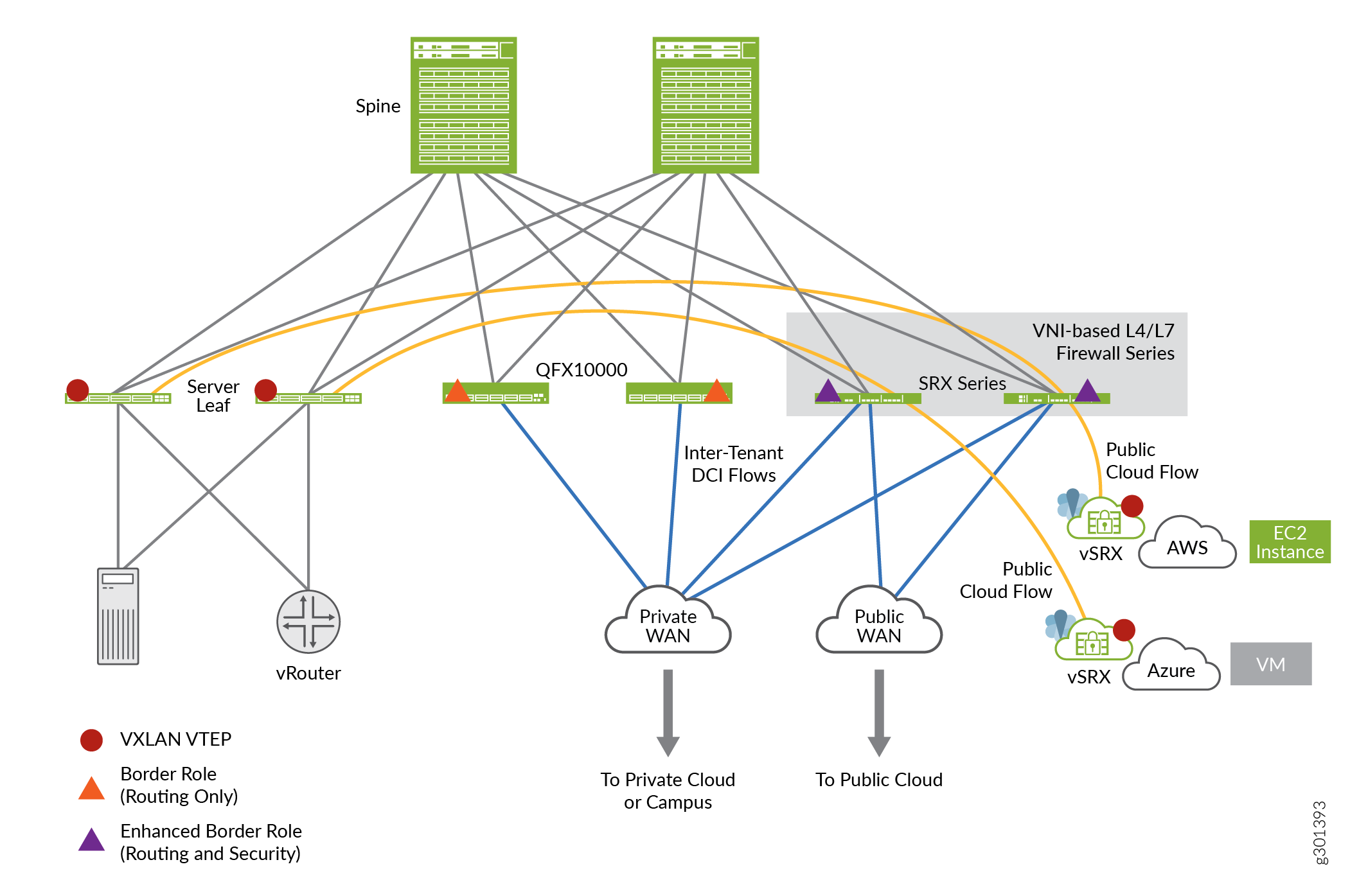
Configuration
CLI Quick Configuration
To quickly configure this example, copy the
following commands, paste them into a text file, remove any line breaks,
change any details necessary to match your network configuration,
copy and paste the commands into the CLI at the [edit] hierarchy
level, and then enter commit from configuration mode.
set security zones security-zone cloud-1
set security zones security-zone dc
set security tunnel-inspection inspection-profile ins-pf1 vxlan vx1 vni r1
set security tunnel-inspection inspection-profile ins-pf1 vxlan vx1 vni r2
set security tunnel-inspection inspection-profile ins-pf1 vxlan vx1 vni r3
set security tunnel-inspection inspection-profile ins-pf1 vxlan vx1 vni r4
set security tunnel-inspection inspection-profile ins-pf1 vxlan vx1 policy-set pset1
set security tunnel-inspection vni r1 vni-range 160 to 200
set security tunnel-inspection vni r2 vni-id 155
set security tunnel-inspection vni r3 vni-range 300 to 399
set security tunnel-inspection vni r4 vni-range 100 to 120
set security tunnel-inspection vni v1 vni-range 1 to 100
set security policies from-zone dc to-zone cloud-1 policy p1 match source-address any
set security policies from-zone dc to-zone cloud-1 policy p1 match destination-address any
set security policies from-zone dc to-zone cloud-1 policy p1 match application junos-vxlan
set security policies from-zone dc to-zone cloud-1 policy p1 then permit tunnel-inspection ins-pf1
set security policies from-zone cloud-1 to-zone dc policy p1 match source-address any
set security policies from-zone cloud-1 to-zone dc policy p1 match destination-address any
set security policies from-zone cloud-1 to-zone dc policy p1 match application junos-vxlan
set security policies from-zone cloud-1 to-zone dc policy p1 then permit tunnel-inspection ins-pf1
set security policies policy-set pset1 policy pset_p1 match source-address any
set security policies policy-set pset1 policy pset_p1 match destination-address any
set security policies policy-set pset1 policy pset_p1 match application any
set security policies policy-set pset1 policy pset_p1 then permit
set security policies default-policy deny-all
Procedure
Step-by-Step Procedure
The following example requires you to navigate various levels in the configuration hierarchy. For instructions on how to do that, see Using the CLI Editor in Configuration Mode in the Junos OS CLI User Guide.
To configure VXLAN:
Define Security Zones.
[edit security zones]
user@host# set security-zone cloud-1
user@host# set zones security-zone dc
Define tunnel-inspection profile.
[edit security tunnel-inspection]
user@host# set inspection-profile ins-pf1 vxlan vx1 vni r1
user@host# set inspection-profile ins-pf1 vxlan vx1 vni r2
user@host# set inspection-profile ins-pf1 vxlan vx1 vni r3
user@host# set inspection-profile ins-pf1 vxlan vx1 vni r4
user@host# set inspection-profile ins-pf1 vxlan vx1 policy-set pset1
user@host# set vni r1 vni-range 160 to 200
user@host# set vni r2 vni-id 155
user@host# set vni r3 vni-range 300 to 399
user@host# set vni r4 vni-range 100 to 120
user@host# set vni v1 vni-range 1 to 100
Define outer session policies.
[edit security policies]
user@host# set from-zone dc to-zone cloud-1 policy p1 match source-address any
user@host# set from-zone dc to-zone cloud-1 policy p1 match destination-address any
user@host# set from-zone dc to-zone cloud-1 policy p1 match application junos-vxlan
user@host# set from-zone dc to-zone cloud-1 policy p1 then permit tunnel-inspection profile-1
user@host# set from-zone cloud-1 to-zone dc policy p1 match source-address any
user@host# set from-zone cloud-1 to-zone dc policy p1 match destination-address any
user@host# set from-zone cloud-1 to-zone dc policy p1 match application junos-vxlan
user@host# set from-zone cloud-1 to-zone dc policy p1 then permit tunnel-inspection ins-pf1
Define policy-set.
[edit security policies]
user@host# set policy-set pset1 policy pset_p1 match source-address any
user@host# set policy-set pset1 policy pset_p1  destination-address any
user@host# set policy-set pset1 policy pset_p1  match application any
user@host# set policy-set pset1 policy pset_p1 then permit
user@host# set default-policy deny-all
Results
From configuration mode, confirm your configuration
by entering the show security policies command. If the
output does not display the intended configuration, repeat the configuration
instructions in this example to correct it.
user@host# show security policies
from-zone dc to-zone cloud-1 {
    policy p1 {
        match {
            source-address any;
            destination-address any;
            application junos-vxlan;
        }
        then {
            permit {
                tunnel-inspection {
                    ins-pf1;
                }
            }
        }
    }
}
from-zone cloud-1 to-zone dc {
    policy p1 {
        match {
            source-address any;
            destination-address any;
            application junos-vxlan;
        }
        then {
            permit {
                tunnel-inspection {
                    ins-pf1;
                }
            }
        }
    }
}
policy-set pset1 {
    policy pset_p1 {
        match {
            source-address any;
            destination-address any;
            application any;
        }
        then {
            permit;
        }
    }
}
default-policy {
    deny-all;
}
If you are done configuring the feature on your device, enter commit from configuration mode.
Verification
Verify tunnel inspection profiles and VNI
Purpose
Verify that the tunnel inpection profile and VNI are confugured..
Action
From operational mode, enter the show security
tunnel-inspection profiles ins-pf1 and show security tunnel-inspection
vnis commands.
user@host> show security tunnel-inspection profiles ins-pf1
node0:
--------------------------------------------------------------------------
Logical system: root-logical-system
  Profile count: 1
  Profile: ins-pf1
    Type: VXLAN
    Vxlan count: 1
    Vxlan name: vx1
    VNI count: 4
      VNI:r1, r2, r3, r4
      Policy set: pset1
Inspection level: 1user@host> show security tunnel-inspection vnis
node0:
--------------------------------------------------------------------------
Logical system: root-logical-system
VNI count: 5
VNI name: r1
VNI id count: 1
[160 - 200]
VNI name: r2
VNI id count: 1
[155 - 155]
VNI name: r3
VNI id count: 1
[300 - 399]
VNI name: r4
VNI id count: 1
[100 - 120]
VNI name: v1
VNI id count: 1
[1 - 100]Meaning
The output displays that the VXLAN feature is enabled and there are no safe search redirects and safe search rewrites.
Verify Safe Search Function
Purpose
Verify that the safe search feature is enabled for Content Security Web filtering solutions.
Action
From operational mode, enter the Show security
flow tunnel-inspection statistic command to view the tunnel-inspection
statistics.
user@host> show security flow tunnel-inspection statistics
node0:
--------------------------------------------------------------------------

  Flow Tunnel-inspection statistics:
  Tunnel-inspection statistics of FPC4 PIC1:
  Tunnel-inspection type VXLAN:
    overlay session active:             0
    overlay session create:           269
    overlay session close:            269
    underlay session active:            0
    underlay session create:          566
    underlay session close:           566
    input packets:       349717
    input bytes:      363418345
    output packets:      348701
    output bytes:     363226339
    bypass packets:         501
    bypass bytes:         50890

  Tunnel-inspection statistics of FPC4 PIC2:
  Tunnel-inspection type VXLAN:
    overlay session active:             0
    overlay session create:           270
    overlay session close:            270
    underlay session active:            0
    underlay session create:          586
    underlay session close:           586
    input packets:       194151
    input bytes:      200171306
    output packets:      193221
    output bytes:     199987258
    bypass packets:         617
    bypass bytes:         92902

  Tunnel-inspection statistics of FPC4 PIC3:
  Tunnel-inspection type VXLAN:
    overlay session active:             0
    overlay session create:           275
    overlay session close:            275
    underlay session active:            0
    underlay session create:          615
    underlay session close:           615
    input packets:       216486
    input bytes:      222875066
    output packets:      213827
    output bytes:     222460378
    bypass packets:        2038
    bypass bytes:        270480

  Tunnel-inspection statistics summary:
  Tunnel-inspection type VXLAN:
    overlay session active:             0
    overlay session create:           814
    overlay session close:            814
    underlay session active:            0
    underlay session create:         1767
    underlay session close:          1767
    input packets:       760354
    input bytes:      786464717
    output packets:      755749
    output bytes:     785673975
    bypass packets:        3156
    bypass bytes:        414272

node1:
--------------------------------------------------------------------------

  Flow Tunnel-inspection statistics:
  Tunnel-inspection statistics of FPC4 PIC1:
  Tunnel-inspection type VXLAN:
    overlay session active:             0
    overlay session create:           269
    overlay session close:            269
    underlay session active:            0
    underlay session create:          566
    underlay session close:           566
    input packets:            0
    input bytes:              0
    output packets:           0
    output bytes:             0
    bypass packets:           0
    bypass bytes:             0

  Tunnel-inspection statistics of FPC4 PIC2:
  Tunnel-inspection type VXLAN:
    overlay session active:             0
    overlay session create:           270
    overlay session close:            270
    underlay session active:            0
    underlay session create:          586
    underlay session close:           586
    input packets:            0
    input bytes:              0
    output packets:           0
    output bytes:             0
    bypass packets:           0
    bypass bytes:             0

  Tunnel-inspection statistics of FPC4 PIC3:
  Tunnel-inspection type VXLAN:
    overlay session active:             0
    overlay session create:           275
    overlay session close:            275
    underlay session active:            0
    underlay session create:          615
    underlay session close:           615
    input packets:            0
    input bytes:              0
    output packets:           0
    output bytes:             0
    bypass packets:           0
    bypass bytes:             0

  Tunnel-inspection statistics summary:
  Tunnel-inspection type VXLAN:
    overlay session active:             0
    overlay session create:           814
    overlay session close:            814
    underlay session active:            0
    underlay session create:         1767
    underlay session close:          1767
    input packets:            0
    input bytes:              0
    output packets:           0
    output bytes:             0
    bypass packets:           0
    bypass bytes:             0
Meaning
The output displays that the VXLAN feature is enabled and there are no safe search redirects and safe search rewrites.