
Example: Configuring Flow Collection
Figure 1 shows the path traveled by monitored traffic as it passes through the router. Packets arrive at input interfaces so-0/1/0, so-3/0/0, and so-3/1/0. The raw packets are directed into a filter-based forwarding routing instance and processed into cflowd records by the monitoring services interfaces mo-7/1/0, mo-7/2/0, and mo-7/3/0. The cflowd records are compressed into files at the flow collector interfaces cp-6/0/0 and cp-7/0/0 and sent to the FTP server for analysis. Finally, a mandatory class-of-service (CoS) configuration is applied to export channels 0 and 1 on the flow collector interfaces to manage the outgoing processed files.
Figure 1: Flow Collector Interface Topology
Diagram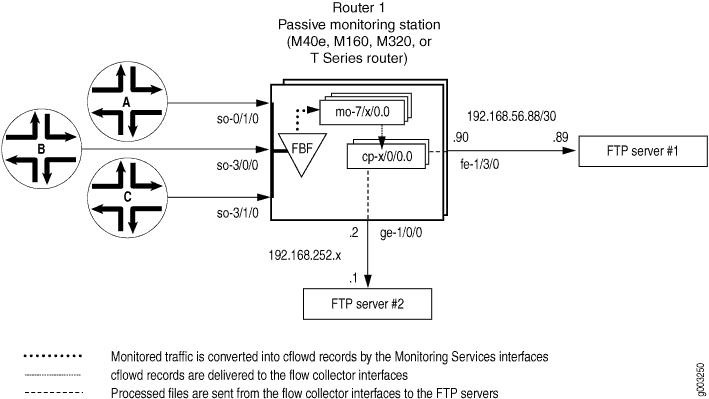
 [edit]
chassis {
    fpc 6 {
        pic 0 {
            monitoring-services {
                application flow-collector; # This converts a Monitoring Services II or
                                   # Multiservices 400 PIC into a flow collector interface.
            }
        }
    }
    fpc 7 {
        pic 0 {
            monitoring-services {
                application flow-collector; # This converts a Monitoring Services II or
                                   # Multiservices 400 PIC into a flow collector interface.
            }
        }
    }
}
interfaces {
    cp-6/0/0 {
        unit 0 { # Logical interface .0 on a flow collector interface is export
            family inet { # channel 0 and sends records to the FTP server.
                filter {
                    output cp-ftp; # Apply the CoS filter here.
                }
                address 10.0.0.1/32 {
                    destination 10.0.0.2;
                }
            }
        }
        unit 1 { # Logical interface .1 on a flow collector interface is export
            family inet {# channel 1 and sends records to the FTP server.
                filter {
                    output cp-ftp; # Apply the CoS filter here.
                }
                address 10.1.1.1/32 {
                    destination 10.1.1.2;
                }
            }
        }
        unit 2 { # Logical interface .2 on a flow collector interface is the flow
            family inet { # receive channel that communicates with the Routing Engine.
                address 10.2.2.1/32 { # Do not apply a CoS filter on logical interface .2.
                    destination 10.2.2.2;
                }
            }
        }
    }
    cp-7/0/0 {
        unit 0 {# Logical interface .0 on a flow collector interface is export
            family inet {# channel 0 and sends records to the FTP server.
                filter {
                    output cp-ftp;# Apply the CoS filter here.
                }
                address 10.3.3.1/32 {
                    destination 10.3.3.2;
                }
            }
        }
        unit 1 {# Logical interface .1 on a flow collector interface is export
            family inet {# channel 1 and sends records to the FTP server.
                filter {
                    output cp-ftp;# Apply the CoS filter here.
                }
                address 10.4.4.1/32 {
                    destination 10.4.4.2;
                }
            }
        }
        unit 2 {# Logical interface .2 on a flow collector interface is the flow
            family inet {# receive channel that communicates with the Routing Engine.
                address 10.5.5.1/32 {# Do not apply a CoS filter on logical interface .2.
                    destination 10.5.5.2;
                }
            }
        }
    }
    fe-1/3/0 { # This is the exit interface leading to the first FTP server.
        unit 0 {
            family inet {
                address 192.168.56.90/30;
            }
        }
    }
    ge-1/0/0 { # This is the exit interface leading to the second FTP server.
        unit 0 {
            family inet {
                address 192.168.252.2/24;
            }
        }
    }
    mo-7/1/0 { # This is the first interface that creates cflowd records.
        unit 0 {
            family inet;
        }
    }
    mo-7/2/0 { # This is the second interface that creates cflowd records.
        unit 0 {
            family inet;
        }
    }
    mo-7/3/0 { # This is the third interface that creates cflowd records.
        unit 0 {
            family inet;
        }
    }
    so-0/1/0 { # This is the first input interface that receives traffic to be monitored.
        encapsulation ppp;
        unit 0 {
            passive-monitor-mode; # This allows the interface to be passively monitored.
            family inet {
                    filter {
                        input catch; # The filter-based forwarding filter is applied here.
                    }
            }
        }
    }
    so-3/0/0 { # This is the second interface that receives traffic to be monitored.
        encapsulation ppp;
        unit 0 {
            passive-monitor-mode; # This allows the interface to be passively monitored.
            family inet {
                    filter {
                        input catch; # The filter-based forwarding filter is applied here.
                    }
            }
        }
    }
so-3/1/0 { # This is the third interface that receives traffic to be monitored.
    encapsulation ppp;
    unit 0 {
        passive-monitor-mode; # This allows the interface to be passively monitored.
        family inet {
            filter {
                input catch; # The filter-based forwarding filter is applied here.
            }
        }
    }
}
forwarding-options {
    monitoring group1 {# Always define your monitoring group here.
        family inet {
            output {
                export-format cflowd-version-5;
                flow-active-timeout 60;
                flow-inactive-timeout 15;
                flow-export-destination collector-pic;  # Sends records to the flow collector.
                interface mo-7/1/0.0 {
                    source-address 192.168.252.2;
                }
                interface mo-7/2/0.0 {
                    source-address 192.168.252.2;
                }
                interface mo-7/3/0.0 {
                    source-address 192.168.252.2;
                }
            }
        }
}
firewall {
    family inet {
        filter cp-ftp { # This filter provides CoS for flow collector interface traffic.
            term t1 {
                then forwarding-class expedited-forwarding;
            }
        }
    }
    filter catch { # This firewall filter sends incoming traffic into the
        interface-specific;# filter-based forwarding routing instance.
            term def {
                then {
                    count counter;
                    routing-instance fbf_instance;
                }
            }
        }
    }
routing-options {
    interface-routes {
        rib-group inet common;
    }
    rib-groups {
        common {
            import-rib [inet.0 fbf_instance.inet.0];
        }
    }
    forwarding-table {
        export pplb;
    }
}
policy-options {
    policy-statement pplb {
        then {
            load-balance per-packet;
        }
    }
}
routing-instances {
    fbf_instance { # This instance sends traffic to the monitoring services interface.
        instance-type forwarding;
        routing-options {
            static {
                route 0.0.0.0/0 next-hop mo-7/1/0.0;
            }
        }
    }
}
class-of-service { # A class-of-service configuration for the flow collector interface
    interfaces { # is required for flow collector services.
        cp-6/0/0 {
            scheduler-map cp-map;
        }
        cp-7/0/0 {
            scheduler-map cp-map;
        }
    }
}
scheduler-maps {
    cp-map {
        forwarding-class best-effort scheduler Q0;
        forwarding-class expedited-forwarding scheduler Q1;
        forwarding-class network-control scheduler Q3;
    }
}
schedulers {
    Q0 {
        transmit-rate remainder;
        buffer-size percent 90;
    }
    Q1 {
        transmit-rate percent 5;
        buffer-size percent 5;
        priority strict-high;
    }
    Q3 {
        transmit-rate percent 5;
        buffer-size percent 5;
    }
}
services {
    flow-collector { # Define properties for flow collector interfaces here.
        analyzer-address 10.10.10.1; # This is the IP address of the analyzer.
        analyzer-id server1; # This helps to identify the analyzer.
        retry 3;   # Maximum number of attempts by the PIC to send a file transfer log.
        retry-delay 30; # The time interval between attempts to send a file transfer log.
        destinations { # This defines the FTP servers that receive flow collector output.
            "ftp://user@192.168.56.89//tmp/collect1/" { # The primary FTP server.
                password "$ABC123"; # SECRET-DATA
            }
            "ftp://user@192.168.252.1//tmp/collect2/" { # The secondary FTP server.
                password "$ABC123";  # SECRET-DATA
            }
        }
        file-specification { # Define sets of flow collector characteristics here.
            def-spec {
                name-format "default-allInt-0-%D_%T-%I_%N.bcp.bi.gz";
                data-format flow-compressed; # The default compressed output format.
            } # When no overrides are specified, a collector uses default transfer values.
            f1 {
                name-format "cFlowd-py69Ni69-0-%D_%T-%I_%N.bcp.bi.gz";
                data-format flow-compressed; # The default compressed output format.
                transfer timeout 1800 record-level 1000000; # Here are configured values.
            }
        }
        interface-map { # Allows you to map interfaces to flow collector interfaces.
            file-specification def-spec; # Flows generated for default traffic are sent to the
            collector cp-7/0/0; # default flow collector interface "cp-7/0/0".
            so-0/1/0.0 { # Flows generated for the so-0/1/0 interface are sent
                collector cp-6/0/0; # to cp-6/0/0, and the file-specification used is
            } # "default."
            so-3/0/0.0 { # Flows generated for the so-3/0/0 interface are sent
                file-specification f1; # to cp-6/0/0, and the file-specification used is "f1."
                collector cp-6/0/0;
            }
            so-3/1/0.0; # Because no settings are defined, flows generated for this
        } # interface use interface cp-7/0/0 and the default file specification.
        transfer-log-archive { # Sends flow collector interface log files to an FTP server.
            filename-prefix so_3_0_0_log;
            maximum-age 15;
            archive-sites {
                "ftp://user@192.168.56.89//tmp/transfers/" {
                    password "$ABC123";
                }
            }
        ]
    }
}