
Configuring Bud Node Support
Along a LSP, PE devices function as an ingress device, transit device or egress device. A bud node is a PE device that functions as both an egress and transit device. In a P2MP LSP, you can have devices that will function in the role of a both as a transit device and an egress device.
Figure 1 illustrates a simple EVPN network with a bud node at PE2. When CE1 sends a multicast packet out, PE2 operates as a transit device and forwards the packet to PE3 . It also functions as a egress device and pops the MPLS label and replicates multicast packets destined for CE2.
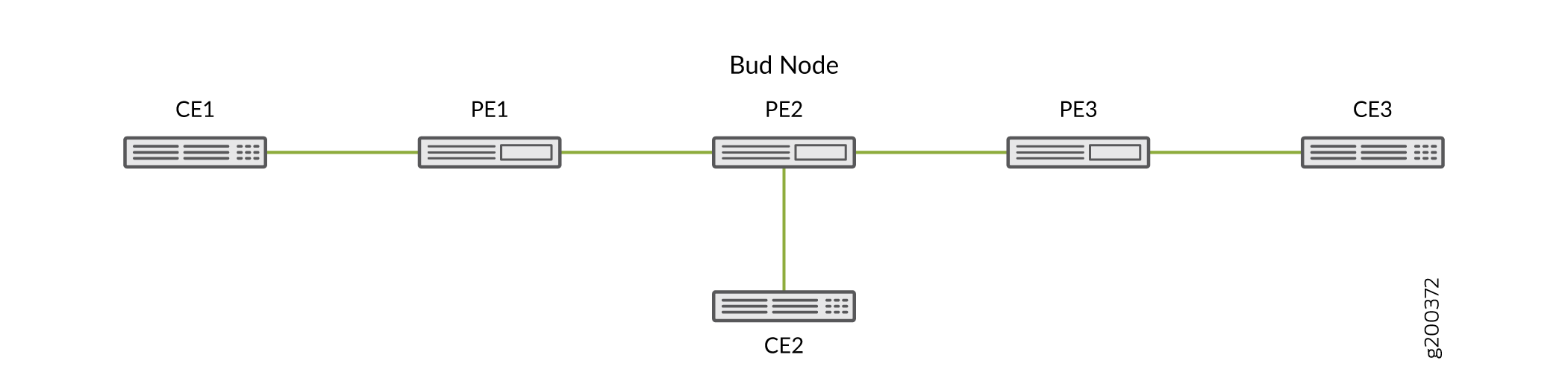
To enable a PE device to function as a bud-node, include p2mp-bud-support statement at the [edit routing-instances
routing-instance-name protocols evpn] hierarchy. When p2mp-bud-support is enabled or disabled, you may observed dropped packets on the
device. This occurs because changing bud node support affects the
forwarding state in the routing instance, which results in the forwarding
table being rebuilt.
We recommend that all PE devices in the LSP that may potentially function as both a egress and transit device be enabled as a bud node.