
Overview
This topic provides an overview of the SRX400 firewall series and their key features.
The SRX400 firewall series deliver secure, cost-effective connectivity for distributed enterprise environments by combining security, routing, switching, WAN interfaces, and hybrid mesh capabilities in a single platform. With integrated next-generation firewall (NGFW) functionality and advanced threat prevention, the SRX400 firewall series helps protect branch networks while simplifying deployment and management.
By consolidating high-performance switching, routing, security, and NGFW services into a single platform, the SRX400 firewall series simplifies network complexity, secures and prioritizes critical resources, and enhances user and application experience. This integrated approach helps organizations streamline operations while reducing total cost of ownership (TCO).
This document covers the following three models:
-
SRX400—Designed to secure small branch and retail office environments, the SRX400 firewall integrates security, routing, switching, and WAN connectivity into a compact desktop platform. Delivering high firewall throughput and high-speed IPSec VPN performance, the SRX400 provides a unified, cost-effective solution for branch networking and security.
-
SRX440—Designed to securely connect small and medium-sized distributed enterprise branches, the SRX440 integrates security, routing, switching, and WAN connectivity into a compact desktop platform. By consolidating these functions in a single device, it delivers a unified, scalable, and cost-effective networking and security solution for branch deployments.
-
SRX440-2AC—An enhanced variant of the SRX440 that provides redundant AC power supply support for improved reliability. The SRX440-2AC retains all the features, performance, and benefits of the SRX440 firewall.




For more information, see SRX400 Firewall Hardware Guide and SRX440 Firewall Hardware Guide.
SRX400 Firewall Series Key Features
-
Hardware Root-of-Trust (HRoT)—HRoT uses tamper-resistant hardware to validate firmware on power up, prior to use. HRoT detects and blocks unauthorized changes to firmware.
-
Security Technologies
-
Trusted Platform Module (TPM) 2.0— TPM 2.0 is a hardware-based security component that provides secure storage and protection for cryptographic assets, such as private keys, certificates, and device identity credentials. By isolating sensitive cryptographic material from the operating system and application software, TPM helps safeguard secrets against unauthorized access and tampering. The trustworthiness of the TPM depends on the integrity of the platform firmware that initializes and manages it. When combined with Secure Boot and a verified firmware chain of trust, TPM 2.0 serves as a foundational security component for device identity, secure key management, attestation, and trusted system operation.
-
Secure Boot Capability—Secure Boot ensures that the firewall starts only with a trusted and authorized software image that has not been altered or tampered with. During the boot process, the platform verifies the integrity and authenticity of the bootloader, operating system, and other critical software components using cryptographic validation. By preventing the execution of unauthorized or modified software, Secure Boot helps protect the platform from malware and unauthorized changes, establishing a trusted foundation for system operation.
-
Secure Zero Touch Provisioning (SZTP)—The firewalls support standards-based SZTP (RFC-compliant) for secure and efficient remote deployment. During the bootstrap process, SZTP uses the device identity (DevID) stored in the TPM 2.0 to generate a unique cryptographic voucher. This voucher enables mutual authentication between the device and the bootstrap server before provisioning begins. By leveraging hardware-backed identity verification and cryptographic validation, SZTP enables secure, unattended device onboarding while ensuring the authenticity and integrity of the deployed device.
-
SRX400 Firewall Series Positioning
The SRX400 firewall series consists of secure hybrid mesh firewall routers that bring high performance and proven deployment capabilities to enterprises that need to build a worldwide network of thousands of remote sites.
SRX400 firewall series addresses future needs to:
-
Scale and performance
-
Small, medium and large branch office deployments.
-
Secure, reliable, and fast overlay links over public internet.
-
Secure and flexible remote access SSL VPN with HPE Networking Secure Connect.
-
Reduce operation expense with Junos OS Evolved automation capabilities.
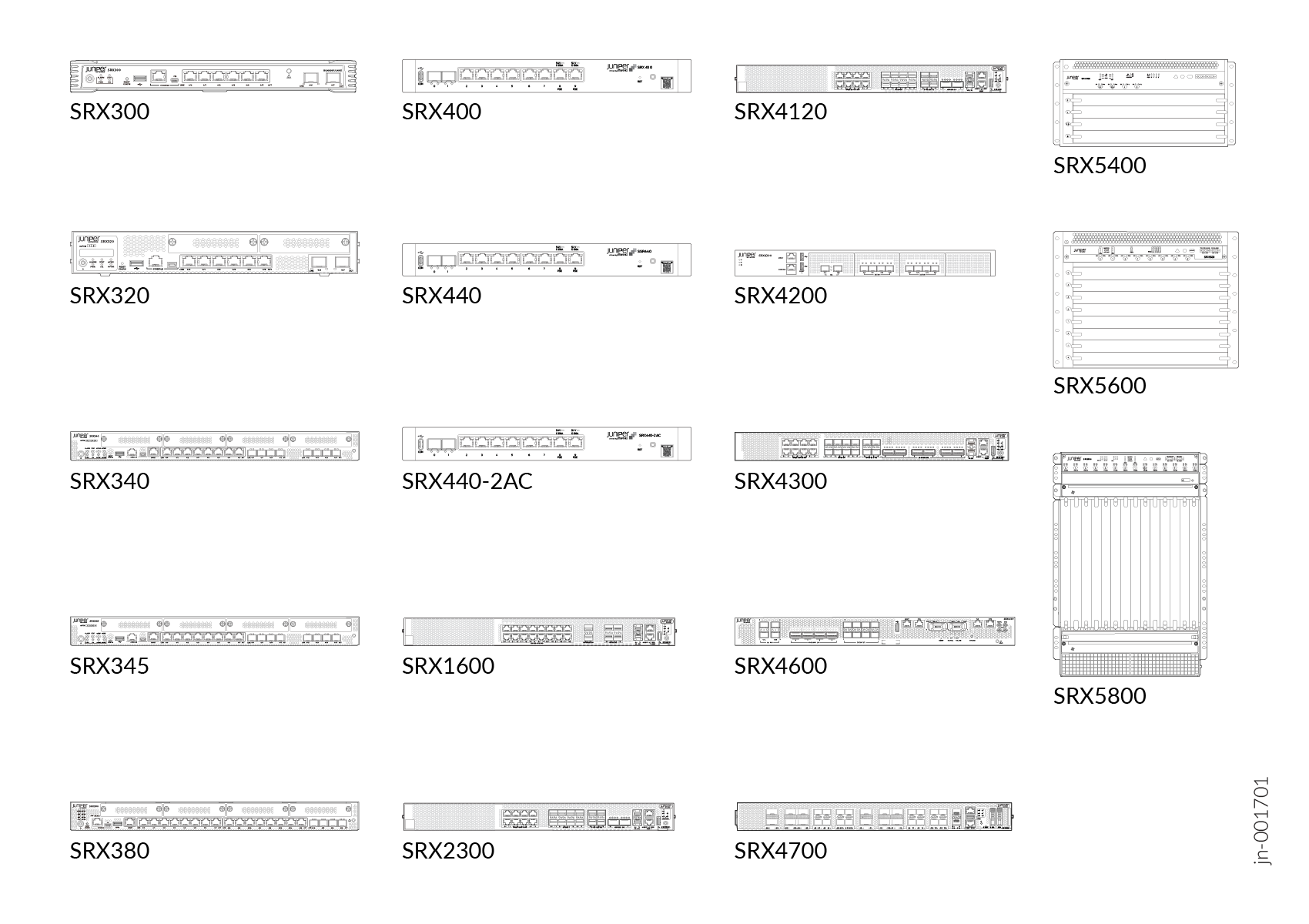
The SRX400 firewall series offers the following key market positioning elements:
-
Performance—Power efficient CPUs for lower power consumption, for optimized energy footprint.
-
End-user experience—Provides visibility and insights into users, applications, WAN links, control, data plane, and CPU for proactive remediation.
-
Business continuity—Supports Multinode High Availability (MNHA).
-
Easy to manage and scale—Includes centralized management for auto-provisioning, firewall policy management, Network Address Translation (NAT), and IPSec VPN deployments, or simple and easy-to-use on-box GUI for local management.