
Stitch Services using Routing Director
Service stitching is the process of interconnecting distinct network services, typically Layer 2 (L2) or Layer 3 (L3) VPNs, to deliver a unified, end-to-end connectivity experience across multiple domains or technologies. For example, an EVPN service at one site can be stitched to an L3VPN service at another site, enabling for centralized policy enforcement (such as internet breakout or security filtering) at the other site.
-
Service Stitching is a beta feature
-
Service Stitching is qualified only between L2Circuit and L3VPN and between EVPN-VPWS and L2Circuit.
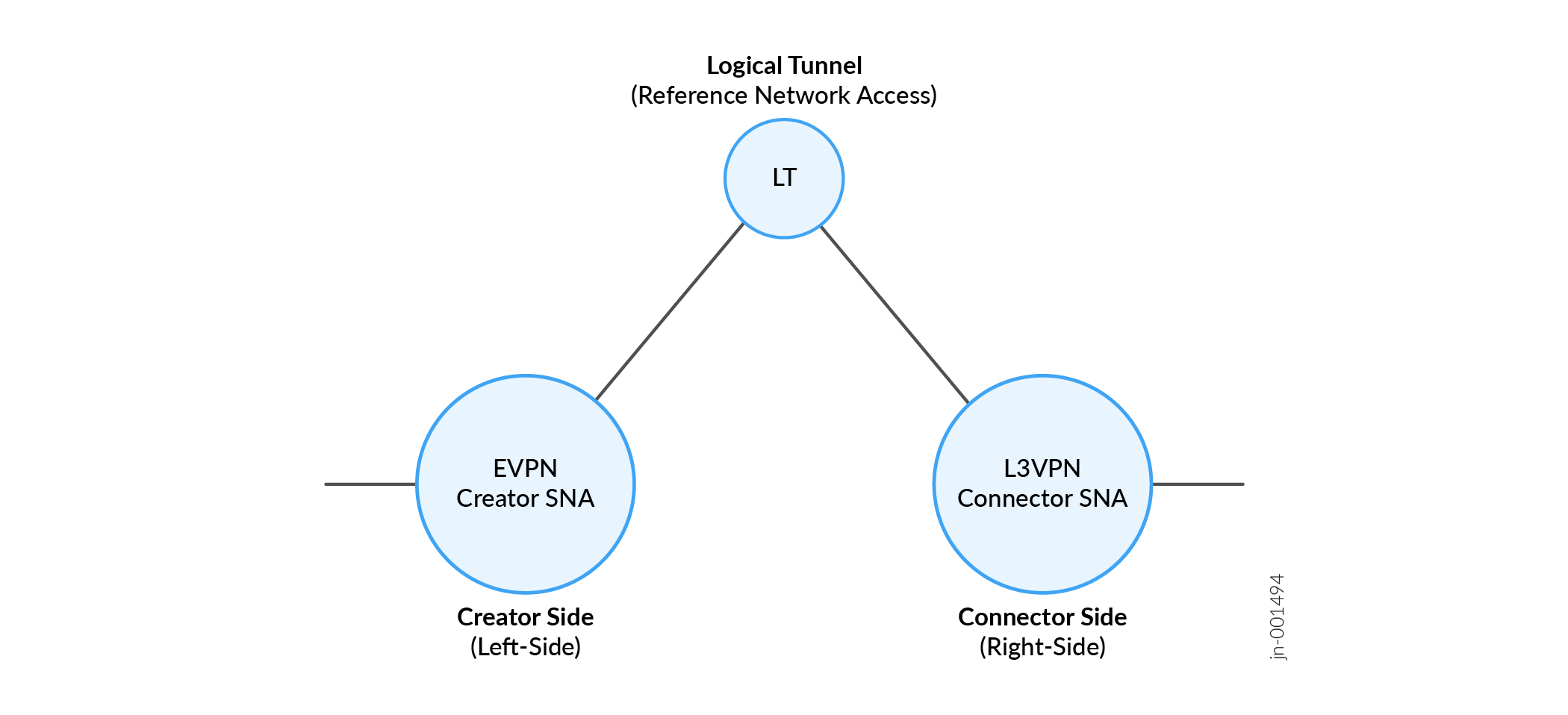
To stitch two services, you must create a logical tunnel (LT) interface. The interface acts as the bridge between the two services, carrying traffic transparently while maintaining separation at the control plane level.
For service stitching, the site network access (SNA) of the two services must use one of the following access types:
- Stitching-endpoint—Used on the creator side of the stitch (for example, EVPN). It exposes a logical interface that can be consumed by another service.
- Service—Used on the connector side of the stitch (for example, L3VPN). It connects to the logical interface exposed by the creator service.
The logical tunnel interface connects the creator and connector SNAs allowing traffic to flow between them. Figure is an illustration of service stitching.
See Service Stitching Workflow for a steps to stitch two services.