
Review the Energy Report
Use this topic to understand how to evaluate energy reports at both the organizational level and at an individual site level.
The Energy Report provides the visibility required to plan, track, and meet your organization's Science Based Targets initiative (SBTi) goals. The report summarizes actual and historical energy performance and uses AI-based forecasting to project future usage, energy cost, and emissions for the selected time range, supporting flexible, time-based analysis. By default, the report displays data for the current calender year.
The report is available at both the organization and the individual site levels. The organization-level report is aggregated from all the sites in the organization.
By combining actual usage, cumulative yearly metrics, historical trends, and AI-based forecasts, the Energy Report helps support long-term sustainability planning and reporting at both the organization and site levels.
When reviewed together, the organization-level and site-level energy reports provide a clearer view of your network’s overall energy profile. The organization-level report highlights high-level trends, while the site-level reports provide granular visibility into the underlying factors. This combined view helps identify where corrective actions are required and whether they should be addressed at an individual site-level or across multiple locations in the organization.
To review Energy Report for the organization, click the Energy Report icon in the top-right corner of the Organization-Level Energy Dashboard to open the organization's energy report.
To review Energy Report for a site, click the Energy Report icon in the top-right corner of the site's Site-Level Energy Dashboard to open the site's energy report.
The Energy Report is organized into the following sections:
Metric Cards
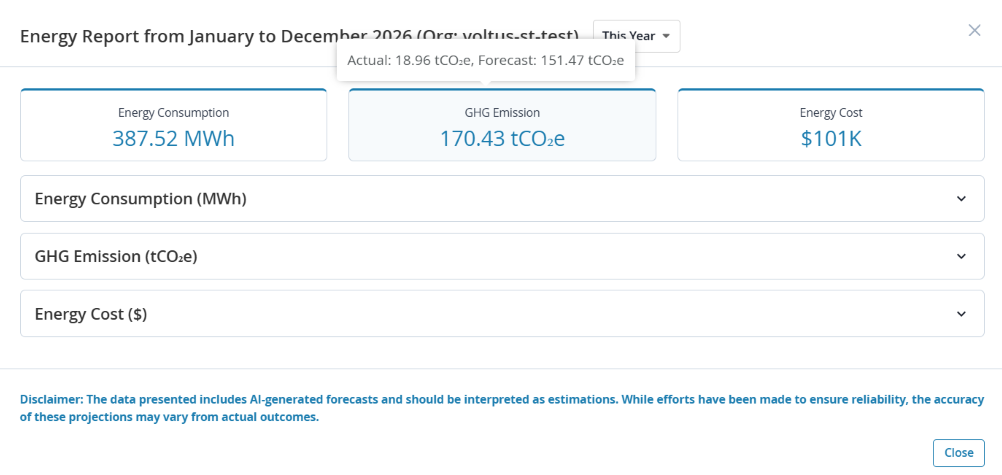
The metric cards display the cumulative expected values for energy consumption, GHG emissions, and energy cost for the selected time range.
Hover over a card to view the breakdown of actual and forecasted values that make up the cumulative total.
Actual values are shown only for past periods. If the selected time range includes future months, only forecasted values are displayed for those months.
Figure 1 shows the cumulative GHG emissions and the breakdown of actual and forecasted values for the current calendar year.
Click a metric card to expand the corresponding accordion to view the monthly trend charts for the selected time range.
Trend Charts
The trend chart provides a month-by-month view of the historical and forecasted values for the selected energy metric (Energy Consumption, GHG Emission, and Energy Cost) for the selected time range. Figure 2 shows the yearly historical and forecasted energy cost trends.
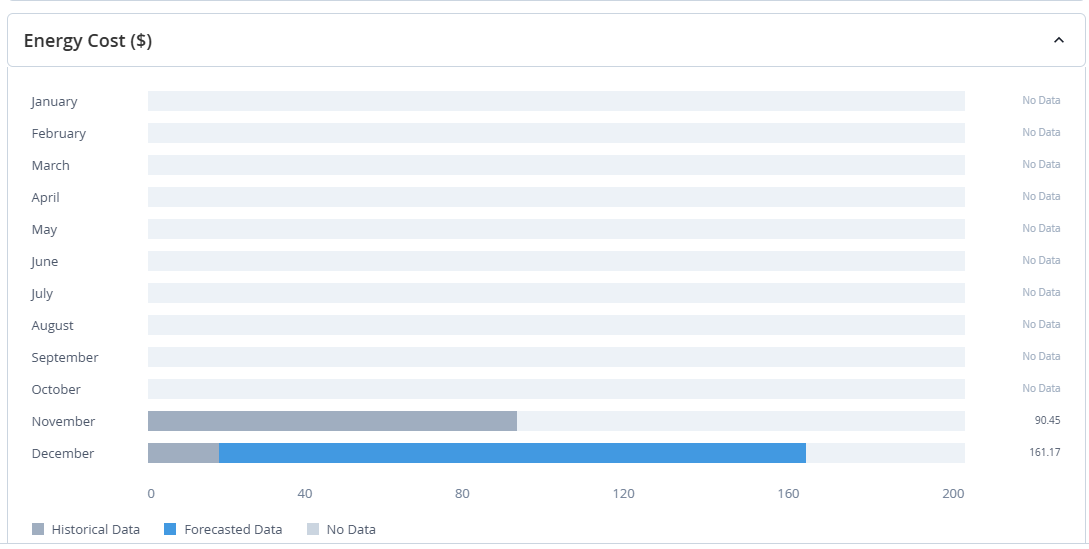
The months are listed on the left and the selected metric's values are listed on the right.
Each row contains a horizontal bar on which the historical data appears in grey and forecasted data in blue. Hover over the bar to view the individual historical and forecasted values for that month. The value displayed on the right represents the cumulative total of the historical and forecasted values.
Time periods without data appear blank.
Forecasted values are AI-generated estimates based on available historical data. While efforts have been made to ensure reliability, accuracy may vary depending on workload shifts, configuration changes, and site-level factors.
Time Range Selection
The Energy Report includes a Time Range Selector that allows you to view data across different periods.
You can select This Year, Last Year, Next Year, or define a Custom Range. By default, the report displays data for This Year.
For the Next Year option to appear, a minimum of six months' data for the current calendar year is required.

The selected time range applies to all metric cards and trend charts within the report. This enables analyzing rolling twelve-month performance, comparing year-over-year results, tracking improvements across reporting cycles, and gaining seamless visibility into historical and projected performance.
Benefits of Using the Energy Report
Use the report to:
-
Visualize and review the actual and forecasted GHG emissions, energy consumption, energy cost for a selected time range. Flexible, time-based reports allow alignment with internal sustainability reporting cycles
-
Identify annual trends and periods of high energy use
-
Anticipate potential increases in energy consumption, cost, or emissions using forecasted values
-
Assess alignment with SBTi goals using projected performance
-
Prioritize energy optimization and sustainability initiatives using data-driven insights
-
Share insights with internal sustainability teams, auditors, or stakeholders