
Use Case: Egress Peer Traffic Engineering Using BGP Add-Path
Egress peer traffic engineering (TE) allows a central controller to instruct an ingress router in a domain.
The Internet – a public global network of networks – is built as system of interconnected networks of service provider infrastructures. These networks are often represented as Autonomous Systems (AS) as shown in the figure Figure 1 each has globally unique Autonomous System Number (ASN).
The central controller directs traffic toward a specific egress router and an external interface. Thus, the traffic reaches a particular destination outside the network and optimizes utilization of the advertised egress routes.
The data plane interconnection link (NNI) and control-plane (eBGP) direct connection between two ASs allows Internet traffic to travel between the two, usually as part of a formal agreement called peering.
A service provider has multiple peering relationships with multiple other service providers. They are usually geographically distributed and vary in the number and bandwidth of the NNI link. They also use different business or cost models.
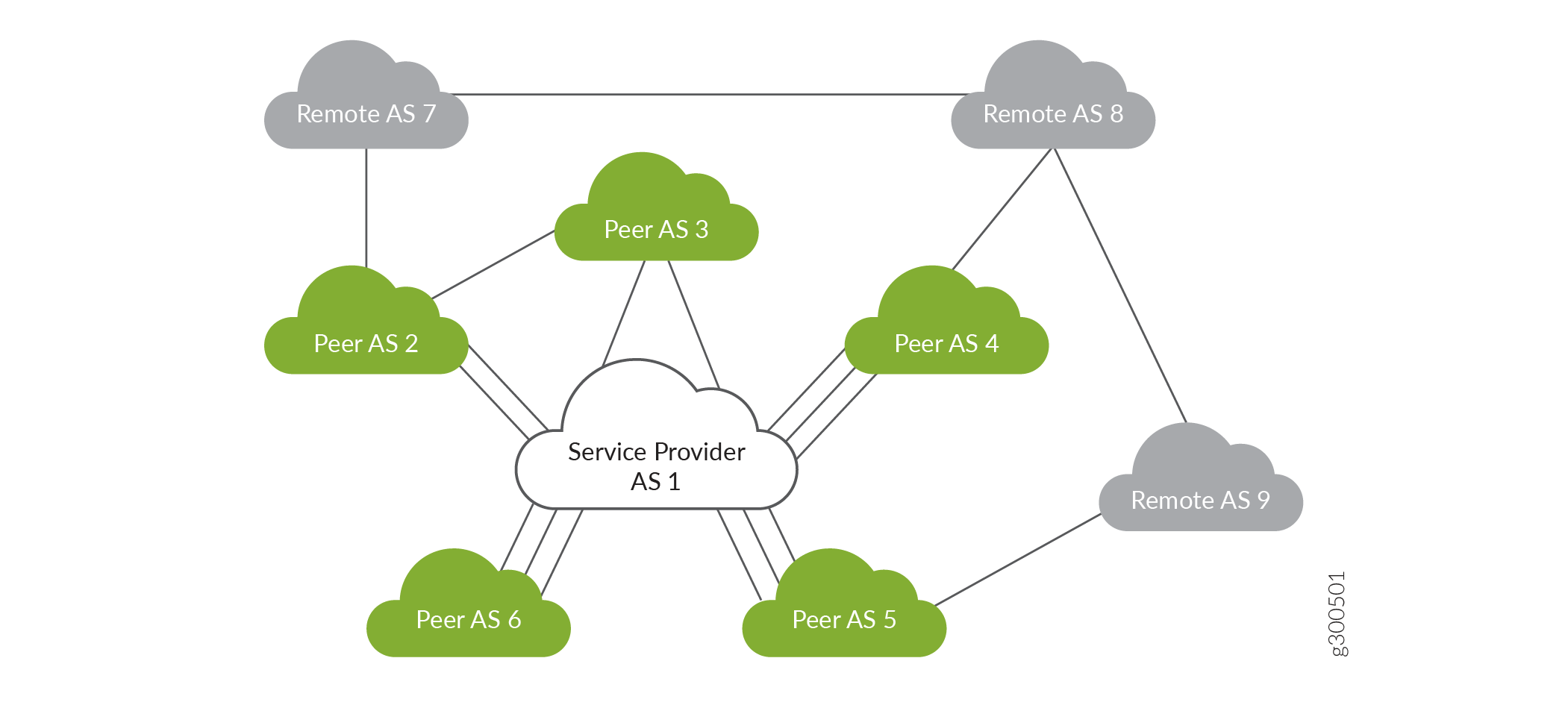
In the context of AS peering, traffic egress assumes that the destination network address is reachable through a certain peer AS. So, for example, a device in Peer AS#2 can reach a destination IP address in Peer AS#4 through Service Provider AS#1.
The peer AS using an eBGP Network Layer Reachability Information (NLRI) advertisement provides the reachability information. An AS typically advertises IP addresses that belong to it, but an AS might also advertise addresses learned from another AS.
For example, Peer AS#2 can advertise addresses to service provider (AS#1). These addresses come from Peer AS#3, Peer AS#7, Peer AS#8, Peer AS#9, Peer AS#4 and Peer AS#5.
The reachability information advertisement depends on the BGP routing policies between the individuals ASs. Therefore, a given destination IP prefix reaches multiple peering ASs and multiple NNIs. Network administrators in the service provider network select “best” exit interface for each destination prefix.
The traffic that exits from the service provider AS is critical for ensuring cost efficiency while providing seamless end user experience at the same time. The definition of “best” exit interface is a combination of cost as well as latency and traffic loss.