
PTX12008 Chassis
Learn about the components in the PTX12008 chassis.
The PTX12008 chassis is a rigid sheet-metal structure that houses all the components of the router.
PTX12008 Front Panel (Premium Configuration)
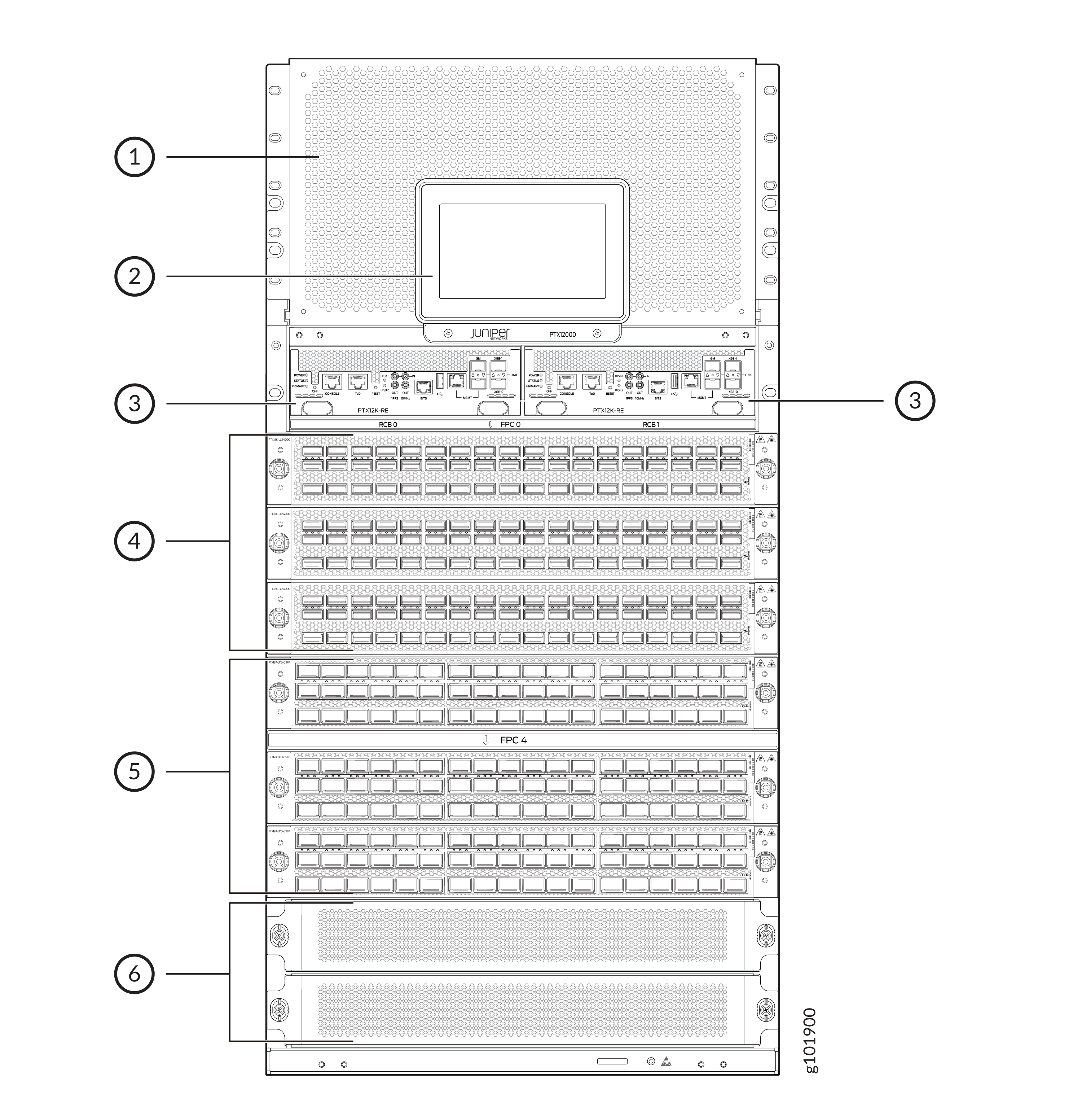
1 — Power shelf | 4 — Flexible PIC Concentrator (FPC) slots 0–2 (numbered top to bottom) |
2 — Status panel | 5 — FPC slots 3–5 (numbered top to bottom) |
3 — Routing and Control Boards (RCBs) | 6 — FPC slots 6 and 7 (numbered top to bottom) |
PTX12008 Rear Panel
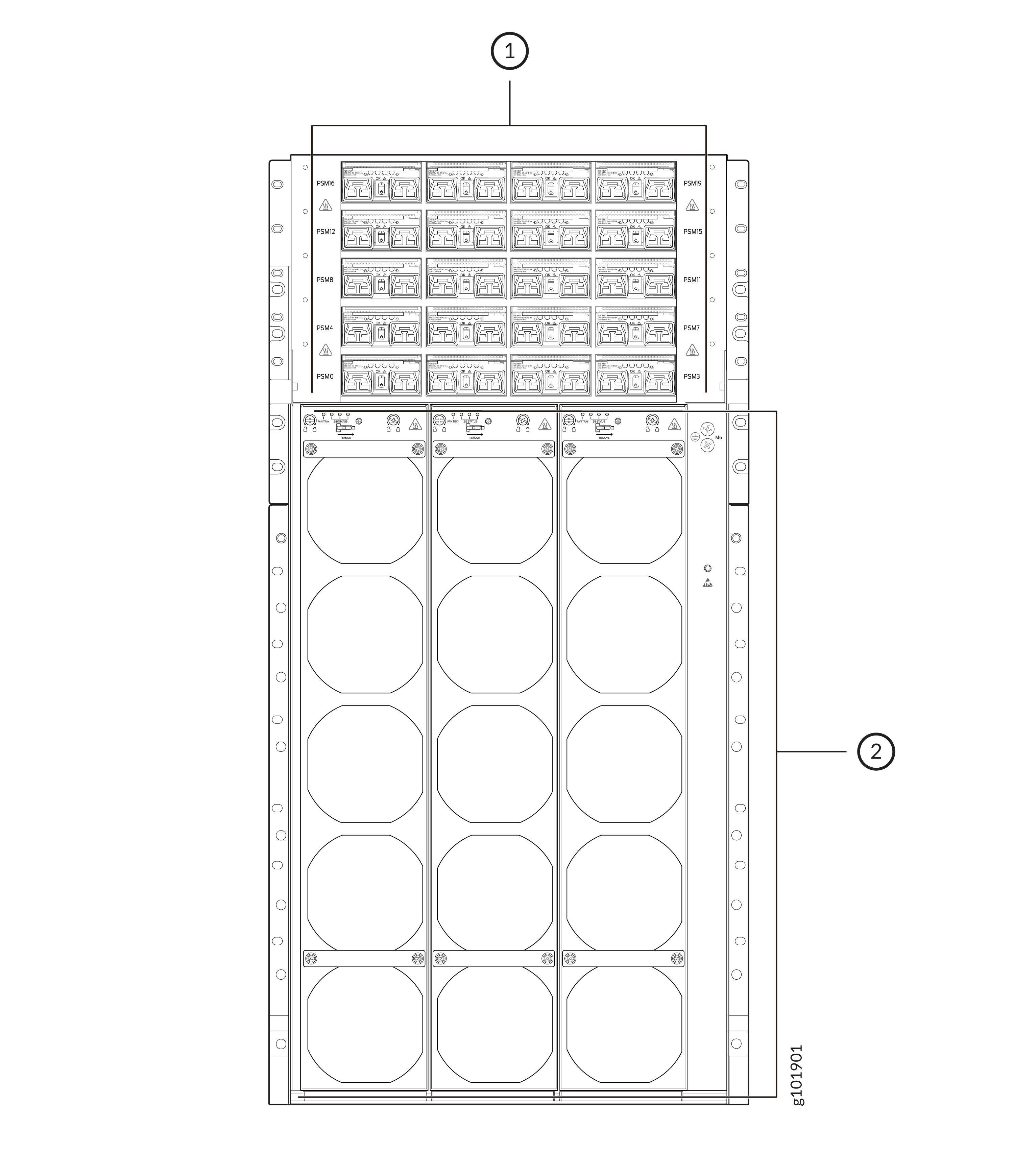
1 — AC/HVAC/HVDC power supply modules (PSMs) numbered 0–19 (left to right and bottom to top) | 2 — Fan trays numbered 0–2 (left to right) |
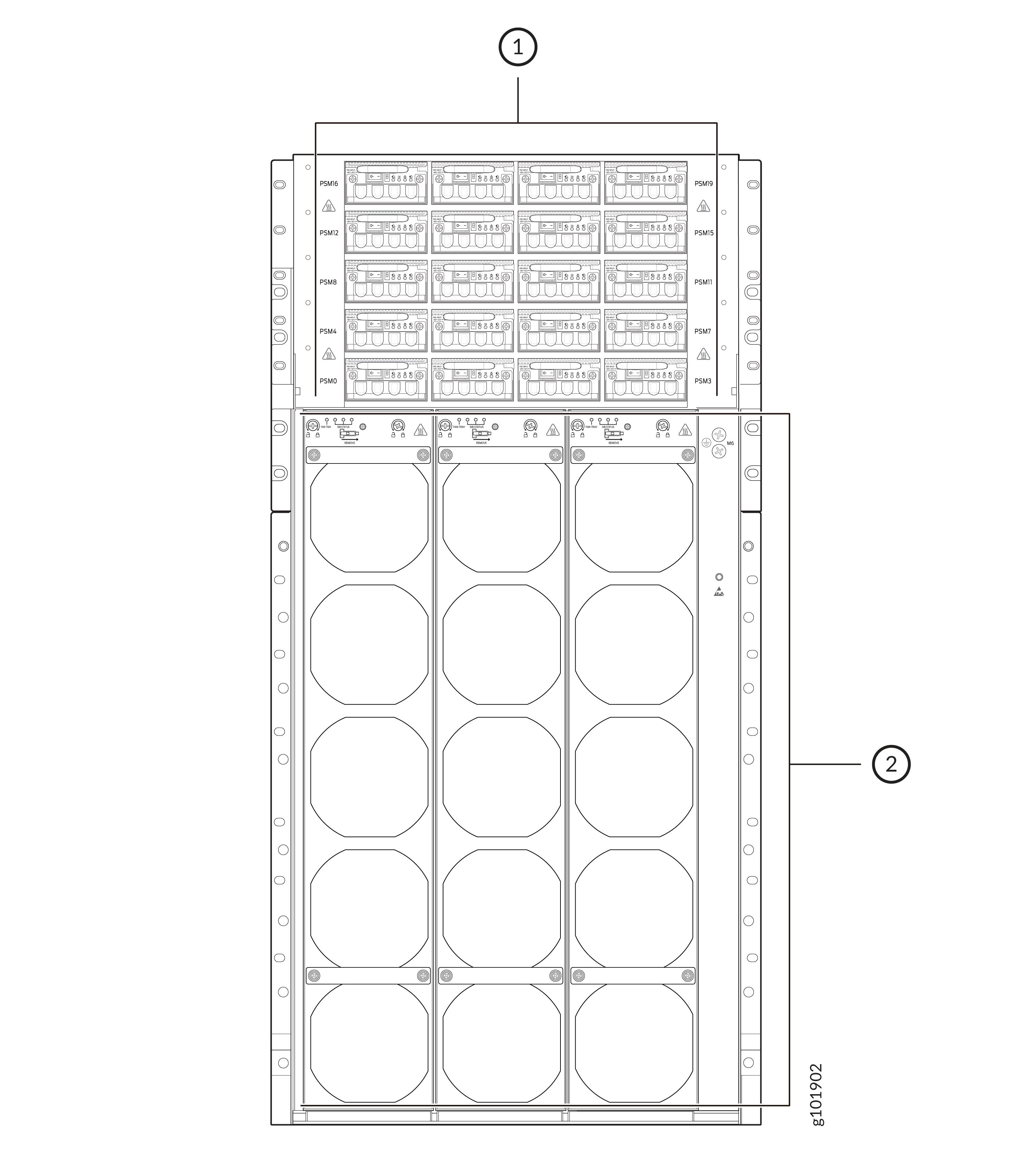
1 — DC PSMs numbered 0–19 (left to right and bottom to top) | 2 — Fan trays numbered 0–2 (left to right) |
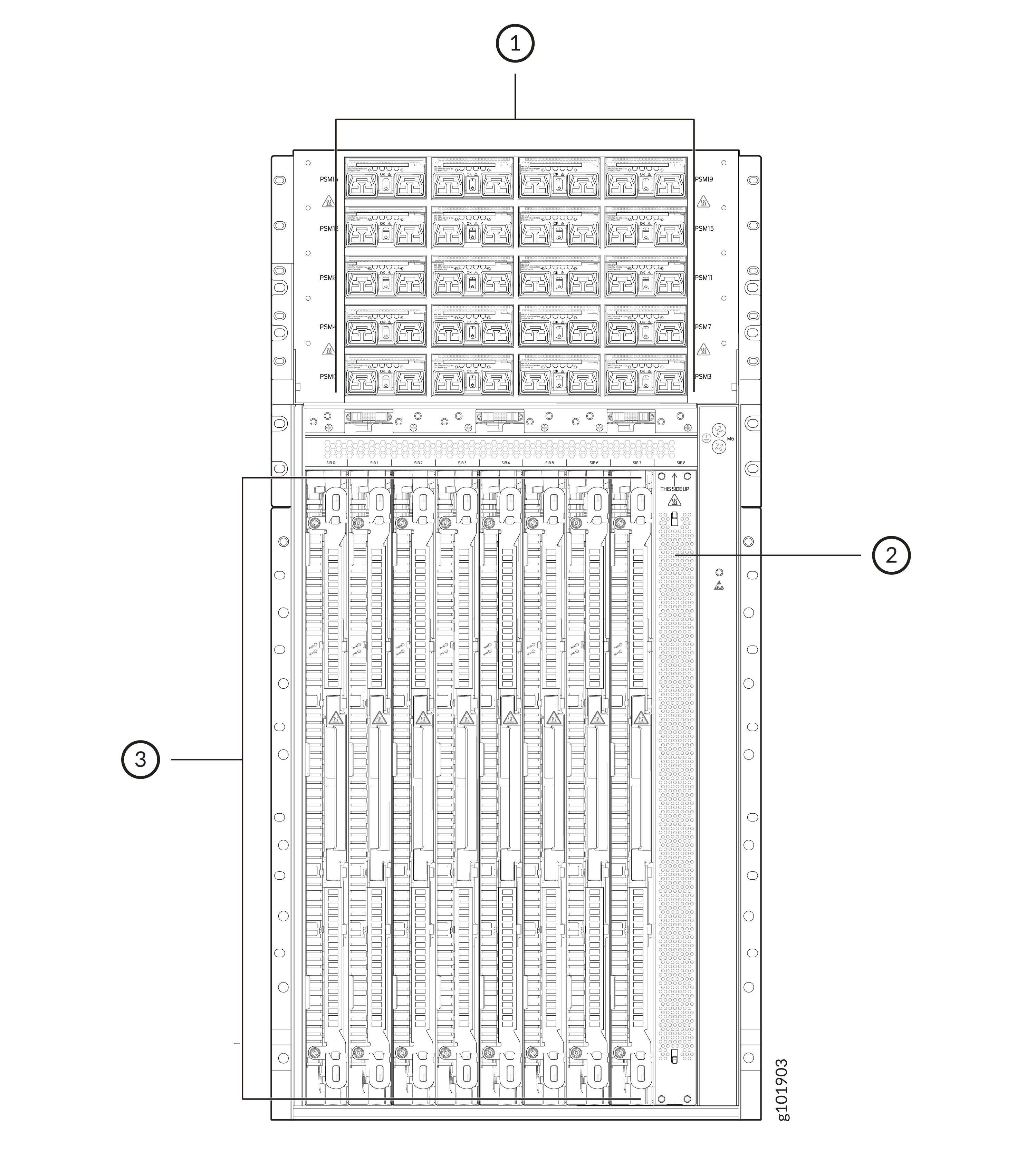
1 — PSMs numbered 0–19 (left to right and bottom to top) | 3 — SIBs |
2 — Blank Switch Interface Board (SIB) slot covered by a blank panel |
PTX12008 Physical Specifications
|
Description |
Weight |
Height |
Width |
Depth |
|---|---|---|---|---|
|
Chassis |
275 lb (124.7 kg) (without any FRU installed) 1100 lb (499 kg) (maximum weight of the premium configuration) |
37.5 in. (95.3 cm) |
18.9 in. (48.01 cm) |
36.1 in. (91.7 cm) chassis only 43.2 in. (109.7 cm) with cable management system and front door |
|
3.7 kilowatt (kW) AC/HVAC/HVDC PSM |
6.8 lb (3.1 kg) |
1.6 in. (4 cm) |
3.2 in. (8 cm) |
21 in. (53.3 cm) |
| 3 kW AC/HVAC/HVDC PSM |
6.8 lb (3.1 kg) |
1.6 in. (4 cm) |
3.2 in. (8 cm) |
21 in. (53.3 cm) |
| DC PSM |
5.1 lb (2.3 kg) |
1.6 in. (4 cm) |
3.2 in. (8 cm) |
21 in. (53.3 cm) |
|
Fan tray |
19.3 lb (8.8 kg) |
27.55 in. (69.98 cm) |
5.04 in. (12.8 cm) |
4.3 in. (10.9 cm cm) excluding handles 5.5 in. (14 cm) including handles |
|
RCB |
10 lb (4.5 kg) |
2.6 in. (6.5 cm) |
8.5 in. (21.7 cm) |
19.2 in. (48.7 cm) |
|
SIB |
25 lb (11.34 kg) |
24.6 in. (62.5 cm) |
1.62 in. (4.2 cm) |
12.96 in. (32.9 cm) |
|
PTX12K-LC54OSFP FPC |
46 lb (21 kg) |
2.8 in. (7 cm) |
18.8 in. (47.8 cm) |
19.2 in. (48.87 cm) |
|
PTX12K-LC54QDD FPC |
47 lb (21.3 kg) |
2.8 in. (7 cm) |
18.8 in. (47.8 cm) |
19.2 in. (48.7 cm) |
|
PTX12K-RMK rack mount kit |
26 lb (11.8 kg) |
6.22 in. (15.8 cm) |
19.69 in. (50 cm) |
25.67 in. (65.2 cm) |
|
PTX12K-RMK-EXT rack mount kit |
60 lb (27.22 kg) |
10.8 in. (27.43 cm) |
21.2 in. (53.85 cm) |
43.4 in. (110.24 cm) |
Midplane
The FPCs and RCBs install into the midplane from the front of the chassis. The SIBs and cooling system components connect to the midplane from the rear of the chassis.
PTX12008 Environmental Specifications
|
Description |
Tolerance |
|---|---|
|
Altitude |
No performance degradation up to 6000 feet (1829 meters) |
|
Relative humidity |
Normal operation is ensured in relative humidity range of 5% through 90%, noncondensing. |
|
Temperature |
|
|
Seismic |
Designed to comply with Zone 4 earthquake requirements according to NEBS GR-3160-CORE, Issue 3 |
Install the routers only in restricted-access areas, such as dedicated equipment rooms and equipment closets, in accordance with Articles 110-16, 110-17, and 110-18 of the National Electrical Code, ANSI/NFPA 70.
Front Door
The PTX12008 supports a front door. The front door protects fiber-optic cabling and provides additional protection from electromagnetic interference (EMI).
FPC Cable Management System
The PTX12008 supports an FPC cable management system as an optional equipment. You can use the cable management system to organize, secure, and route the cables attached to the ports on the FPCs. The cable management system helps prevent the cables from dislodging or developing stress points and to ensure that the cables do not block the air inlets of the chassis.
Power Cable Management System
The PTX12008 supports a power cable management system as an optional equipment. You can use the cable management system to organize, secure, and route the power cables attached to the PSMs. The cable management system helps prevent the cables from dislodging or developing stress points and to ensure that the cables do not block the air inlets of the chassis.