
Converged Optical Routing Architecture
In traditional architectures, the IP layer (routers) and the Optical Layer (transponders and ROADMs) were managed as two separate entities. The Converged Optical Routing Architecture (CORA) combines these layers into a unified, packet-centric architecture by integrating the high-performance coherent optics (JCO series) directly into the router.
IP over Dense Wavelength Division Multiplexing
IP over Dense Wavelength Division Multiplexing (IPoDWDM) is the technological foundation of CORA. It eliminates the need for a standalone transponder shelf by integrating the DWDM interface into the router's line card. Instead of handing off a short-reach signal to an external transport system, the router generates the colored DWDM signal itself.
Benefits
-
Direct visibility—Because the optic lives inside the router, Junos OS sees the optical layer directly. Operators can monitor OSNR, CD, and Polarization Dependent Loss (PDL) straight from the router CLI or using telemetry.
-
Reduced overhead—Managing only the router instead of both a router and a transponder reduces operational complexity. Using Netconf/YANG models further automates optical parameter provisioning.
-
Power efficiency—Router-based coherent optics consume significantly less power than shelf-based transponders. This efficiency maintains high port density without exceeding thermal limits in data centers or central offices.
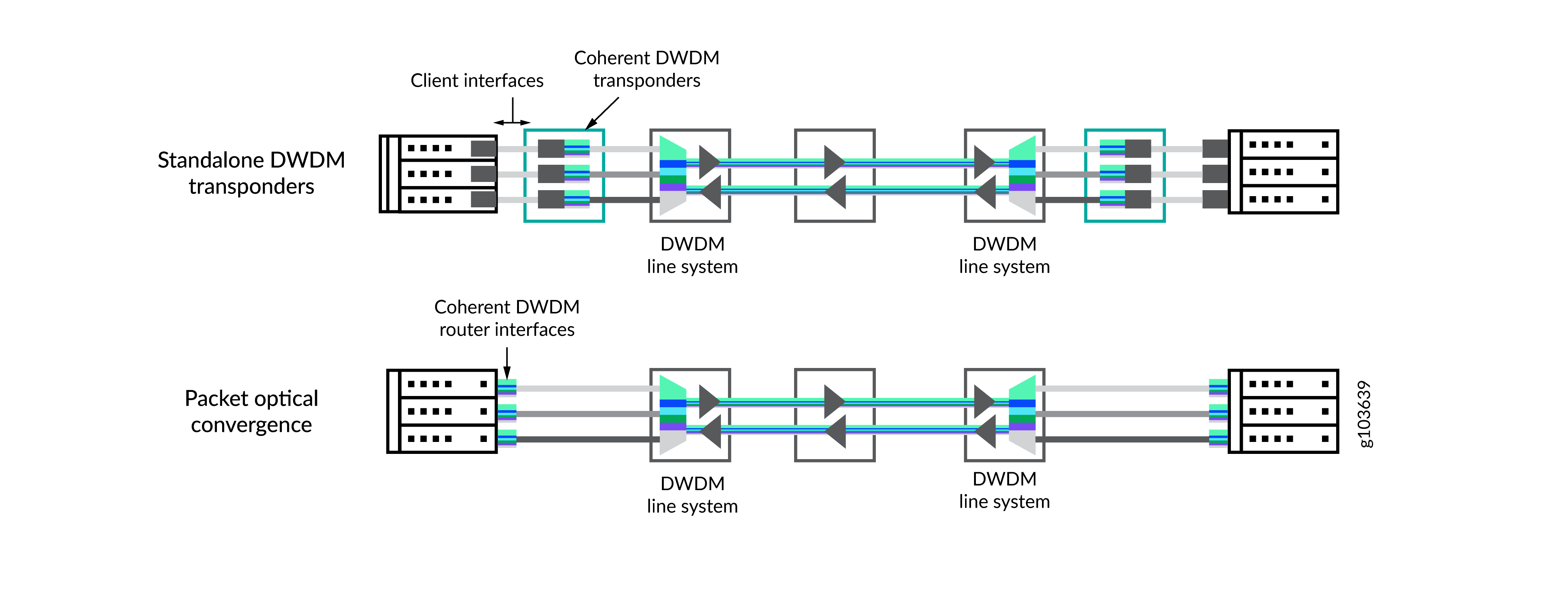
|
Feature |
Traditional Transport |
CORA (IPoDWDM) |
|---|---|---|
|
Hardware |
Router and transponder shelf |
Router with coherent optical transceivers |
|
Footprint |
High (multiple racks) |
Low (router only) |
|
Power |
~50 W-100 W per 100G |
~15 W-25 W per 400G/800G |
|
Management |
Two separate NMS platform |
Unified IP/Optical management |
|
Interconnect |
Short-reach gray optics |
No intermediate gray optics needed |