Dense Wavelength Division Multiplexing
Coherent optics uses Dense Wavelength Division Multiplexing (DWDM). This technology increases the amount of data that can be transmitted over a single optical fiber. DWDM achieves this by using multiple light wavelengths or channels. The two types of DWDM connections used by Juniper's coherent DWDM optics are:
- Unamplified link (limited optical power)—In an unamplified link, the optical signal is sent through the optical fiber without any amplification. In this type of coherent DWDM optics, the maximum transmission distance is limited by the natural loss of optical power as the signal travels through the optical fiber. Without amplification, the light signal gradually weakens, restricting the distance it can travel. An unamplified link is more suitable for shorter distances and is often referred to as a power-limited optical signal.
- Amplified link (limited optical signal-to-noise ratio and chromatic dispersion)—In an amplified link, the optical signal strength is boosted using optical amplifiers. As you boost the signal strength in amplified link, the signal can travel long distances. However, it can also introduce noise or loss in signal quality. The noise is more prominent if you are using Erbium-Doped Fiber Amplifier (EDFAs). A high OSNR value ensures that the noise is low and the signal quality is acceptable.
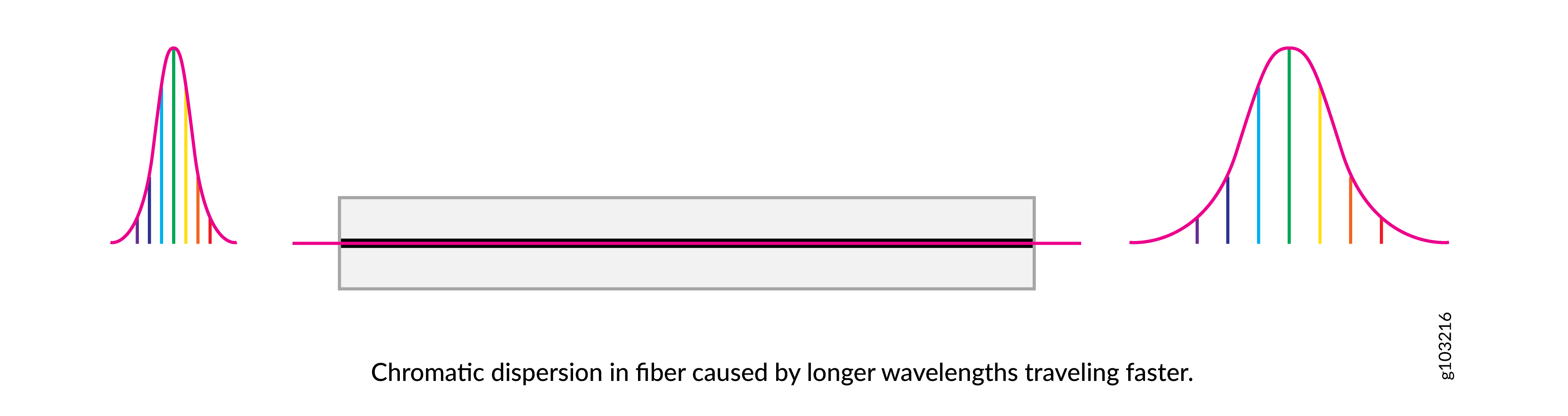
Chromatic dispersion occurs because different wavelengths of light travel at different speeds through the optical fiber. This can cause signal distortion, especially over long distances. During optical transmission, short-duration input optical signals composed of multiple wavelengths or colors are incident on the optic fiber. The colored lines within the optical signal correspond to different wavelengths. These varied wavelengths in the optic signal enter the optical fiber simultaneously but propagate at different velocities due to their unique refractive indices. After traveling through the optical fiber, the output optical signal broadens and the different colors or wavelengths spread apart. This indicates that longer wavelengths have traveled at a different speed than shorter wavelengths.
To overcome the OSNR limitation, a RAMAN amplifier can be used. RAMAN amplifiers have lower effective noise figure as they amplify the signal along the fiber.
For more information about the maximum chromatic dispersion and minimum ROSNR values of individual transceivers, see Hardware Compatibility Tool.