
Connector Types
Optical connectors ensure efficient and reliable connections between fiber optic cables. Connectors are designed to minimize insertion loss and back reflection, ensuring high-quality signal transmission.
400G transceivers support the following connector types:
-
MPO-12/APC and MPO-12 BiDi/UPC—A multifiber push-on (MPO-12) has a single row of connectors with 12 optical fiber channels or lanes. An MPO-12 connector contains four transmission (TX) channels and four reception (RX) channels that is used to transmit and receive signals. Four optic fiber channels are unused or reserved in MPO-12 connectors used with 400G optical transceivers. In a standard deployment, the four unused channels or lanes are those located in the center of the row.
-
APC—Angled physical contact (APC) denotes an optical fiber endface that is polished at an eight-degree angle. APC reduces back reflection by directing reflected light into the fiber cladding rather than back toward the source.
-
BiDi/UPC—Ultra physical contact (UPC) denotes a rounded optical fiber endface that is polished to maintain a very smooth, slightly curved surface (nearly zero degrees). UPC helps to improve contact quality and reduce back reflection compared to other physical contact connectors. BiDi (bidirectional) indicates bidirectional optical transmission over a single fiber strand or fiber pair. This allows simultaneous transmission and reception on the same fiber using different wavelengths.
MPO-12 APC is used for parallel single-mode optics such as 400G DR4. MPO-12 Bidi UPC is used for parallel multi-mode BiDi optics such as 400G SR4.2.
Figure 1: MPO-12 Connector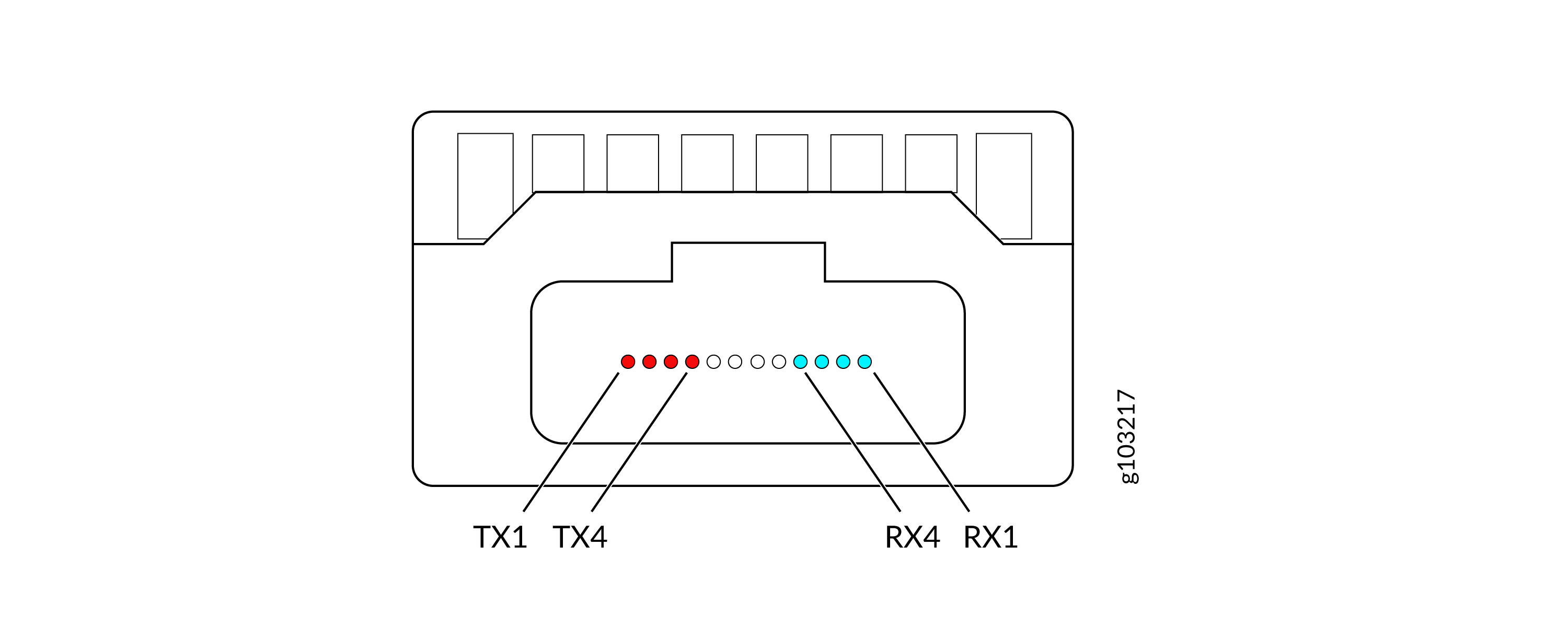
The image represents the channel or lane allocation for a 400G optical transceiver using an MPO-12 connector:
-
Red (TX): Fibers 1 through 4, named TX1, TX2, TX3, and TX4 respectively.
-
White (unused): Fibers 5 through 8.
-
Blue (RX): Fibers 9 through 12, named RX4, RX3, RX2, and RX1 respectively.
-
-
MPO-16/APC—A multi-fiber push-on 16 (MPO-16) connector has 16 optical fibers in a single connector. For example, the 400G-SR8 transceiver uses all 16 fibers of the MPO-16 connector. Eight fibers are used as TX (transmit) channels and eight fibers are used as RX (receipt) channels. Each fiber carries a 50G PAM4 channel, totaling eight parallel channels for 400G aggregate bandwidth. With angled physical contact (APC), the connector minimizes back reflection and ensure better signal integrity. MPO connectors offer high-density connections and support multiple fibers in a single connector. MPO connectors are often used in data centers.
Figure 2: MPO-16 Connector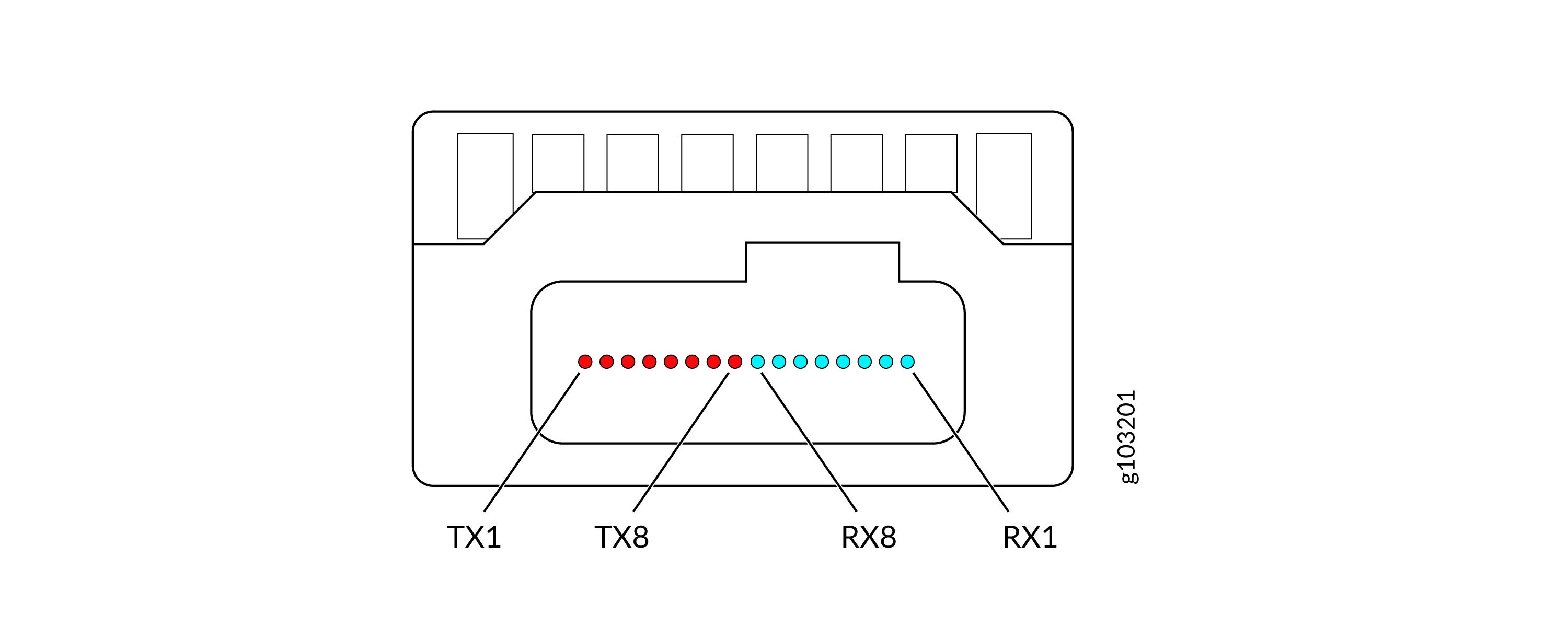
The connector has 16 fiber channels arranged in a single row. TX (transmit) is handled by eight channels and the RX (receive) is handled by the other eight. The image represents the channel or lane allocation for a 400G optical transceiver using MPO-16 connector:
-
Red (TX): Fibers 1 through 8, named TX1, TX2, TX3, TX4, TX5, TX6, TX7, and TX8 respectively.
-
Blue (RX): Fibers 9 through 16, named RX8, RX7, RX6, RX5, RX4, RX3, RX2, and RX1 respectively.
-
-
Duplex LC—A duplex LC connector is a type of lucent connector (LC) that has small form factor and high-density design. The term duplex indicates that the connector houses two separate fiber optic channels or lanes within a single unit. One channel is for transmission (TX) and the other is for reception (RX). The TX and RX channels enable full-duplex, bidirectional communication over a single connector. The typical LC interface is half the size of the traditional standard connector (SC). The smaller size allows greater port density in patch panels and transceivers. Like other optical connectors, the duplex LC connector is color-coded. This helps maintain correct polarity and simplifies installation and troubleshooting.
Duplex LC/UPC is a duplex LC connector where each fiber end-face is polished using the ultra physical contact (UPC) method. For example, QDD-400G-ER4-30 use duplex LC/UPC connectors.
Note: All 400G optical transceivers with duplex LC connectors are UPC.Note: Tunable DWDM 400G optical transceivers such as QDD-400G-ZR, QDD-400G-ZR-M, and QDD-400G-ZR-M-HP use Duplex LC connectors for their optical connections.Figure 3: Duplex LC Connector
The image represents the channel or lane allocation for a 400G optical transceiver using duplex LC connector:
-
Red (TX)
-
Blue (RX)
-