
100G Optical Transceiver Technologies
100G optical transceivers can be organized by their wavelength technologies and reach capabilities. Understanding these options helps you select the appropriate transceiver for your specific deployment scenario.
Single-wavelength Optics
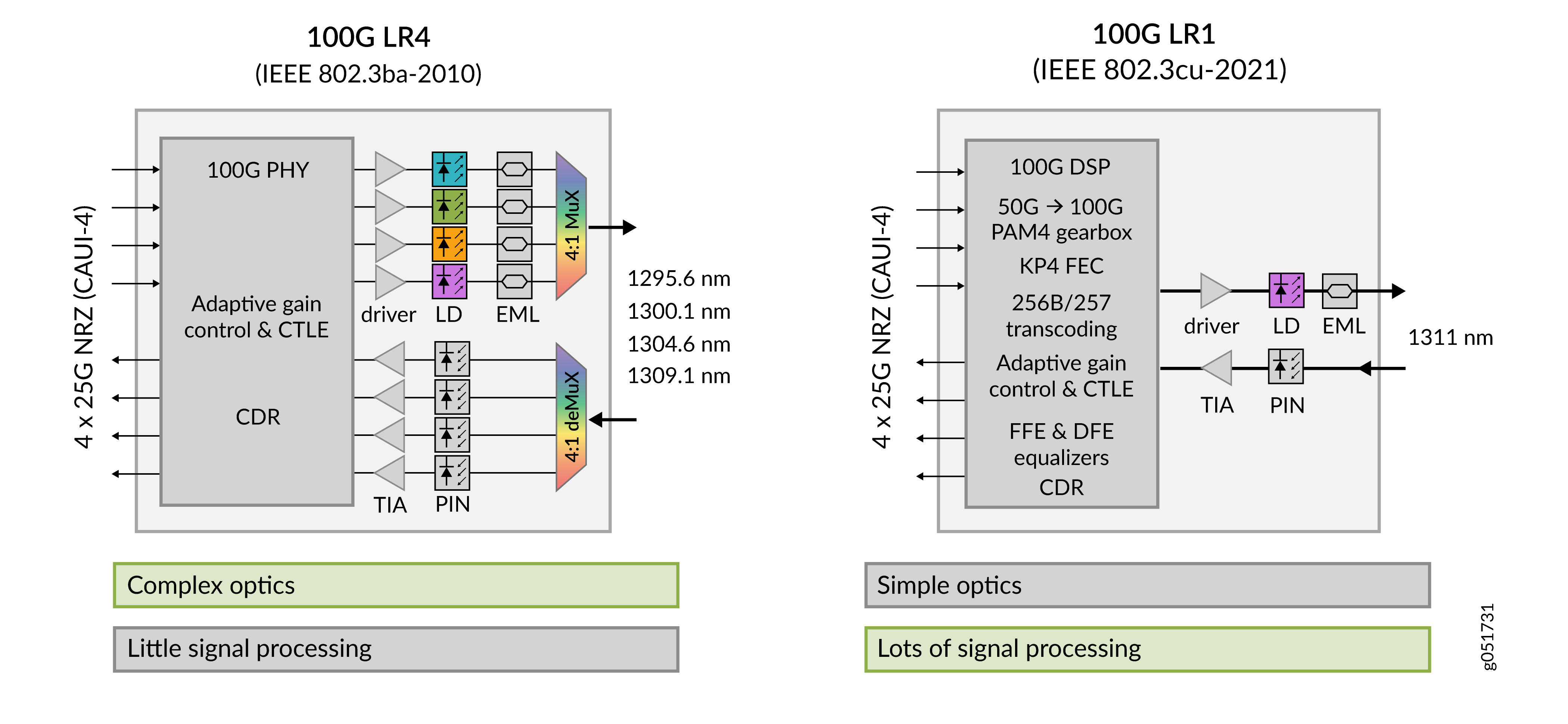
100G single-wavelength optics (FR, LR, DR, ER1) are pluggable transceivers that leverage PAM4 modulation technology to transmit the full 100G data using a single laser. These optics conform to IEEE 802.3cd-2018 and IEEE 802.3-2022 standards for 50 Gbps and 100 Gbps per lane operation using PAM4 modulation.
Single-wavelength optics are different from legacy 100G modules such as LR4, PSM4, CWDM4, and so on. Also, due to the adoption of PAM4 optical modulation, single-wavelength optics are not interoperable with legacy 100G modules. However, they are interoperable with 400G optics using breakout cables. 400G break-out optics are thus backwards compatible with legacy 100G line cards and optics:
The following are Juniper's current 100G single-wavelength optical transceivers:
| Product Number | Long Description | IEEE Standard |
|---|---|---|
|
SDD-100G-DR |
SFP56-DD or SFP-DD form-factor, 100G-DR/DR1, 500 m reach over SMF, Standard Temperature (0 °C through 70 °C), Duplex LC connector |
IEEE 802.3cd (100GBASE-DR) |
|
SDD-100G-FR1 |
SFP-DD form-factor, 100G-FR/FR1, 2 km reach over SMF, Standard Temperature (0 °C through 70 °C), Duplex LC connector |
IEEE 802.3cd (100GBASE-FR1) |
|
SDD-100G-LR1 |
SFP-DD form-factor, 100G-LR/LR1, 10 km reach over SMF, Standard Temperature (0 °C through 70 °C), Duplex LC connector |
IEEE 802.3cu (100GBASE-LR1) |
|
SDD-100G-ER1-40 |
SFP-DD form-factor, 100G-ER/ER1, 40 km reach over SMF, Standard Temperature (0 °C through 70 °C), Duplex LC connector |
MSA specification (BiDi technology with complementary wavelengths) |
|
SDD-100G-SR1P2 |
SFP-DD form-factor, 100G-SR, 100 m reach over MMF (OM4), Standard Temperature (0 °C through 70 °C), Duplex LC connector |
IEEE 802.3cd (100GBASE-SR1, 2-lane BiDi) |
|
QSFP-100G-FR |
QSFP form-factor, 100G-FR/FR1, 2 km reach over SMF, Standard Temperature (0 °C through 70 °C), Duplex LC connector |
IEEE 802.3cd (100GBASE-FR1) |
|
QSFP-100G-LR |
QSFP form-factor, 100G-LR/LR1, 10 km reach over SMF, Standard Temperature (0 °C through 70 °C), Duplex LC connector |
IEEE 802.3cu (100GBASE-LR1) |
|
QSFP-100G-DR |
QSFP, 100G-DR/DR1, 500 m reach over SMF, Standard Temperature (0 °C through 70 °C), Duplex LC connector |
IEEE 802.3cd (100GBASE-DR) |
|
QSFP-100G-SR1P2 |
QSFP28 form-factor, 100G-SR, 100 m reach over MMF (OM4), Standard Temperature (0 °C through 70 °C), Duplex LC connector |
IEEE 802.3cd (100GBASE-SR1, 2-lane BiDi) |
Optical transceivers with SFP112 form-factor (when available) are expected to support single-wavelength 100G optics.
The SFP56-DD and SFP-DD modules (SDD-prefix) use a 2×50G electrical interface with PAM4 modulation. QSFP28 modules (QSFP-prefix) use a 4×25G electrical interface. However, both support single-wavelength optical transmission.
Bidirectional (BiDi) 100G Optical Transceivers
Bidirectional (BiDi) optical transceivers use wavelength division multiplexing to transmit and receive data simultaneously over the same fiber strand. BiDi reduces fiber infrastructure requirements. 100G BiDi transceivers come in two main categories:
-
Duplex LC multimode BiDi optics (SR1P2, BXSR)
-
Simplex LC single-mode BiDi optics (LRBD, ERBD)
Duplex LC Multimode BiDi Optics (SR1P2, BXSR)
Multimode BiDi transceivers use two fiber strands (duplex configuration) with bidirectional transmission on each fiber. Each fiber carries bidirectional traffic using different wavelengths. The two wavelengths that duplex LC multimode BiDi employs are 850 nm and 910 nm. That is, when one fiber transmits at 850 nm and receives at 910 nm, the other transmits at 910 nm and receives at 850 nm. Thereby, it creates two independent 50 Gbps bidirectional optical lanes (2x50G). Some of the Juniper optical transceivers that use duplex LC multimode BiDi technology are:
- JNP-QSFP-100G-BXSR—100 m reach on OM4 fiber
- QSFP-100G-SR1P2—70 m (OM3), 100 m (OM4), 150 m (OM5)
Simplex LC single-mode BiDi optics (LRBD, ERBD)
Single-mode BiDi transceivers use a single fiber strand (simplex configuration) with bidirectional transmission. The simplex optic transmits and receives on the same fiber using different wavelengths. It has a single optical lane that operates at 100 Gbps and a 100GAUI-2 (2x50G PAM4) electrical interface. The common simplex LC single-mode BiDi wavelength pairs are LRBD (1270 nm Tx and 1330 nm Rx or reversed) and ERBD (1270 nm Tx and 1330 nm Rx or reversed). Some of the Juniper optical transceivers that use simplex LC single-mode BiDi technology are:
-
QSFP-100G-LRBD-D—QSFP28 100G LR BiDi downstream transceiver
-
QSFP-100G-ERBD-D—QSFP28 100G ER BiDi upstream transceiver
Extended Reach and ZR 100G Optical Transceivers
Extended reach (ER) 100G transceivers are designed for long-distance transmission ranging from 40 km to 80 km, serving metro, regional, and inter-data center applications. These transceivers use advanced technologies including APD photodiodes, higher-power lasers, and sophisticated DSP to achieve extended reach over single-mode fiber.
ZR 100G transceivers represent coherent optical technology designed for ultra-long-distance transmission up to 80 km and beyond. Unlike traditional ER transceivers that use direct detection with intensity modulation, ZR transceivers employ coherent detection with advanced modulation schemes (DP-QPSK), tunable DWDM lasers, and sophisticated digital signal processing. This enables ZR transceivers to achieve significantly greater reach, integrate seamlessly with DWDM transport systems, and provide built-in performance monitoring capabilities, making them ideal for long-haul metro, regional networks, and data center interconnect applications.
| Characteristic | ER (Extended Reach) | ZR (Long Haul) |
|---|---|---|
| Transceiver Types |
ER4 (legacy), ER4L 4WDM-40 ER1-40 BiDi |
ZR4 |
| Technology Type | Direct detection, intensity modulation | Coherent detection, phase modulation |
| Optical Lanes |
4 lanes (ER4, ER4L, 4WDM-40) 1 lane (ER1-40) |
4 lanes |
| Lane Speed |
25 Gbps NRZ (ER4, ER4L, 4WDM-40) 100 Gbps PAM4 (ER1-40) |
25 Gbps DP-QPSK |
| Modulation |
NRZ-OOK (ER4, ER4L, 4WDM-40) PAM4 (ER1-40) |
DP-QPSK (coherent) |
| Wavelength Technology |
LAN WDM - 4 wavelengths (ER4, ER4L, 4WDM-40) Single wavelength BiDi with complementary pairs (ER1-40) |
Tunable DWDM (ITU grid, C-band, 50 GHz spacing) |
| Wavelengths |
1295.56, 1300.05, 1304.58, 1309.14 nm (ER4, ER4L, 4WDM-40) Complementary pairs - vendor specific (ER1-40) |
Tunable across ITU grid |
| Maximum Reach |
40 km (ER4, ER4L with FEC, 4WDM-40, ER1-40) 30 km (ER4L without FEC) |
80 km (up to hundreds of km with DWDM amplification) |
| Fiber Type | Single-mode | Single-mode |
| Fiber Count | 2 (duplex) | 2 (duplex) |
| Connector Type | Duplex LC | Duplex LC |
| Electrical Interface |
CAUI-4 or 100GAUI-4 (ER4) 100GAUI-4 (ER4L, 4WDM-40) 100GAUI-2 / 2x50G PAM4 (ER1-40) |
100GAUI-4 |
| FEC Type |
Optional (ER4) Mandatory KR4 FEC (ER4L, 4WDM-40, ER1-40) |
Internal coherent FEC (RS-FEC) |
| Form Factor |
QSFP28 (ER4, ER4L, 4WDM-40) SFP-DD (ER1-40) |
QSFP28 |
| Photodiode Type | APD (Avalanche PhotoDiode) | APD (Avalanche PhotoDiode) |
| Power Consumption |
~3.5W (ER4) ~2.5W (ER4L, 4WDM-40) ~2.0W (ER1-40) |
~4-5W |
| Technology Generation |
Legacy (ER4) Modern (ER4L, 4WDM-40, ER1-40) |
Modern (coherent) |
| Platform Compatibility |
Older platforms without FEC or modern with FEC (ER4) Modern platforms with KR4 FEC (ER4L, 4WDM-40) Modern platforms with 2x50G SerDes (ER1-40) |
Modern platforms with DWDM support |
| Relative Cost |
Higher (ER4) Lower (ER4L, 4WDM-40) Medium (ER1-40) |
Significantly higher |
| Status |
Legacy, being phased out (ER4) Current standard (ER4L, 4WDM-40, ER1-40) |
Current standard |
| DWDM Integration | No | Yes (tunable wavelength) |
| Wavelength Tunability |
No - fixed wavelengths (ER4, ER4L, 4WDM-40) No - fixed complementary pairs (ER1-40) |
Yes (tunable ITU grid) |
| Performance Monitoring | Basic DDM (Digital Diagnostics Monitoring) | Advanced (coherent DSP with comprehensive diagnostics) |
| DSP Complexity |
Low (ER4, ER4L, 4WDM-40) Medium (ER1-40) |
Very High (coherent) |
| Matched Pair Requirement |
No (ER4, ER4L, 4WDM-40) Yes - complementary wavelengths (ER1-40) |
No |
| APD Protection Required | Yes - optical attenuators required on short links or back-to-back connections | Yes - optical attenuators required on short links or back-to-back connections |
| Breakout Support |
Yes - 4x25G (ER4, ER4L, 4WDM-40) No (ER1-40) |
Yes - 4x25G |
| Interoperability |
ER4, ER4L, 4WDM-40 are interoperable with each other ER1-40 not interoperable with ER4 variants (different modulation/lanes) |
Not interoperable with direct detection ER optics |
| Standards |
IEEE 802.3ba (ER4) MSA based on 802.3ba (ER4L, 4WDM-40) MSA BiDi specification (ER1-40) |
OIF 100G-ZR Implementation Agreement |
| Use Cases |
Metro networks, inter-building (ER4 - legacy) Metro networks, cost-sensitive deployments (ER4L, 4WDM-40) Modern metro, high-density deployments (ER1-40) |
Long-haul metro (60-80 km), regional networks, DCI, DWDM integration |
| Advantages |
Established technology, broad compatibility (ER4) Lower power/cost, modern standard (ER4L, 4WDM-40) High port density (SFP-DD), lower power (ER1-40) |
Maximum reach (80 km), DWDM compatible, tunable wavelength, advanced performance monitoring |
| Limitations |
Higher power, being phased out (ER4) 4-lane requires more host resources (ER4, ER4L, 4WDM-40) Requires matched pairs, BiDi technology (ER1-40) |
High cost, high power consumption, complex technology |