
Form Factors
Juniper's 100G transceivers cater to the growing demand for bandwidth in metro, edge, core, and data center networks. To support the multivendor network environment, Juniper 100G transceivers adhere to key industry standards.
Form factor refers to the physical dimensions and shape of a transceiver. Form factor includes aspects like the size, shape, connector type, and other physical characteristics. It determines how the transceiver fits into networking equipment like switches, routers, or servers.
Juniper supports the following form factors:
-
CFP (centum form-factor pluggable or C form-factor pluggable)
-
CFP2 (centum form-factor pluggable or C form-factor pluggable 2)
-
SFP56-DD (small form-factor pluggable 56 double density)
-
QSFP-28 (quad small form-factor pluggable 28)
-
SFP-DD (small form-factor pluggable double density)
-
SFP112 (small form-factor pluggable 112) - When available from Juniper
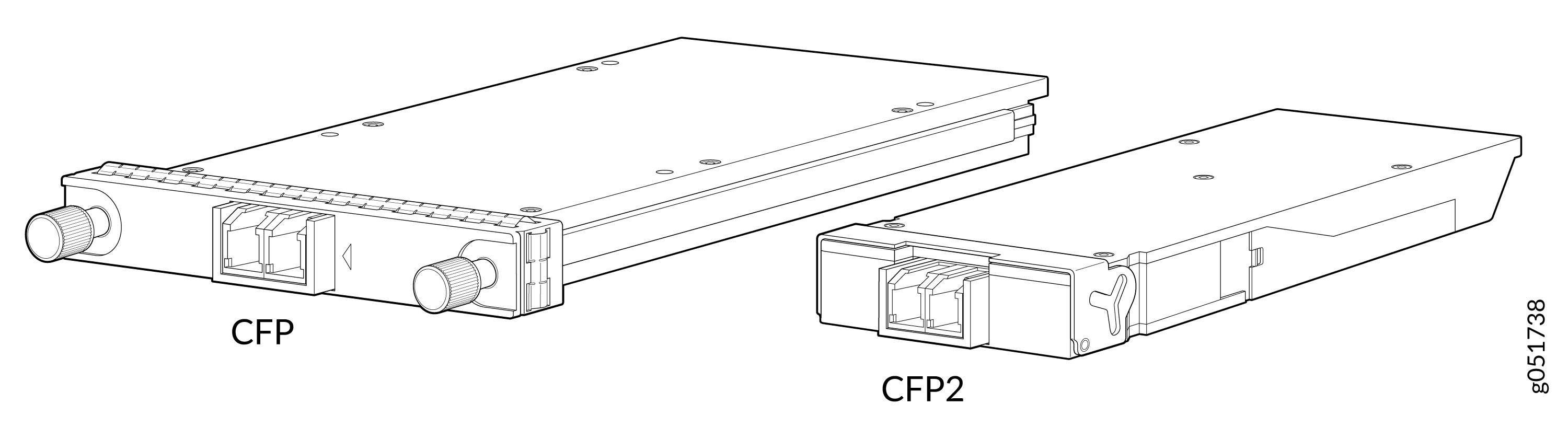
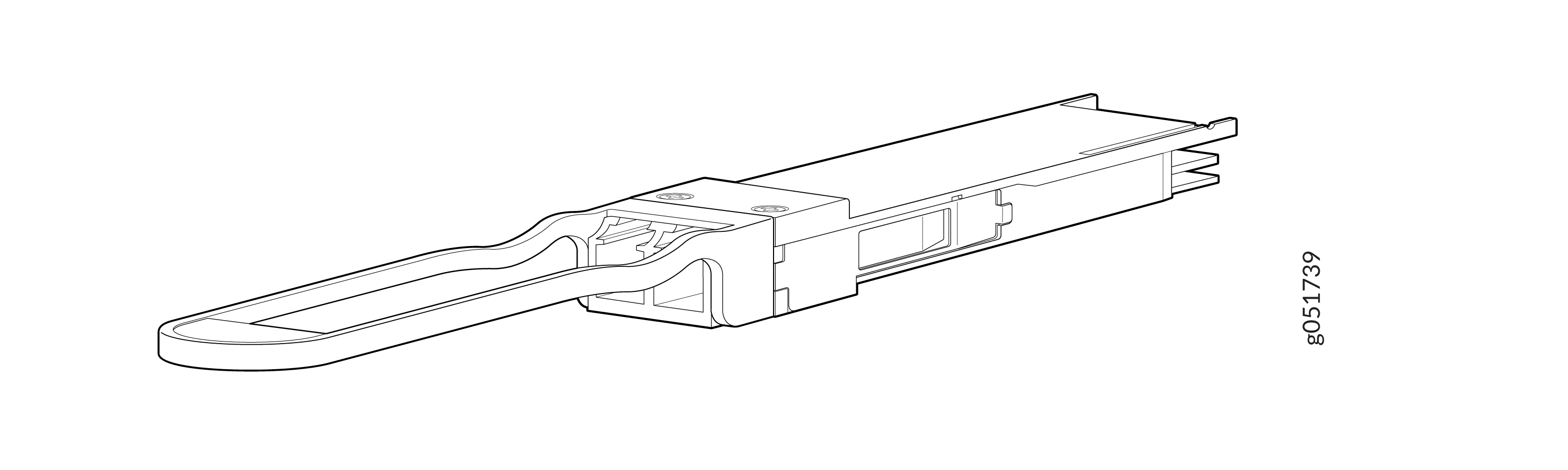
The CFP, CFP2, SFP56-DD, SFP-DD, SFP112, and QSFP-28 form factors are defined by the standards CFP MSA, CFP2 MSA, SFF-8402 (SFP56-DD MSA), SFF-8402 (SFP-DD MSA), SFP112 MSA, and SFF-8665 respectively.
CFP, CFP2, SFP56-DD, SFP112, SFP-DD, and QSFP-28 are all physically distinct form-factors:
-
CFP represents the first generation of 100G optics. CFP has the largest physical dimension.
-
CFP2 offers a balanced approach with reduced size.
-
SFP56-DD provides a compact, single-port solution with two electrical lanes operating at 56 Gbps each (2x50G PAM4).
-
SFP-DD provides a compact, single-port solution with two electrical lanes operating at 50 Gbps each (2x50G PAM4). SFP-DD is backward compatible with SFP28, SFP+, and SFP modules.
-
SFP112 provides compact, single-port solution with a single electrical lane operating at 112 Gbps (1x100G PAM4).
Note: Support for SFP112 optical transceivers will be available soon from Juniper Networks. -
QSFP-28 provides a compact, four-port, breakout-capable solution with optimal power efficiency.
Each form factor utilizes different electrical interfaces and signal processing approaches to achieve 100 Gbps total bandwidth:
-
CFP and CFP2 use a 10x10G or 4x25G electrical interface to achieve a total bandwidth of 100 Gbps.
-
SFP56-DD uses a 2x56G (~2x50G) electrical interface to achieve a total bandwidth of 100 Gbps.
-
SFP-DD uses a 2x50G electrical interface to achieve a total bandwidth of 100 Gbps.
-
SFP112 (when available) uses a 1x112G (~1x100G) electrical interface to achieve a total bandwidth of 100 Gbps.
-
QSFP-28 uses a 4x25G electrical interface to achieve a total bandwidth of 100 Gbps.
Here are some major differences between the 100G form factors:
| Feature | CFP | CFP2 | QSFP-28 | SFP56-DD | SFP-DD | SFP112 | Notes |
|---|---|---|---|---|---|---|---|
| Physical Dimensions | 82 mm × 13.6 mm × 144.8 mm | 41.5 mm × 12.4 mm × 107.5 mm | 18.35 mm × 8.5 mm × 89.4 mm | 13.5 mm × 8.5 mm × 56.6 mm | 13.5 mm × 8.5 mm × 56.6 mm | 13.5 mm × 8.5 mm × 56.6 mm | |
| Relative Size | Large | Medium | Small | Very Small | Very Small | Very Small | |
| Power Consumption |
Gray Optics: < 24 W Coherent (tunable DWDM): up to 32 W |
Gray Optics: < 12 W Coherent (tunable DWDM): up to 24 W |
Gray Optics: typically < 3.5 W Coherent (tunable DWDM): up to 6.5 W |
Gray Optics: typically < 2.5 W |
Gray Optics: typically < 2.5 W Coherent (tunable DWDM): up to 6.5 W |
Gray Optics: typically < 2 W |
|
| Signal Processing | Integrated, within package | Relies on host card | Relies on host card | Relies on host card | Relies on host card | Relies on host card | |
| Electrical Interface | 10x10G or 4x25G | 4x25G | 4x25G | 2x56G (2x50G PAM4) | 2x50G | 1x112G (1x100G PAM4) | SFP112 uses single-lane architecture for lowest complexity |
| Connector Configuration | High-density connector with comprehensive pin configuration | Compact connector optimized for 4x25G | High-density connector with 38 pins | High-density connector with 38 pins | High-density connector with 38 pins | High-density connector with 38 pins | |
| Heat Sink Requirements | Large heat sink for substantial cooling | Optimized heat sink for medium power consumption | Minimal heat sink due to low power consumption | Minimal heat sink due to very low power consumption | Minimal heat sink due to very low power consumption | Minimal heat sink due to lowest power consumption | Heat sink design is evaluated based on system configuration |
| Thermal Requirements |
Operating: 0°C to 70°C Storage: -40°C to 85°C |
Operating: 0°C to 70°C Storage: -40°C to 85°C |
Operating: 0°C to 70°C Industrial: -40°C to 85°C |
Operating: 0°C to 70°C Industrial: -40°C to 85°C |
Operating: 0°C to 70°C Industrial: -40°C to 85°C |
Operating: 0°C to 70°C Industrial: -40°C to 85°C |
|
| Backward Compatibility | Not compatible with smaller form factors | Not backward compatible with CFP | Compatible with QSFP+ (40G) in some configurations | Limited | Compatible with SFP28, SFP+, and SFP modules | Expected compatibility with SFP-DD and SFP28 (when available) | SFP-DD offers excellent backward compatibility with other SFP transceivers |
| Port Density | Low | Medium | High | High | High | High | Critical consideration for data center deployments |
| Breakout Capability | Yes (10×10G or 4×25G) | Yes (4×25G) | Yes (4×25G or 2×50G) | Yes (4×25G or 2×50G) | No (single 100G port only) | No (single 100G port only) | SFP-DD operates as single port, QSFP28 and CFP modules support breakout |