
ジュニパー Mist NAC アーキテクチャ
ビデオを見て、ジュニパー Mist Access Assurance の背後にあるアーキテクチャについて理解しましょう。マイクロサービスの詳細と、そのマイクロサービスの詳細をご覧ください。ジュニパーMistがマイクロサービスを活用して高可用性と拡張性を提供する方法をご覧ください。
ジュニパーのMist Access Assuranceは、マイクロサービスアーキテクチャを活用しています。このアーキテクチャは、稼働時間、冗長性、自動拡張を優先し、有線、無線、広域ネットワーク全体で最適化されたネットワーク接続を可能にします。
Mist Access Assuranceアーキテクチャについては、次のビデオをご覧ください。
Architecture. So what we've done is actually we've separated the Authentication Service from the Mist cloud that you all know. We now have authentication service as its own separate cloud, actually spread out around the globe in different pods or points of presence, so we'll talk about that a little bit later on.
But what we have here is an authentication service cloud that has its own set of microservices, where each and every feature, each and every component has its own pool of microservices, whether it's responsible for enforcing policies, for actually doing the user device authentication, keeping state of sessions, keeping the databases of all the endpoints, records, or having identity providers' connectors or cloud connectors back to the Mist cloud.
All the authentication requests, if they're coming from the Mist managed infrastructure, whether it's a Mist AP or a Juniper EX switch, they're automatically wrapped into a secure TLS-encrypted RadSec tunnel going to back to our authentication service.
And from there, once the authentication has happened, the Mist authentication service will would have connections to third-party identity sources like an Okta or Azure ID or Ping Identity. Or it could be an MDM provider, such as Microsoft Intune or Jamf, just to get more context, more visibility in terms of who is trying to connect and what type of device we're dealing with.
And what the Mist authentication service cloud will do is it will actually do all the heavy lifting, all the authentication. But it will send all the visibility metadata, all the session information, all the events, all the statistics back to the Mist cloud. So this is how you get all the visibility, all the end-to-end connection experience in one place, and you can manage everything from there.
In addition to that, when we're dealing with third-party network infrastructure-- say you have a Cisco wired switch. You have an Aruba controller or a third-party vendor AP or a switch. The way we would integrate there is we would leverage our Mist Edge application platform that would function as the authentication proxy component.
What you could do is you could take your third-party infrastructure point, point it via RADIUS to Mist Edge. And from there, Mist Edge will convert it automatically to secure RadSec and then perform the authentication. This way, if you look at this architecture, we're really bringing the microservices architecture down to the authentication service.
All of that gives you the performance that is generally associated with microservices clouds. It also gives you the capability of getting feature updates on a biweekly basis and security patches as and when they're needed, without any downtime to your network or to the functionality that this brings.
ジュニパー Mist Access Assuranceは、Google Workspace、Microsoft Entra ID、Okta Identityなどの外部ディレクトリサービスや、JamfやMicrosoft Intuneなどのモバイルデバイス管理(MDM)プロバイダを組み込むことで、認証サービスを強化します。この統合により、ユーザーとデバイスを正確に識別できるようになり、検証済みの信頼できるIDのみにネットワークアクセスを許可することでセキュリティ対策が強化されます。
図1 は、Mist Access Assuranceネットワークアクセス制御(NAC)のフレームワークを示しています。
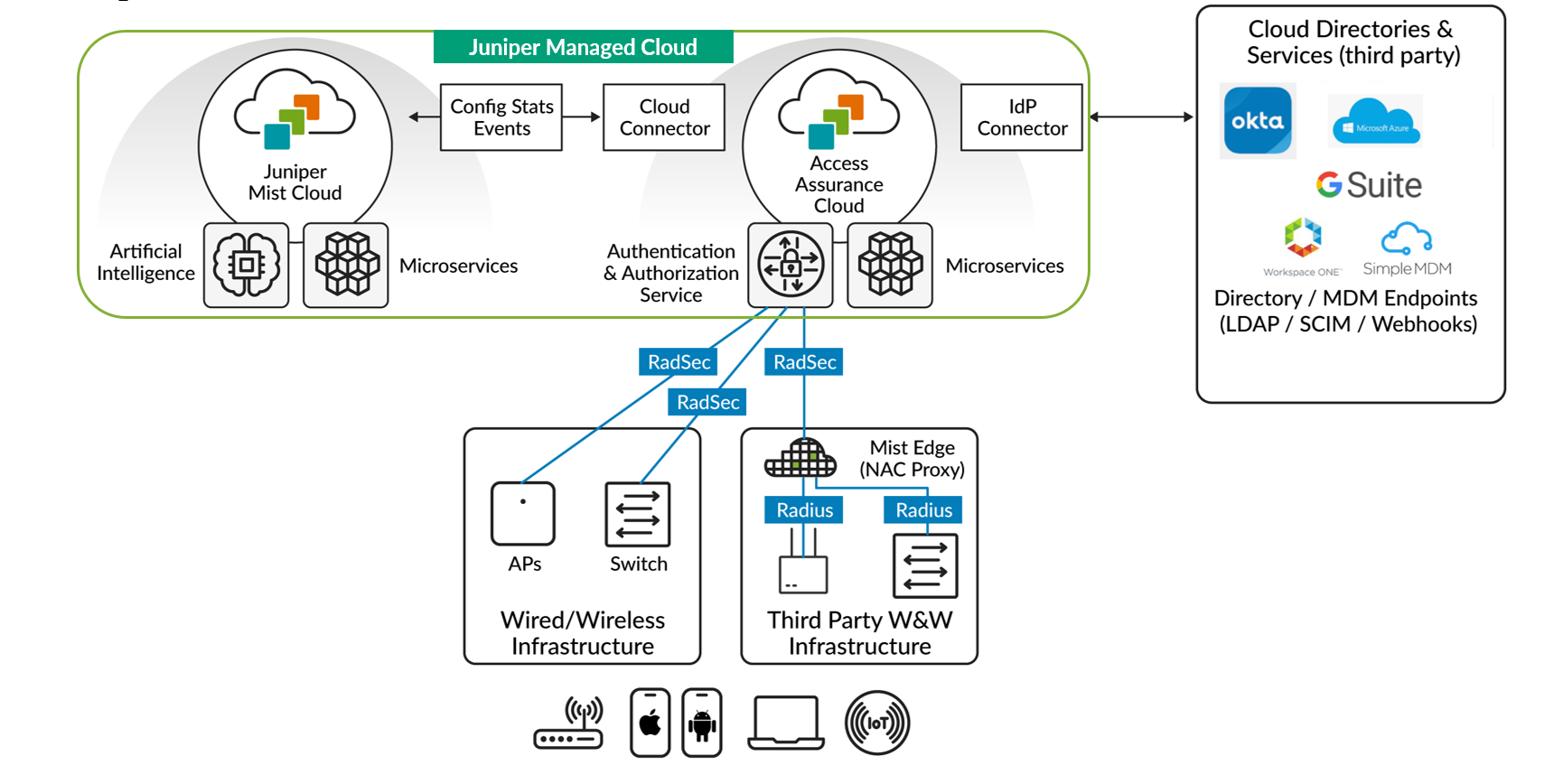
ジュニパー Mist 認証サービスは、ジュニパー Mistクラウドから切り離され、スタンドアロンのクラウドサービスとして機能します。この認証および認可サービスは、パフォーマンスと信頼性を強化するために、グローバルなさまざまなポイントオブプレゼンスに分散されます。
このジュニパーMist認証サービスは、マイクロサービスアプローチを採用しています。つまり、マイクロサービスの専用グループまたはプールが、ポリシーの適用やユーザーデバイス認証などの各サービスコンポーネントの機能を管理します。同様に、個々のマイクロサービスが、セッション管理、エンドポイントデータベースのメンテナンス、ジュニパー Mistクラウドへの接続などの追加タスクをそれぞれ管理します。
ジュニパー®シリーズのハイパフォーマンスアクセスポイントやジュニパーネットワークス®EXシリーズスイッチなど、ジュニパー Mistクラウドによって管理されるデバイスは、ジュニパー Mist認証サービスに認証リクエストを送信します。これらのリクエストは、RADIUS over TLS(RadSec)を使用して自動的に暗号化され、セキュアなトランスポート層セキュリティ(TLS)トンネルを介して認証サービスに送信されます。
Mist認証サービスはこれらのリクエストを処理し、外部のディレクトリサービス(Google Workspace、Microsoft Azure AD、Okta Identityなど)およびPKIおよびMDMプロバイダ(Jamf、Microsoft Intuneなど)に接続します。この接続の目的は、ネットワークに接続しようとしているデバイスやユーザーをさらに認証し、コンテキストを提供することです。
認証タスクに加えて、ジュニパー Mist 認証サービスは、主要なメタデータ、セッション情報、分析をジュニパー Mist クラウドに中継します。このデータ共有により、エンドツーエンドの可視化と一元管理がユーザーに提供されます。
当社は、ジュニパーのMist Edgeプラットフォームを認証プロキシとして使用し、サードパーティのネットワークインフラストラクチャをジュニパー Mist Access Assuranceと統合します。サードパーティインフラストラクチャは、RADIUSを介してジュニパーのMist Edgeプラットフォームと対話します。一方、ジュニパーのMist Edgeプラットフォームは、RadSecを使用して通信を保護し、認証を続行します。
このクラウドネイティブのマイクロサービスアーキテクチャは、認証と承認サービスを強化し、ネットワークのダウンタイムを最小限に抑えながら、定期的な機能アップデートと必要なセキュリティパッチをサポートします。
Mist Access Assuranceの高可用性アーキテクチャについては、次のビデオをご覧ください。
Design of the Mist Access Assurance service. What we've done is we've placed various access assurance clouds that will do the authentication in various regions around the globe, such that you have a POD in the West Coast, in the East Coast, in Europe and Asia/Pac, et cetera, et cetera.
The way that high availability works, which is actually a very nice and tidy way of doing things, it's looking at the physical location of the site where you have you Mist APs or Juniper switches. Based on the geo-affinity, based on the geo AP of that site, the authentication traffic, the RadSec channels that these are forming, it will automatically be redirected to the nearest access assurance cloud available around the globe.
So if you have a site, as you can see in this example, on the West Coast in the United States, it will automatically be redirected to the Mist Access Assurance cloud on the West Coast as well. Similarly, if you have a site on the East Coast, that authentication traffic will be redirected to the East Coast POD as well.
This will provide with the optimal latency, no matter where your physical sites are, while they're still managed by the same Mist dashboard of your choice.
In addition to that, that also serves as the redundancy mechanism as well. So should anything happen to one of the access assurance clouds or one of the components of the access assurance cloud which would result in a service disruption, all the authentication traffic will be automatically redirected to the next nearest access assurance cloud available in the globe.
Mist Access Assuranceのワークフローについては、次のビデオをご覧ください。
Mist Assurance authentication service.
So what does it do?
First of all, it's there to do the identification, what or who is trying to connect to our network. Whether it's a wired or wireless device, we want to understand the identity of that user or that device, whether it's using secure authentication, it's using certificate to identify itself, or it's using credentials to authenticate, or it's just a headless IoT device that just has a MAC address that we can look at.
We want to understand the security posture of the device. We want to understand where it belongs to in a customer organization, or where it's located physically, which site it belongs to.
Once we have the user fingerprint, once we understand what type of user or device is trying to connect, we want to assign a policy. We want to say, OK, if it's an employee, a device that's managed by IT that's using a certificate to identify itself, it's a fairly secure device.
We want to assign a VLAN that has less restrictions that provides full access to the network resources. We can optionally assign a group-based policy tag, or we can assign a role to apply a network policy for that given user.
Lastly, but most important, we want to validate that end-to-end connectivity experience across the full stack. We don't care just about the authentication authorization process. We want to combine that whole connection stage end to end.
So we want to answer the question if the user or a device is able to authenticate, and if not, why not exactly? Is it expired certificate? Is it the account that's been disabled?
Is it the policy that's explicitly denying the specific device to connect? We want to answer the question, which policy is assigned to the user?
And after that authentication we want to confirm and validate that the user's getting a good experience so it's able to associate the AP or connect to the right port, get the right VLAN assigned, get the IP address, validate DHCP, resolve ARP and DNS, and finally get access to the network and move packets left and right.
We want to validate that whole path not just some parts of it. And this is where MARVIS anomaly detection, this is where MARVIS conversational interface would help us with troubleshooting.
Mist Access Assuranceアーキテクチャの拡張については、次のビデオをご覧ください。
And now let's take a look a little bit, and let's add scale into perspective. Let's take a look at a typical NAC deployment in a production environment.
When you're looking at any type of scale, obviously one box will not be enough just from a redundancy perspective. But more so from a scaling perspective because you'll need to distribute the load, you'll need to load balance your authentications, your endpoint databases, and things like that.
So you're typically looking at deploying a clustered solution, where you would have your policy or authentication nodes, or your brains of the solution, somewhere closer to your NAS devices, your APs and switches, so that they will authenticate clients, they will do the heavy lifting. And at the top, you would have a pair of management nodes. This is where you would configure your NAC policy. This is where you have the visibility logs and things like that.
So that's the cluster deployment you're going to look at. And obviously, in front of that, you'll need to put a load balancer to actually load balance the authentication requests, the RADIUS requests that are come in coming in from various devices, so they would hit all these policy nodes respectively.
And today, this whole deployment is customer managed. It's a customer problem to solve. You need to design for it. You need to scale for it. You need to make sure that you can change that when you need to add scale. You need to make sure that you will maintain this during software upgrades, maintenance windows, and things of that nature.
So that becomes a main challenge. These solutions are becoming complex very, very quickly.
And with those solutions, they're still lacking insights and end-to-end visibility. Because we're still looking at a standalone NAC deployment, which is an overlay to your current network infrastructure.
So even vendors who have infrastructure and NAC from the same vendor, they will not give you end-to-end user connectivity experience visibility in one place. You'll troubleshoot your NAC in one place. You'll troubleshoot your network, your controller switch, your AP or whatever, in a totally different place.
And obviously, think of what will happen if you need to do maintenance, where you'll just want to get a new feature. How would you upgrade this kind of deployment? That requires a lot of investment from the customer side.
Now, just as an example, I'll put the reference here.
We'll take Clearpass as an example, but it's the same for other vendors.
Clearpass has a clustering tech note which is 50 pages long just on how to set up a cluster.
Nothing else, not about the scaling-- nothing else-- it's just about clustering. Think about the complexity here.
マイクロサービスベースのアーキテクチャの概要については、次のビデオをご覧ください。
What do we want from a NAC solution today, if we would do it from a clean sheet of paper?
First of all, the architecture has to be microservices based. Ideally, it should be a cloud NAC offering.
It should be managed by the vendor. It should be highly available. Feature upgrades should just come periodically automatically, without requiring any downtime whatsoever. Most importantly, the architecture should be API-based and should allow for cross-platform integration.
Secondly, it has to be IT-friendly. We know that existing solutions, they have been so complex that you needed to have an expert on an IT team dedicated just for NAC.
We want that new NAC product to be tightly integrated into the network management and operations. So you want that single pane of glass that manages your whole full stack network, as well as all of your network access control rules and provide end-to-end visibility.
Lastly, with AI being there to help us solve network-specific problems, we want to extend that and make sure that we can capture that end-to-end user connectivity experience and answer questions. Will this affect my end user network experience?
Is it the client configuration problem? Is it the network that is to blame, or network service that is to blame? Is it my NAC policy that is causing users to have a bad experience and have connectivity issues throughout the day?